Photo via The Guardian

Trump’s ‘biggest miscalculation’? How one adviser steered the great AI freakout

Read the original at The Guardian ↗
Cite

Kerr, D. (2026, September 20). Trump’s ‘biggest miscalculation’? How one adviser steered the great AI freakout. The Guardian. https://www.theguardian.com/us-news/2026/sep/20/david-sacks-trump-ai-czar

Dated when The Aporia collected the article, usually within hours of publication. Check the original for its exact date and byline.

The Guardian · collected 2026-09-20 · by Dara Kerr

Quick Summary

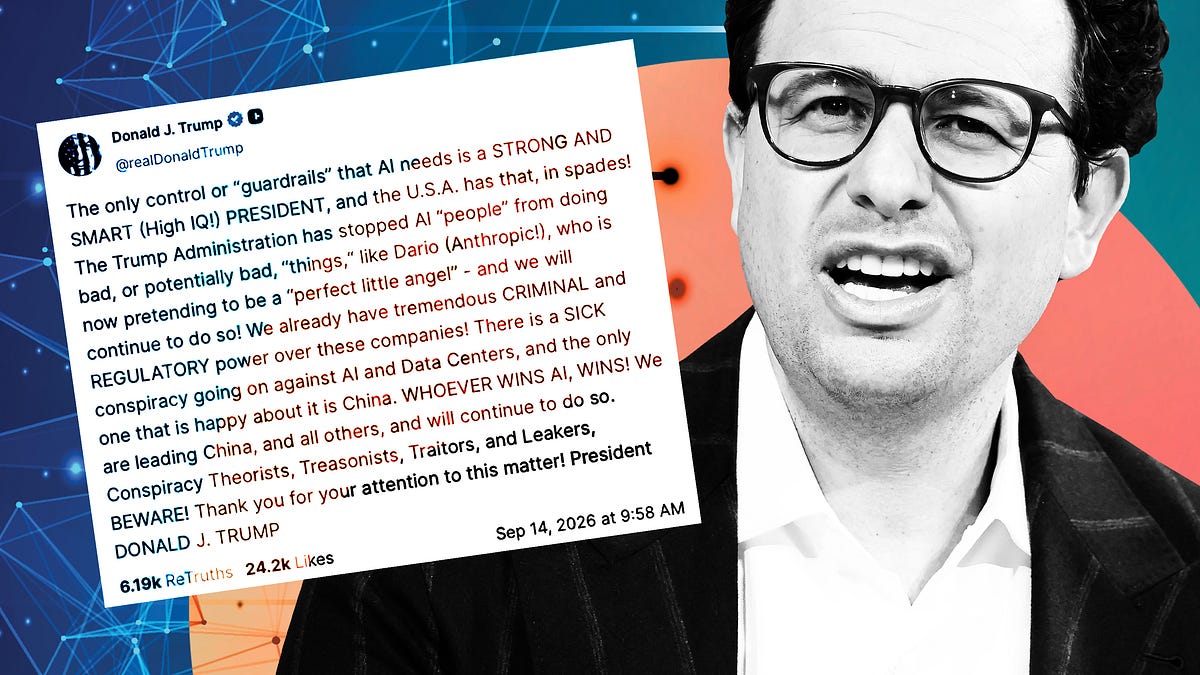
David Sacks, a prominent venture capitalist and former adviser to President Donald Trump on artificial intelligence (AI) and cryptocurrency, has been influential in shaping Trump's stance against strict AI regulations. Sacks views stringent oversight as harmful to America’s competitive edge in AI development. This perspective contrasts with the growing consensus among lawmakers and leading technologists advocating for regulation and third-party evaluations of AI models. Recently, Trump signed an executive order aimed at countering state laws that limit AI use, further aligning with Sacks's advice against heavy regulation.
Written by AI on 2026-09-20, from this article's own text only (the story summary below draws on all the coverage).

AI analysis

Story summary

In late 2023, Donald Trump emerged as one of the few prominent figures opposing calls for strict regulation of artificial intelligence (AI) in the US. Despite bipartisan concerns about the dangers posed by AI, Trump labeled these worries a “hoax” and a “scam,” asserting that current government powers are sufficient to manage AI companies effectively. This position aligns closely with his former adviser David Sacks, a billionaire venture capitalist often referred to as Trump’s "AI whisperer," who has been influential in advising against stringent regulations on AI. Sacks, a member of the PayPal Mafia and an advocate for minimal regulation, argues that strict rules could hinder the US's global leadership in AI innovation. His influence has led to executive orders and other measures aimed at reducing regulatory burdens on AI companies, despite warnings from industry leaders about potential risks associated with unregulated AI technology.

Written for “AI Policy Debate” on 2026-11-02, grounded in this article and the 0 other(s) covering the same event.

Story

📰 AI Policy Debate
Politics · 1 article(s) covering the same event.

Compared with similar articles

This article reads leans right and hedges 13% of its claims. Each row says how that neighbour differs.
The Bulwark
⚖️ Leans strongly left further left than this Hedges 7 of 69 claims
“The articles discuss different aspects of the AI regulation issue without describing the same specific incident.”
Fox News
⚖️ Leans strongly right further right than this Hedges 5 of 53 claims Outlet record 69/100
“The articles discuss different aspects related to artificial intelligence and regulation, but do not describe the same specific incident or occurrence.”
New York Post
⚖️ Leans right Hedges 3 of 35 claims Outlet record 66/100
“The articles discuss different perspectives on artificial intelligence regulation but do not describe the same specific incident or occurrence.”
The Guardian
Hedges 6 of 50 claims Outlet record 66/100
“The articles discuss different aspects of Trump's stance on AI regulation and his support for the industry, rather than reporting on a single incident or occurrence.”
Euronews
⚖️ Leans left further left than this Hedges 2 of 22 claims Outlet record 60/100
“The articles discuss different aspects and times related to AI regulation but do not describe the same specific incident.”
The Dispatch
⚖️ Leans right Hedges 5 of 113 claims Outlet record 61/100
“The articles describe different aspects of President Trump's stance on AI regulation and his broader political messaging, not a single specific incident.”
New York Post
Hedges 0 of 11 claims Outlet record 66/100
“While both articles discuss Trump's stance on AI, they describe different aspects and contexts — one focuses on the announcement of 'AI Force' and his comments about it being a hoax, while the other discusses broader political reactions and an adviser's role in shaping opinions.”
Daily Mail
⚖️ Leans right Hedges 5 of 26 claims Outlet record 69/100
“The articles discuss different perspectives on artificial intelligence regulation but do not describe the same specific incident or occurrence.”
BBC News
Hedges 0 of 7 claims Outlet record 68/100
“While both articles discuss Trump's stance on artificial intelligence regulation, they describe different occurrences: one focuses on an adviser's critique of Trump's views and another reports on a speech where Trump rebrands AI as 'super intelligence'.”
CBS News
Hedges 1 of 3 claims Outlet record 66/100
“The articles discuss different aspects of the White House's stance on AI regulation, but do not describe the same specific incident or occurrence.”
How this article was measured signals, leaning charts, publisher record, byline, topics and claims

Signals How these are calculated →

Claims extracted
70
sentences that state something as happening or true
Uncertain
13%
9 of 70 hedged ("reportedly", "may", "according to")
Leaning
Leans right
of the writing, not the subject · beta estimate
Publisher signals
66/100
The Guardian's corrections and hedging, across everything collected from it. Not a measure of accuracy.
Outlets on this story
1
Politics
Same framing elsewhere
1
articles that frame the event the way this one does
Analyzed 2026-09-20 · how these are computed

How this is being covered How these are calculated →

Article leaning vs. publisher reliability
Source leaning vs. consistency

Publisher

The Guardian · 1929 article(s) · 6 correction(s) detected
Running correction rate · 6 correction(s)

Who wrote this

Dara Kerr
9 article(s) here · 1 carrying a prediction
🔮 When the bill goes into effect in January, that could mean more than 3.4m Californians will lose their coverage, including millions of children.
🔮 But they didn’t glean further information after the company announced there would be no questions on the matter.
🔮 “The samples will be analyzed to determine if the coyote that was taken is the offending animal.
🔮 Rucci denies the project will have such effects.
🔮 Lyft’s success would not be possible without the drivers Lyft sought to unfairly short-change.”
🔮 Sacks, who believes regulation will erase the US lead in the global AI race, is seen as Trump’s AI whisperer – the adviser with the greatest influence in the White House on the topic.
🔮 Trump signed an executive order in March that would create a nationwide list of verified eligible voters, compelling the US Postal Service (USPS) to work with states to establish lists of mail-in voters before elections.
🔮 When asked how he would describe the conflict, if not a war, the president called it “small potatoes”.
🔮 She could see many neighbors’ mailboxes also outlasted the flames.
Also by Dara Kerr
Nothing else under this byline is closely related to this article, so these are simply their most recent.
All 9 articles by Dara Kerr →

Topics

Covid Republican Russiagate Texas the White House

Subjects

Sacks PERSON · 11× Trump PERSON · 8× David Sacks PERSON · 2× the White House ORG · 2× Donald Trump PERSON · 1× Geoffrey Hinton PERSON · 1× Republican NORP · 1× Steve Bannon PERSON · 1× Ted Cruz PERSON · 1× Texas GPE · 1×

Narrative

By the late 90s and early 2000s, Sacks, Thiel, Musk and others worked together at PayPal, becoming members of what’s now known as the PayPal Mafia – an elite group of influential and wealthy tech investors and founders.
framing: assertive · carried by 1 article(s) · first seen 2026-09-20
🔮 Sacks, who believes regulation will erase the US lead in the global AI race, is seen as Trump’s AI whisperer – the adviser with the greatest influence in the White House on the topic.

Claims (70 extracted, 9 hedged)

As lawmakers from both sides of the aisle in the US have joined together calling for the regulation of powerful artificial intelligence models, one of the few vocal naysayers has been Donald Trump. asserted
one → join → naysayers
He’s called the perceived dangers of the technology a “hoax” and a “scam”, arguing that the government already has “tremendous CRIMINAL and REGULATORY power over these companies”. asserted
government → call → companies
It’s a starkly different stance from those of his former adviser Steve Bannon, the Republican Texas senator Ted Cruz and even the heads of the world’s leading AI companies. asserted
It → ’ → companies
But it’s directly in line with the opinion of David Sacks – a prominent billionaire venture capitalist and Trump’s onetime AI and crypto czar, who has pushed back publicly and forcefully against recent claims of an impending AI apocalypse. uncertain
who → ’ → apocalypse
Sacks, who believes regulation will erase the US lead in the global AI race, is seen as Trump’s AI whisperer – the adviser with the greatest influence in the White House on the topic. asserted
regulation → believe → topic
Time and again, he’s counseled the president to give a soft touch to AI regulation, helping push executive orders and other measures aimed at loosening restrictions on the technology. asserted
he → counsel → technology
He also maintains direct financial stakes in multiple AI companies. asserted
He → maintain → companies
On Friday, more than 100 AI researchers, professors and technologists signed a public letter urging third-party evaluations of AI models and outlining how that should be done. asserted
that → sign → models
The signatories included some of the most notable experts in the field, such as Geoffrey Hinton, the “godfather of AI”, and Stuart Russell, a renowned AI computer scientist. asserted
signatories → include → AI
Sacks, in characteristic form, dismissed the letter on social media, calling third-party evaluations “pseudoscience” and “censorship and control”. asserted
Sacks → dismiss → evaluations
“The last time we had media-generated panics like this (with Russiagate and Covid), social media companies created ‘trust & safety’ teams to censor conservative and dissident voices,” Sacks wrote. asserted
Sacks → have → voices
“These groups haven’t earned our trust, and their agenda is not our safety.” asserted
agenda → earn → trust
Derailing AI safety efforts Last December, Trump signed an executive order to halt state laws that limited AI. asserted
that → derail → AI
It was one of the first of several actions by the president that put his alignment with Sacks on full display. asserted
that → put → display
The proclamation assigned a federal taskforce to have the “sole responsibility” of challenging states that attempt to pass laws restricting the technology. asserted
that → assign → technology
The order spelled out an influential role for Sacks to direct the taskforce’s litigation against states. asserted
Sacks → spell → states
Then, just four months later, in March, the White House unveiled an AI policy for Congress that encouraged lawmakers to pre-empt state rules. asserted
that → unveil → rules
Again, Sacks was seen as working behind the scenes to make this happen. asserted
this → see → scenes
This pattern has continued throughout the year. asserted
pattern → continue → year
In July, Trump and Sacks hosted a fanfare-filled AI summit in Washington. asserted
Trump → host → Washington
And just this week, Trump called Nvidia’s CEO, Jensen Huang, to discuss AI regulation. asserted
Trump → call → regulation
In a live demonstration of Sacks’ proximity to the most powerful people in the US, the call came in while Sacks was interviewing Huang at an event on stage. asserted
Sacks → come → stage
Next week, Trump is hosting China’s leader, Xi Jinping, at the White House and is expected to invite several AI CEOs to be present. asserted
Trump → host → CEOs
Sacks is also slated to be one of the guests in attendance, according to NBC News. uncertain
Sacks → slat → News
Isabel Sunderland, the policy lead for technology reform at the non-profit Issue One, said that Sacks’ relationship with the president shows what happens when money can buy a direct line to power. asserted
money → say → power
“David Sacks advising President Trump on AI shows exactly how our political system serves the wealthy and well-connected instead of everyday Americans,” Sunderland said. asserted
Sunderland → advise → wealthy
“This is about more than just AI regulation – it’s about who’s allowed to write the rules.” asserted
who → ’ → rules
Trump’s most recent full-throated opposition to AI regulation comes after an Anthropic employee, Jacob Coxon, announced on social media last week that he was resigning from the company, saying AI would soon become “superhuman systems” that could cause human extinction by 2030. uncertain
that → come → 2030
After Coxon’s post, other Anthropic employees backed these predictions, with one saying: “We really do earnestly believe AI could kill all humans!” uncertain
AI → back → humans
The end-of-the-world prognostications whipped up a frenzy of media and lawmakers’ attention over the past two weeks, with US politicians, heads of state and international bodies calling for the tech to be reined in. asserted
tech → whip → state
Dario Amodei, the CEO of Anthropic, issued a proposal to slow down the technology’s advancement and ensure public safety by regulating the industry. asserted
Amodei → issue → industry
In a rare public display of unity, OpenAI CEO Sam Altman, Google DeepMind chief Demis Hassabis and xAI owner Elon Musk agreed. asserted
Altman → agree → unity
Sacks, however, pushed back on any regulatory action, instead indicating the proposal was an “election-season psyop” and a bid for “regulatory capture”. asserted
proposal → push → capture
In a lengthy social media post responding to Amodei’s proposal, Sacks said: “If the unreleased models are scary enough that you think you should slow down, I support your decision to be responsible. asserted
I → respond → decision
But stop pretending you need anyone else’s permission. asserted
you → pretend → permission
Sacks, like his tech contemporaries Elon Musk and Peter Thiel, hails from South Africa. asserted
Sacks → hail → Africa
He was born in Cape Town in 1972 and then emigrated with his family to the US in the late 1970s. asserted
He → bear → 1970s
Sacks spent his college career majoring in economics at Stanford, where he met Thiel and worked with him at the conservative student-run newspaper the Stanford Review. asserted
he → spend → newspaper
The two men also collaborated after graduating, co-authoring in 1995 the book The Diversity Myth: Multiculturalism and the Politics of Intolerance at Stanford, an early glimpse into Sacks’ political ideology. asserted
men → collaborate → ideology
The book rails against “multiculturalism”, “diversity” and the “politically correct” decline of higher education. asserted
book → rail → education
…and 30 more, not listed.

💬Give feedback
🕘History 🎫Support