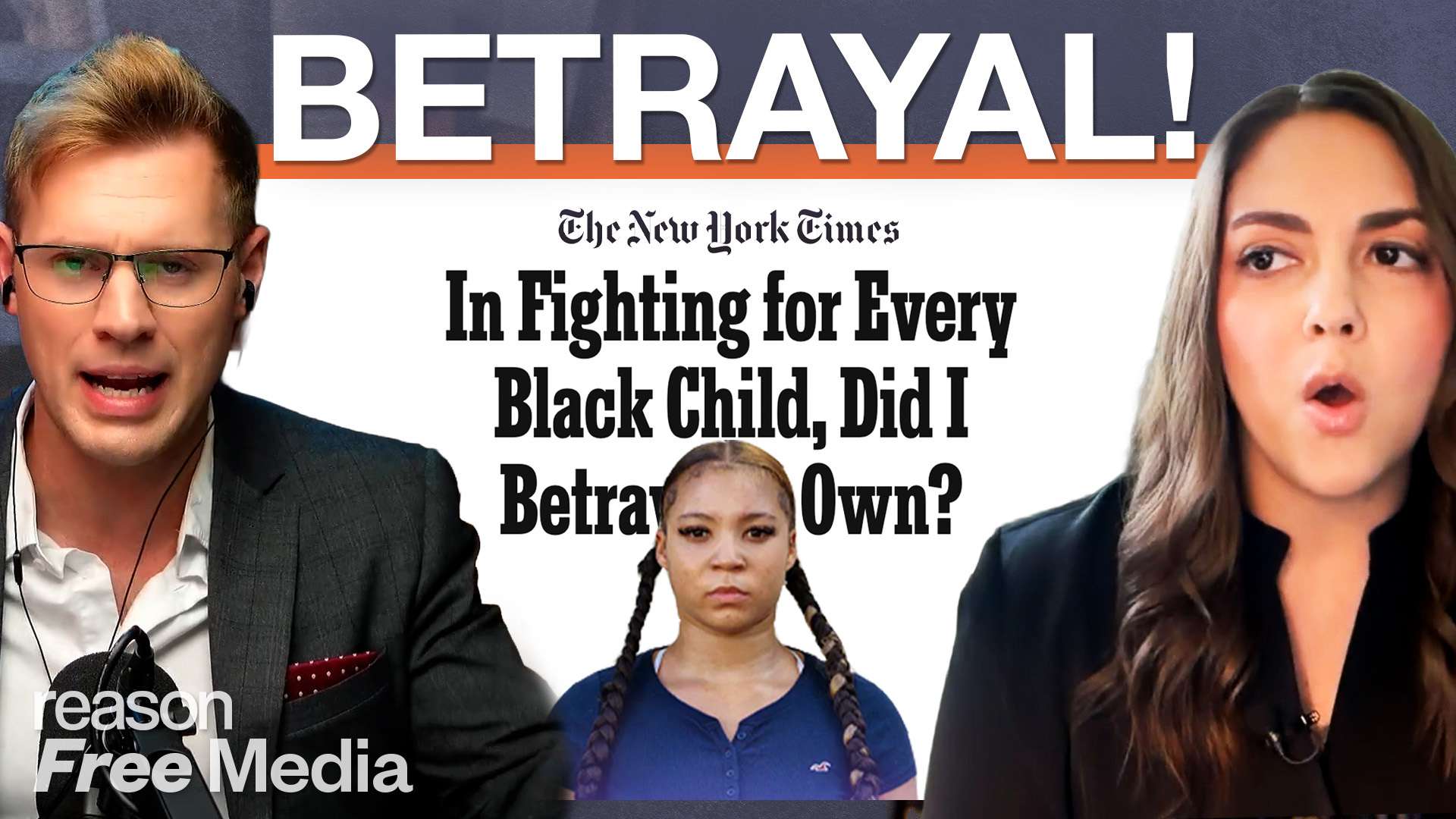
Photo via New York Post

Woke NYT, 1619 Project writer deliberately sent daughter to troubled schools as a ‘sacrifice’ — and it backfired spectacularly

Read the original at New York Post ↗
Cite

Oliveira, A. (2026, September 20). Woke NYT, 1619 Project writer deliberately sent daughter to troubled schools as a ‘sacrifice’ — and it backfired spectacularly. New York Post. https://nypost.com/2026/09/20/us-news/nyt-writer-nikole-hannah-jones-sent-daughter-to-troubled-schools-as-a-sacrifice-and-it-backfired/

Dated when The Aporia collected the article, usually within hours of publication. Check the original for its exact date and byline.

New York Post · collected 2026-09-20 · by Alex Oliveira

Quick Summary

Nikole Hannah-Jones, writer of the New York Times’ 1619 Project, sent her daughter to struggling public schools in Brooklyn from 2015 as an act of social activism. Despite having the means to send her child to better schools, Hannah-Jones aimed to improve conditions for black students by enrolling her daughter in PS 307 and Urban Assembly Unison, a decision that backfired when her daughter struggled academically and felt let down by her parents’ choices.
Written by AI on 2026-09-21, from this article's own text only (the story summary below draws on all the coverage).

AI analysis

Story summary

Nikole Hannah-Jones, creator of the New York Times' 1619 Project, recently admitted regret over sending her daughter to underperforming public schools in Brooklyn instead of better-performing ones. In a piece for The New York Times Magazine, she explained that a decade ago she believed sending her daughter Najya to these schools would improve conditions there using her resources and influence. However, the quality of education failed to meet expectations, leading Hannah-Jones to eventually acknowledge error after Najya confronted her about the poor educational environment. Critics argue this decision prioritized ideological goals over her child's academic needs, while supporters see it as an attempt to address systemic inequalities in education through personal sacrifice. Despite the admitted failure, some suggest expanding school choice options could better help disadvantaged students. Hannah-Jones' story highlights ongoing debates around educational equity and parental responsibility.

Written for “Nikole Hannah-Jones School Choice Con…” on 2026-10-31, grounded in this article and the 10 other(s) covering the same event.

Story

📰 Nikole Hannah-Jones School Choice Con…
Education · 11 article(s) covering the same event. Compare every outlet's account →

Compared with similar articles

This article reads unscored and hedges 9% of its claims. Each row says how that neighbour differs.
New York Post
⚖️ Leans strongly right Hedges 3 of 15 claims Outlet record 66/100
New York Post
Hedges 5 of 45 claims Outlet record 66/100
“The articles discuss different aspects of education issues in New York but do not describe the same specific incident.”
New York Post
⚖️ Leans strongly right Hedges 1 of 34 claims Outlet record 66/100
The Free Press
Hedges 1 of 15 claims Outlet record 96/100
“While both articles discuss Nikole Hannah-Jones' decision and its aftermath regarding her daughter's schooling, they describe different points in time and different aspects of the incident.”
New York Post
⚖️ Leans strongly right Hedges 3 of 24 claims Outlet record 66/100
Fox News
Hedges 3 of 48 claims Outlet record 69/100
“The articles discuss Hannah-Jones's decision to send her daughter to struggling schools as a form of activism, but they do not describe the same specific incident or occurrence.”
Washington Examiner
⚖️ Leans strongly right Hedges 4 of 42 claims Outlet record 70/100
“While both articles discuss Nikole Hannah-Jones sending her daughter to underperforming schools, they describe different aspects or reactions to this decision rather than the same single incident.”
Reason
⚖️ Leans right Hedges 10 of 80 claims Outlet record 67/100
“The articles discuss Hannah-Jones' decision to send her daughter to underperforming schools, but they do not describe a single specific incident occurring at a particular time and place. Instead, they cover the broader context and aftermath of this decision, which is related but not the same as the initial event itself.”
Reason
Hedges 0 of 2 claims Outlet record 67/100
“Article A describes the backfiring of Hannah-Jones' decision to send her daughter to troubled schools and her daughter's feelings about it. Article B discusses a broader discussion and analysis around an essay written by Hannah-Jones, likely not the same specific incident.”
How this article was measured signals, leaning charts, publisher record, byline, topics and claims

Signals How these are calculated →

Claims extracted
46
sentences that state something as happening or true
Uncertain
9%
4 of 46 hedged ("reportedly", "may", "according to")
Leaning
withheld
no quote in the article backed the model's score
Publisher signals
66/100
New York Post's corrections and hedging, across everything collected from it. Not a measure of accuracy.
Outlets on this story
11
Education
Same framing elsewhere
1
articles that frame the event the way this one does
Analyzed 2026-09-21 · how these are computed

How this is being covered How these are calculated →

Article leaning vs. publisher reliability
Source leaning vs. consistency

Publisher

New York Post · 15490 article(s) · 35 correction(s) detected
Running correction rate · 35 correction(s)

Who wrote this

Alex Oliveira
54 article(s) here · 1 carrying a prediction
🔮 Bystanders were mercifully able to flag down police and stop trains from barreling into the station until they could free her from the roadbed, but she was severly injured.
🔮 “No rational adult would show up to a job with proximity to kids in a skimpy costume and a reference to a novel about the sexual abuse of a child by a middle-aged man … and then revive the controversy by engaging in lawfare,” she added.
🔮 Mayor Zohran Mamdani should be investigated for using $1.6 million in taxpayer funds to push New Yorkers to back ballot proposals with messaging that plastered his face on buses and kiosks, a city lawmaker said.
🔮 Republican gubernatorial candidate Bruce Blakeman warned New York voters that congestion pricing could come to a “community near you” if Gov. Kathy Hochul wins reelection Blakeman, the Nassau County executive, vowed to kill the program outright if he beats the Democratic incumbent in the Nov. 3 election as he claimed Hochul could have a menu of new taxes she could unleash if she secures another term. “Doesn’t matter whether it’s New York City, Buffalo, Rochester, Syracuse, Albany, Binghamton or any town in between,” Blakeman claimed while speaking on Fifth Avenue in Manhattan Tuesday.
🔮 Mayor Zohran Mamdani stumped with Gov. Kathy Hochul for the first time Friday — hoping to give the moderate Democrat a boost with his lefty base in New York City less than two weeks before Election Day.
🔮 That means about 200 carriage drivers will see their livelihoods – and entire industry – vanish from the city without a trace in less than two years.
🔮 Mayor Zohran Mamdani has signed just one bill into law in 10 months since taking office — leaving critics to wonder if the millennial mayor is more interested in social media stardom than his daily government duties.
🔮 Griffin John was let out of prison early after he was sentenced to 48 months behind bars for the attack on wife Shauntai Nickerson — and he begged a judge to lift a restraining order against him so he could “see his son grow up” in the coastal town of Newport, docs obtained by The Post said.
🔮 “Real Housewives” star Carole Radziwill insisted Monday that she’s a hard-nosed parking enforcer in her SoHo neighborhood — even as she’s racked up thousands of dollars in tickets herself.
🔮 Blakeman, the Nassau County executive, also hammered Hochul for her infamous 2024 claim that “young black kids in the Bronx” don’t know what a computer is — insisting youngsters in the borough “know more about a computer” than the governor will “ever know.”
Also by Alex Oliveira
Nothing else under this byline is closely related to this article, so these are simply their most recent.
All 54 articles by Alex Oliveira →

Topics

1619 Project Brooklyn New York City the New York Times’ the Times Magazine

Subjects

Hannah-Jones PERSON · 5× Najya PERSON · 5× Brooklyn GPE · 3× Hannah-Jones’ PERSON · 3× Urban Assembly Unison ORG · 2× 1619 Project ORG · 1× New York City GPE · 1× Nikole Hannah-Jones PERSON · 1× the New York Times’ ORG · 1× the Times Magazine ORG · 1×

Narrative

That essay went viral and sparked national dialogues about race in American schools, while also helping establish Hannah-Jones’ career as a leading name in black studies before she helped created the 1619 Project — a hotly-debated and massively successful series of books, podcasts and other media which argued slavery was the most importnat throughline of all American history.
framing: assertive · carried by 1 article(s) · first seen 2026-09-21
🔮 “We thought by sending Najya to a mostly low-income and Black school, we could help improve it for all the children there,” Hannah-Jones said of her decision.

Claims (46 extracted, 4 hedged)

The writer behind the New York Times’ controversial 1619 Project deliberately sent her daughter in poor New York City schools as a “sacrifice” in an attempt to help the struggling eduction system. asserted
writer → send → system
But now the teen is boiling angry — and badly behind her peers finally being allowed to enroll in a more rigorous high school, she revealed in a bombshell essay. asserted
she → boil → essay
Nikole Hannah-Jones, 50, enrolled her only child in two struggling Brooklyn public schools beginning in 2015 — as part of a battle to change what she characterized as systemic racism, despite having the “connections and time and status” to get the girl into the city’s best schools, she wrote in the Times Magazine Sunday. asserted
she → enrol → Magazine
That status included top-notch education of her own and financial security — she and her husband bought a $1.5 million Bed-Stuy brownstone in 2018 — but she still decided to offer up her daughter’s education for the cause of bettering the experience of black students in city schools. asserted
she → include → schools
By her own accounting, Hannah-Jones’ daughter Najya knows she was cheated by her parents. asserted
she → know → parents
“So you had money to send me to one of the best schools, and you chose not to?” the girl yelled in one fight, according to the essay. uncertain
girl → have → essay
“Because other kids are disadvantaged, you didn’t want to put me in a great school?” asserted
you → disadvantage → school
“We thought by sending Najya to a mostly low-income and Black school, we could help improve it for all the children there,” Hannah-Jones said of her decision. uncertain
Jones → think → decision
“We believed strongly that if families like ours went into schools like this one, it would challenge other families with similar values to do the same.” asserted
it → believe → same
“I felt an obligation to make educational decisions based on the collective good and not just our individual advantage,” she added. asserted
she → feel → good
But after years at the schools — PS 307 and Urban Assembly Unison, a specialty middle school — Hannah-Jones discovered her sharp-witted daughter lacked the basic skills to keep up in high school. asserted
daughter → discover → school
And the girl was furious her own family put the community’s needs before hers. asserted
family → put → hers
“Sometimes I wish instead of always thinking about other kids, you would have thought about me,” Hannah-Jones’ now-16-year-old daughter, Najya, said during a confrontation over the summer. “I never really got the education I wanted.” asserted
I → wish → education
And Hannah-Jones had to agree, telling her daughter, “I feel like you got cheated” during that conversation and admitting in the essay she may have “failed” her daughter. uncertain
she → have → daughter
“Najya was asking what I’d accomplished by not choosing the ‘best’ school for her,” Hannah-Jones wrote. asserted
Jones → ask → her
“The honest answer is, I don’t know. asserted
I → know → ?
When it comes to the choices my husband and I have made about public education, these days I feel that I failed both my values and my child.” asserted
I → come → values
Hannah-Jones herself went to a below-average high school in her hometown in Iowa — but then went on to attend the University of Notre Dame and the University of North Carolina-Chapel Hill, both highly regarded schools. asserted
Jones → go → Carolina
PS 307, near DUMBO in Brooklyn, had a 56% black student body, and just 19% of students met state standards on English — well below the citywide average of about 40% of students in 2016, according to Department of Education figures. uncertain
% → have → figures
Nearly 40% of students had special needs. asserted
% → have → needs
Urban Assembly Unison, between Clinton Hill and Bed-Stuy, has a 69% black student body and 40% of students met state standards in 2024 — compared to 55% for middle schools city-wide. asserted
% → have → schools
About one-third of students have special needs. asserted
third → have → needs
The extensive essay was a follow-up to one she wrote in 2016 first explaining her decision to enroll Najya in local Brooklyn public schools, which she described as being deeply segregated and lacking both the funding and ability to competently teach and supervise their largely-impoverished student body. asserted
she → write → body
That essay went viral and sparked national dialogues about race in American schools, while also helping establish Hannah-Jones’ career as a leading name in black studies before she helped created the 1619 Project — a hotly-debated and massively successful series of books, podcasts and other media which argued slavery was the most importnat throughline of all American history. asserted
slavery → go → history
Ten years later, Najya found herself in schools so overwhelmed that they’d stopped assigning homework or providing basic supervision during the school day. asserted
they → find → day
In one shocking revelation during Najya’s 4th grade, Hannah-Jones discovered the girl’s teachers hadn’t been grading her schoolwork — and that her supposed proficiency was complete nonsense. asserted
proficiency → discover → schoolwork
“Najya believed herself to be good at math — it was her favorite subject. asserted
it → believe → math
But now I understood she thought she was correctly solving all her problems because her teacher was not checking her work,” the distraught mother wrote. asserted
mother → understand → work
“I sat there silently for several minutes, conjuring the image of my little girl thinking she was soaring in class when she was failing, and my devastation morphed into hot rage,” she said. asserted
she → sit → rage
Despite that fury, Hannah-Jones kept her daughter enrolled in local public schools once she reached the 6th grade — and even though Najya was sent to a middle school with an admired and sympathetic principal, the girl was soon complaining that studious kids were neglected while misbehavior would get attention. asserted
misbehavior → keep → attention
Najya’s complaints came to ahead as she neared high school and found her schools’ struggling scores online — sparking an explosive fight between mother and daughter. asserted
she → come → mother
“Did you know my school was bad like this when you decided to put me here?” Najya said, before her mother explained her reasoning. asserted
mother → know → reasoning
It wasn’t long before Najya insisted she be allowed to choose her own high school, and Hannah-Jones finally agreed — only for Najya to get there and teachers to discover she was woefully behind in fundamental skills, requiring close personal tutoring for her to catch up and finally thrive. asserted
her → insist → tutoring
And the experience left Hannah-Jones doubting the wisdom of the convictions she held to so dear for nearly a decade — and foisted upon her daughter to fight against racial inequality. asserted
she → leave → inequality
“I wanted my child to see it my way, to see the struggles she was having as part of a lineage and a mandate,” she wrote. asserted
she → want → lineage
“To understand the tremendous privilege that I believed inoculated her against the worst consequences of the dysfunction and at times educational malpractice that she and her classmates experienced.” asserted
she → understand → that
“But now I felt overcome with regret. asserted
I → overcome → regret
Najya deserved better. asserted
Najya → deserve → better
They all did. asserted
They → do → ?
This girl, my only child, looked to me to protect her, to give her what she needed to thrive. asserted
she → look → what
…and 6 more, not listed.

💬Give feedback
🕘History 🎫Support