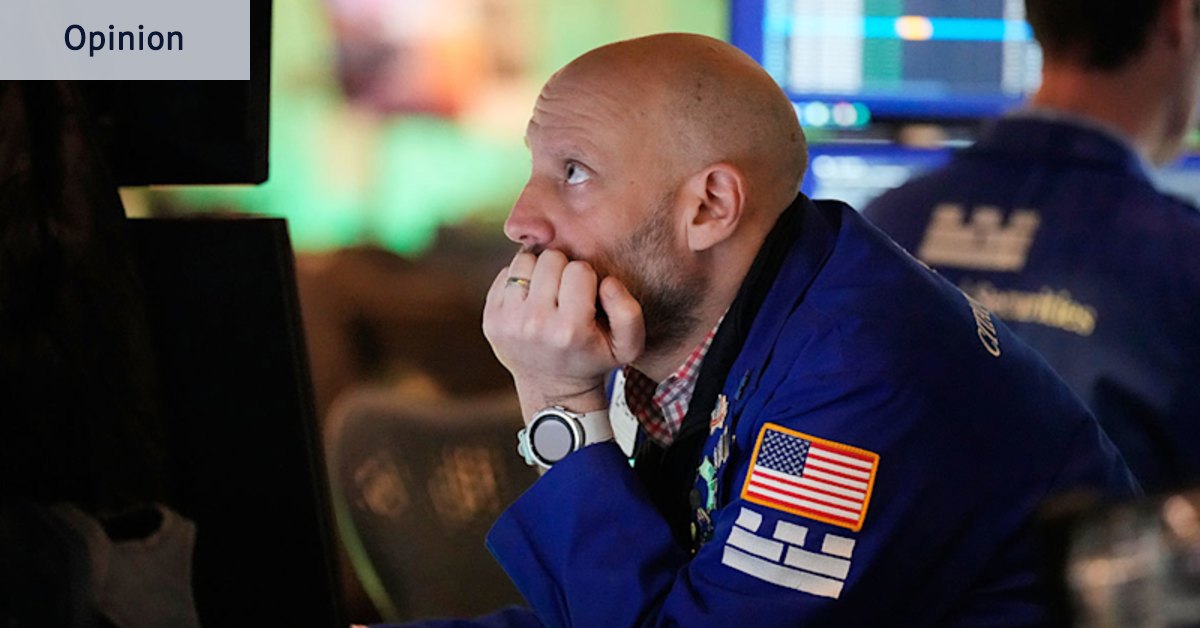
Photo via The Sydney Morning Herald

Wall Street’s multi-trillion-dollar question: Could bonds end the AI boom?

Read the original at The Sydney Morning Herald ↗
Cite

Bartholomeusz, S. (2026, September 28). Wall Street’s multi-trillion-dollar question: Could bonds end the AI boom? The Sydney Morning Herald. https://www.smh.com.au/business/markets/wall-street-s-multi-trillion-dollar-question-could-bonds-end-the-ai-boom-20260928-p610yo.html?ref=rss&utm_medium=rss&utm_source=rss_feed

Dated when The Aporia collected the article, usually within hours of publication. Check the original for its exact date and byline.

The Sydney Morning Herald · collected 2026-09-28 · by Stephen Bartholomeusz

Quick Summary

US bond yields have recently surged to near 20-year highs, reaching 5.16% from 4.95%, raising concerns about their potential impact on stock markets and artificial intelligence (AI) investments. The article explores whether higher debt returns could crash the sharemarket and derail AI-related investment, given that AI companies are heavily reliant on debt to fund their growth. This increase in bond yields could affect the valuation of these companies by raising borrowing costs and discount rates used for calculating future cash flows.
Written by AI on 2026-09-28, from this article's own text only (the story summary below draws on all the coverage).

AI analysis

Story summary

US bond yields surged to near 20-year highs, rising from 4.95% to 5.16% over a week, amid concerns over escalating tensions between Iran and the US, which have driven up oil prices. This increase in bond yields is inversely correlated with stock markets; for instance, the S&P 500 fell by 0.8% while the Nasdaq Composite dropped by 1%, reflecting investor anxiety about higher borrowing costs impacting corporate profits. The spike in bond yields also questions the sustainability of the artificial intelligence investment boom as bonds become more attractive compared to stocks with a lower dividend yield, currently around 1%. Additionally, US President Donald Trump's rejection of Iran’s offer to reopen the Strait of Hormuz has exacerbated fears over sustained high oil prices, contributing further to the instability in financial markets.

Written for “Bond Selloff And Market Volatility” on 2026-10-30, grounded in this article and the 3 other(s) covering the same event.

Story

📰 Bond Selloff And Market Volatility
Economy/Business · 4 article(s) covering the same event. Compare every outlet's account →

Compared with similar articles

This article reads unscored and hedges 14% of its claims. Each row says how that neighbour differs.
Daily Mail
⚖️ Leans left Hedges 3 of 20 claims Outlet record 68/100
“The articles discuss different aspects of AI and its economic impacts, not the same specific incident.”
Al Jazeera
⚖️ Leans right Hedges 1 of 13 claims Outlet record 60/100
“The articles describe different market conditions and concerns over a period of time, not the same specific incident.”
South China Morning Post
Hedges 0 of 6 claims Outlet record 64/100
“The articles discuss different aspects of financial markets and economic indicators related to AI, oil prices, and bonds, but do not describe the same specific incident.”
Al Jazeera
⚖️ Leans left Hedges 6 of 43 claims Outlet record 60/100
“The articles discuss different aspects of AI and financial markets without describing the same specific incident.”
New York Post
Hedges 11 of 26 claims Outlet record 66/100
“The articles discuss different aspects of financial markets and do not describe the same specific incident or occurrence.”
The Guardian
⚖️ Leans strongly left Hedges 3 of 34 claims Outlet record 66/100
“The articles discuss different aspects of AI and financial markets, not a single specific incident.”
Semafor
⚖️ Leans left Hedges 1 of 4 claims Outlet record 60/100
“The articles discuss different aspects of financial and technological concerns related to AI but do not describe the same specific incident.”
South China Morning Post
⚖️ Leans left Hedges 1 of 5 claims Outlet record 64/100
“The articles discuss different aspects of AI investment and economic concerns, with Article A focusing on China's AI transformation and valuation risks, while Article B addresses potential market impacts due to bond yields.”
Semafor
Hedges 0 of 4 claims Outlet record 60/100
“The articles discuss different aspects of financial markets related to AI investments but do not describe the same specific incident or occurrence.”
The Hindu
Hedges 5 of 43 claims Outlet record 60/100
“The articles discuss different aspects of AI and financial markets, not a single specific incident.”
How this article was measured signals, leaning charts, publisher record, byline, topics and claims

Signals How these are calculated →

Claims extracted
35
sentences that state something as happening or true
Uncertain
14%
5 of 35 hedged ("reportedly", "may", "according to")
Leaning
not political
takes no side on a contested political question
Publisher signals
61/100
The Sydney Morning Herald's corrections and hedging, across everything collected from it. Not a measure of accuracy.
Outlets on this story
4
Economy/Business
Same framing elsewhere
1
articles that frame the event the way this one does
Analyzed 2026-09-28 · how these are computed

How this is being covered How these are calculated →

Article leaning vs. publisher reliability
Source leaning vs. consistency

Publisher

The Sydney Morning Herald · 5572 article(s) · 15 correction(s) detected
Running correction rate · 15 correction(s)

Who wrote this

Stephen Bartholomeusz
18 article(s) here · 1 carrying a prediction
🔮 Anthropic has launched the prospectus for what may be the biggest-ever initial public offering – and the fate of the entire US artificial intelligence complex may rest on it.
🔮 Next week the lower house of the Swiss parliament will debate a proposal from their colleagues in the upper house that would force the bank to capitalise its offshore subsidiaries almost entirely with equity.
2026-10-21 · assertive framing · Could a 164-year-old Swiss giant quit Switzerland?
🔮 Earlier this month, Firmus, a data centre operator, yanked what would have been Australia’s second-largest initial public offering – after investors balked at the $44 billion valuation and the very pricey capitalisation of revenues and earnings from projects that are still on drawing boards.
2026-10-19 · assertive framing · Wall Street’s boom is sitting on a shaky foundation
🔮 Given that the core issue in the election is affordability, the headline rise in the rate in September of 0.6 per cent – a material increase on the 0.4 per cent rise in August – and the year-on-year increase in prices of 3.7 per cent (3.4 per cent previously) couldn’t have come at a worse time for Donald Trump and the Republicans.
🔮 What would it look like if demand for government and corporate debt rose rapidly even as its cost surged?
🔮 When the latest inflation data is released on Wednesday morning in the US, it is expected to show that the inflation rate in the world’s largest economy rose again in September, adding to the cost-of-living pressures that are the key issue in the midterms.
🔮 Donald Trump announced a deal last Friday under which Russia will supply the US and the global market with diesel that Russia may not have and America doesn’t need.
🔮 A delegation of European Union trade negotiators is in Beijing, hoping to avert what could be a full-scale trade confrontation with China.
🔮 The equal weight index has risen 10.8 per cent this year and has actually fallen almost 3 per cent in the past month – the market might be at record levels, but its performance is very narrowly based. Indeed, only four stocks – Nvidia, Apple, Micron and AMD – account for roughly half the S&P 500’s rise this year.
🔮 Inflation rates are too high, growth rates are weak and there’s not the political will or ability to address the threat of a self-fuelling cycle of escalating debts and interest costs.
Also by Stephen Bartholomeusz
Could a 164-year-old Swiss giant quit Switzerland?
2026-10-21 · The Sydney Morning Herald
Wall Street’s boom is sitting on a shaky foundation
2026-10-19 · The Sydney Morning Herald
The damage Trump has inflicted on America is spreading
2026-10-15 · The Sydney Morning Herald
Nothing else under this byline is closely related to this article, so these are simply their most recent.
All 18 articles by Stephen Bartholomeusz →

Topics

Iran Israel Treasury the US Federal Reserve’s

Subjects

Fed ORG · 2× Alphabet ORG · 1× Amazon ORG · 1× Iran GPE · 1× Israel GPE · 1× Republicans NORP · 1× Treasury ORG · 1× the US Federal Reserve’s ORG · 1×

Narrative

With stocks trading at pricey levels – the cyclically adjusted profit-to-earnings or CAPE ratio is at levels last seen in 1999, in the lead-up to the bursting of the dot-com bubble – a sustained rise in interest rates is an obvious threat. It’s also a threat to both the real economy and the financial sector, where there’s been massive increases in non-bank, or “shadow banking” activity since the regulatory response to the 2008 crisis forced regulated institutions out of a lot of financial market activities.
framing: assertive · carried by 1 article(s) · first seen 2026-09-28
🔮 The sudden spike in US bond yields over the past week to near 20-year highs raises a multi-trillion dollar question: Will those higher debt returns crash the sharemarket, and in the process derail the boom in artificial intelligence-related investment?
2026-09-28 · The Sydney Morning Herald
Wall Street’s multi-trillion-dollar question: Could bonds end the AI boom? · assertive framing

Claims (35 extracted, 5 hedged)

The sudden spike in US bond yields over the past week to near 20-year highs raises a multi-trillion dollar question: Will those higher debt returns crash the sharemarket, and in the process derail the boom in artificial intelligence-related investment? asserted
returns → raise → investment
Having edged up for most of the year - since the war in the Middle East caused oil prices to soar – the yield on US 10-year Treasury bonds has jumped from 4.95 per cent to 5.16 per cent in the space of a week, with similar moves across the yield curve. asserted
yield → edge → curve
That’s the highest yield on the 10-year bond – the global reference point for most interest-bearing securities – since 2007, when it rallied in the lead-up to the global financial crisis. asserted
it → ’ → crisis
Bond yields and sharemarkets generally (there are exceptions) have an inverse correlation. asserted
yields → be → correlation
If you can get more than 5 per cent from investing in bonds, the dividend yield on the US stock market –currently about 1 per cent – starts to look unappealing when the risks of a sharemarket inflated by the hype around artificial intelligence stocks and trading at near-record levels are factored into decision-making. asserted
risks → get → making
Higher yields push up borrowing costs, lowering company profits and dampening economic activity. They also lift the discount rates used to calculate the value of companies’ forecast future cashflows in today’s dollars, which is a particular threat to an AI sector increasingly reliant on access to the debt market to fund the extraordinary levels of investment in chips and data centres, and the energy and water infrastructure to support those centres. asserted
which → push → centres
The scale of the AI investments being made – in the US, it is more than $US700 billion ($990 billion) this year and could top a trillion dollars next year – and the mind-boggling rates of revenue growth that would be required to justify the investments make the AI sector and the “hyperscalers” dominating the digital infrastructure and accounting for about 35 per cent of the US market’s value exceptionally vulnerable to an increase in discount rates. uncertain
sector → make → rates
So far, there’s been no material impact on the sharemarket from the spikes in yields and, apart from a brief sell-off when the US and Israel launched their attack on Iran in February, it has traded largely unaffected by the surge in oil prices above $US100 a barrel, the stubbornly high inflation rate and the US Federal Reserve’s decision this month to raise its policy rate for the first time in more than three years. asserted
it → launch → years
That may be because of the continuing conviction that AI will change the world, and those companies leading the revolution will profit immeasurably. uncertain
companies → continue → revolution
It may also be because the US economy is growing strongly, buoyed by the investment in AI, by fiscal stimulus – the US government deficit is running at almost 6 per cent of GDP - and the strength of spending by higher income households, and by booming corporate profitability. uncertain
deficit → grow → profitability
The AI investment boom may, however, taper or burst. uncertain
boom → taper → ?
The resort to debt by even the hyperscalers – companies like Amazon and Alphabet – is an indication of the stresses even the biggest and most profitable companies are experiencing in funding their ever-escalating AI investments. asserted
companies → experience → investments
Spending on AI has absorbed their vast legacy cashflows and is stretching the equity market’s capacity to support them with new equity. asserted
Spending → absorb → equity
The rise in yields makes the cost of AI debt – which already has a risk premium – more expensive, while the rise in interest rates being driven by the bond market and the Fed will start to squeeze consumers’ finances. asserted
rise → make → finances
The spending by wealthier households has been held up, so far, by the Republicans’ tax cuts and by the wealth effects of the sharemarket boom. asserted
spending → hold → boom
The rise in yields makes the cost of AI debt more expensive, while the rise in interest rates being driven by the bond market and the Fed will start to squeeze consumers’ finances. asserted
rise → make → finances
Third-quarter earnings estimates put it at about 25 per cent of the same period last year. asserted
estimates → put → period
The earnings numbers are, however, inflated to some degree by the hundreds of billions of profits AI companies are reporting that flow from the markups in the value of their holdings in each other in what’s been described as the “circular” AI economy. asserted
what → inflate → economy
At a macro level, the current US settings – the 6 per cent government deficit and more than $US40 trillion of government debt – are unsustainable in a rising interest rate environment. asserted
settings → rise → environment
With the Fed having just started a rate-rising cycle, with the market pricing in at least three more 25 basis point increases over the next year, the threat posed to government and corporate finances posed by a significant increase in interest costs will only intensify. asserted
threat → start → costs
The US could grow its way out of the looming debt trap as low-cost debt issued in the post-financial crisis and pandemic eras continues to mature and be refinanced with higher-cost debt. uncertain
debt → grow → debt
But, more likely, it will have to try to inflate its way out, which will probably agitate the bond vigilantes even more. asserted
which → have → vigilantes
The risk to the sharemarket is heightened because today’s bond market is not what it once was. asserted
it → heighten → sharemarket
Donald Trump’s trade wars and US sanctions have made the foreign central banks and institutions that were once the major buyers of US bonds more wary. asserted
that → make → bonds
They’ve been diversifying away from the US, into gold and other assets. asserted
They → diversify → gold
The market is now peopled by hedge funds and other traders, pursuing carry trades by either borrowing cheaply in other markets (Japan used to be the primary source of low-cost funding) or by running leveraged arbitrages between US physical bonds and their policing in futures markets. asserted
Japan → people → markets
That makes the market more volatile and potentially vulnerable if an “event” causes the funds to suddenly unwind their trades. asserted
funds → make → trades
The bond market’s equivalent of the VIX index (often referred to as the “fear” index), which measures volatility in the sharemarket, is the MOVE (Merrill Option Volatility Estimate) index. asserted
which → refer → sharemarket
It leapt over the past week from 78.56, which is roughly its average level of the past decade, to 96. asserted
which → leap → 96
Presumably some of those leveraged bondholders became spooked by the pace of the run-up in yields. asserted
some → spook → yields
With stocks trading at pricey levels – the cyclically adjusted profit-to-earnings or CAPE ratio is at levels last seen in 1999, in the lead-up to the bursting of the dot-com bubble – a sustained rise in interest rates is an obvious threat. It’s also a threat to both the real economy and the financial sector, where there’s been massive increases in non-bank, or “shadow banking” activity since the regulatory response to the 2008 crisis forced regulated institutions out of a lot of financial market activities. asserted
response → trade → activities
There is perceived increased risk to the corporate sector and the economy being priced into markets, with the credit default swaps for investment trade companies blowing out and the yield curve in the bond market flattening. asserted
curve → be → market
An index for insuring against defaults on US investment grade debt started the year at 51 basis points and is now at 58 basis points – where it would have cost $US510,000 to buy insurance against a default on $US100 million of loans, it now costs $US580,000. asserted
it → insure → US580,000
The flattening of the yield curve – the difference between the yields on two and 10-year bonds has shrunk from about 85 basis points at the start of the year to about 30 basis points – points to an expectation that the US economy will slow as the Fed, and the market, respond to the risk of sustained high inflation levels. asserted
Fed → shrink → levels
It is, of course, conceivable that a sharemarket that has shrugged off Trump’s tariffs, the war in the Middle East and $US100-a-barrel-plus oil prices, $US40 trillion of government debt and the administration’s erratic policymaking can ignore the myriad of latent threats, buoyed by the transformative potential of AI. asserted
that → shrug → AI

💬Give feedback
🕘History 🎫Support