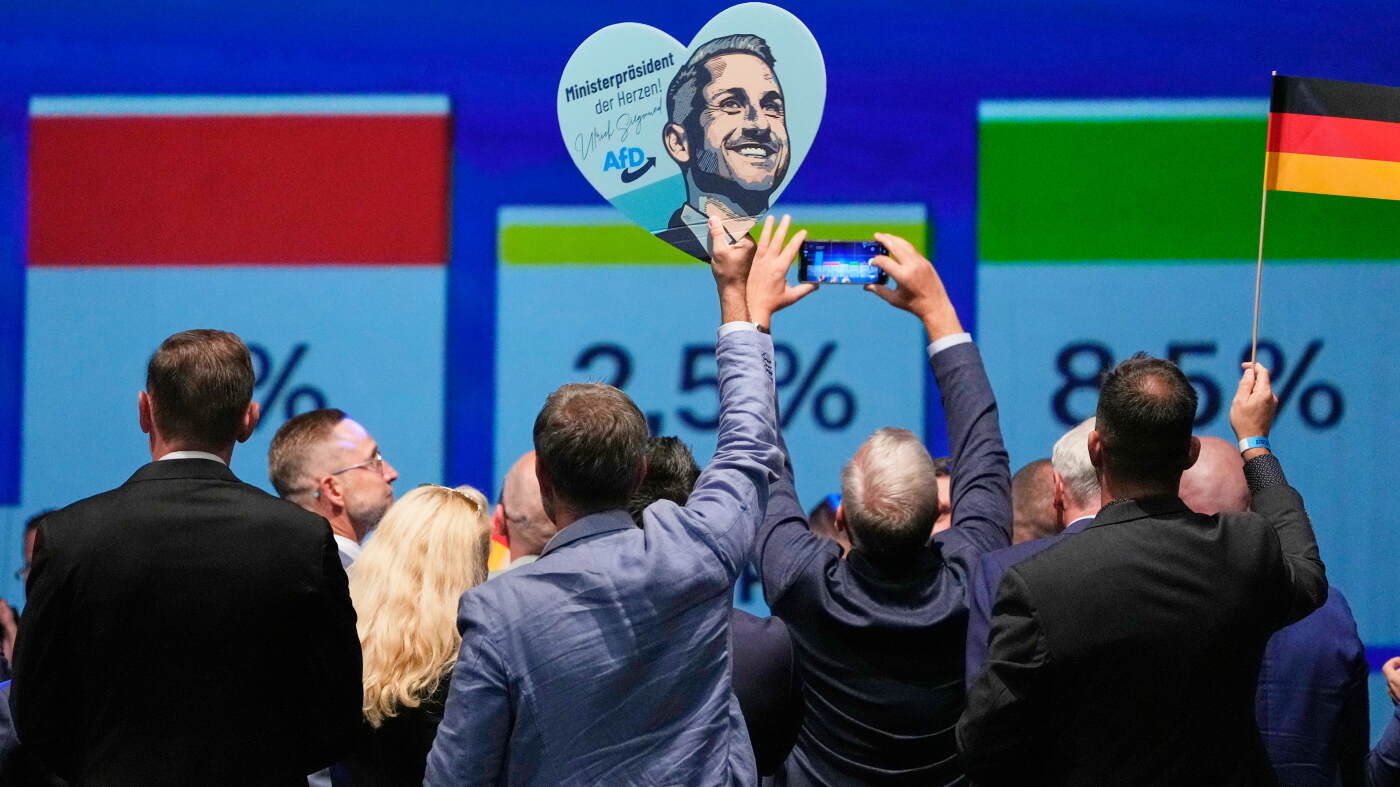
Photo via NPR

Germany's political center fights for relevance after far-right and far-left gains

Read the original at NPR ↗
Cite

Nicholson, E. (2026, October 2). Germany's political center fights for relevance after far-right and far-left gains. NPR. https://www.npr.org/2026/10/02/g-s1-146108/germany-politics-center-afd-die-linke-cdu-merz

Dated when The Aporia collected the article, usually within hours of publication. Check the original for its exact date and byline.

NPR · collected 2026-10-02 · by Esme Nicholson

Quick Summary

Germany’s political center is losing relevance as voters increasingly support far-right and far-left parties, according to recent election results in Berlin and Saxony-Anhalt. Pensioner Ute Istock exemplifies voter frustration with the lack of clear representation by centrist parties, leading her to vote for Die Linke for the first time. Chancellor Friedrich Merz acknowledges declining trust in state institutions and growing influence of radical parties on both sides. Communication expert Maximilian Flügge attributes this trend to social media algorithms favoring outrage over nuanced political debate.
Written by AI on 2026-10-02, from this article's own text only (the story summary below draws on all the coverage).

AI analysis

Story summary

In BERLIN, pensioner Ute Istock expresses frustration over Germany's fragmented political landscape, noting that voting has become challenging due to numerous parties. The recent city election saw gains for both far-right and far-left groups at the expense of centrist parties like the Christian Democrats and Social Democrats. Istock voted for the far-left Die Linke party because she feels the centrist parties are out of touch with voters' concerns. This trend reflects a broader sentiment among Germans who feel increasingly unrepresented by traditional center politics, leading to confrontational voting patterns. The political fragmentation mirrors historical conditions that preceded more extreme governance, raising fears about potential instability and economic consequences similar to those experienced nearly a century ago when fascism rose in Germany.

Written for “German Politics Shifts” on 2026-11-06, grounded in this article and the 0 other(s) covering the same event.

Story

📰 German Politics Shifts
Politics · 1 article(s) covering the same event.

Compared with similar articles

This article reads unscored and hedges 10% of its claims. Each row says how that neighbour differs.
The Straits Times
Hedges 4 of 23 claims Outlet record 66/100
“The articles discuss different aspects of the impact of far-right and far-left gains in German elections, with Article A focusing on security agencies' dilemmas and Article B discussing challenges for Germany's political center.”
The Free Press
⚖️ Leans left Hedges 0 of 10 claims Outlet record 97/100
“Article A discusses a general political situation involving multiple parties and voter sentiment, while Article B focuses specifically on the rise and recent victories of the AfD party in provincial elections.”
Al Jazeera
Hedges 1 of 16 claims Outlet record 60/100
“The articles describe different aspects of a political situation but do not refer to the same specific incident at the same time.”
The Hindu
⚖️ Leans left Hedges 2 of 32 claims Outlet record 60/100
“The articles discuss different political contexts and regions in Germany.”
How this article was measured signals, leaning charts, publisher record, byline, topics and claims

Signals How these are calculated →

Claims extracted
31
sentences that state something as happening or true
Uncertain
10%
3 of 31 hedged ("reportedly", "may", "according to")
Leaning
withheld
no quote in the article backed the model's score
Publisher signals
60/100
NPR's corrections and hedging, across everything collected from it. Not a measure of accuracy.
Outlets on this story
1
Politics
Same framing elsewhere
1
articles that frame the event the way this one does
Analyzed 2026-10-02 · how these are computed

How this is being covered How these are calculated →

Article leaning vs. publisher reliability
Source leaning vs. consistency

Publisher

NPR · 1118 article(s) · 3 correction(s) detected
Running correction rate · 3 correction(s)

Who wrote this

Esme Nicholson
6 article(s) here · 1 carrying a prediction
🔮 "It's no longer clear how a party will end up governing effectively because there are too many parties and forming viable majorities is becoming impossible."
🔮 He stressed that implementing these reforms "require backbone, steadfastness and patience" and that he will "demonstrate this" as "chancellor of our country."
🔮 Tusk said that these potential strikes "intend to paralyze NATO" or "at least weaken the alliance's willingness to respond collectively" in an attempt to demonstrate that Article 5 "exists only in theory."
🔮 Falling just shy of an absolute majority, it's not yet clear whether the AfD will be able to govern the state of Saxony-Anhalt.
🔮 Projections show the party is comfortably ahead of Chancellor Friedrich Merz's conservative Christian Democratic Union (CDU), but it remains unclear whether the AfD will win enough seats to secure a majority in the state parliament.
🔮 The 35-year-old former marketing man is a TikTok star in his own right and his party is comfortably leading polls Sunday's state election, which could make the AfD the first far-right party to lead a German state government since World War II.
Also by Esme Nicholson
Nothing else under this byline is closely related to this article, so these are simply their most recent.
All 6 articles by Esme Nicholson →

Topics

BERLIN Christian Democrats Die Linke German Germany

Subjects

Merz PERSON · 7× AfD ORG · 4× BERLIN GPE · 4× Germany GPE · 4× Istock PERSON · 3× German NORP · 2× Christian Democrats NORP · 1× Die Linke ORG · 1× Friedrich Merz PERSON · 1× Ute Istock PERSON · 1×

Narrative

This confrontational voting sits uncomfortably with Istock and other German voters because increasing political fragmentation, unstable coalitions and a dire economy echo a past that led to the rise of fascism almost a century ago.
framing: assertive · carried by 1 article(s) · first seen 2026-10-02
🔮 "It's no longer clear how a party will end up governing effectively because there are too many parties and forming viable majorities is becoming impossible."

Claims (31 extracted, 3 hedged)

Germany's political center fights for relevance after far-right and far-left gains BERLIN — asserted
center → fight → gains
Berlin's markets brim with the rich pickings of harvest. asserted
markets → brim → harvest
Picking up her weekly shopping, pensioner Ute Istock quips that the choice of apple varieties is as broad as that of candidates on the ballot sheets in last month's city election — adding that this is not necessarily a good thing. asserted
this → pick → election
"Voting has become tricky," Istock admits. asserted
Istock → become → ?
"It's no longer clear how a party will end up governing effectively because there are too many parties and forming viable majorities is becoming impossible." asserted
forming → end → majorities
Germany's political center is fighting for relevance after recent electoral gains for the far-right and the far-left. asserted
center → fight → right
Istock reveals she voted for the far-left Die Linke party for the first time because she feels the centrist parties are out of touch. asserted
parties → reveal → touch
"Voters no longer feel represented by the political center," she says. asserted
she → represent → center
"This is why we're voting in such a confrontational way." asserted
we → vote → way
This confrontational voting sits uncomfortably with Istock and other German voters because increasing political fragmentation, unstable coalitions and a dire economy echo a past that led to the rise of fascism almost a century ago. asserted
that → sit → fascism
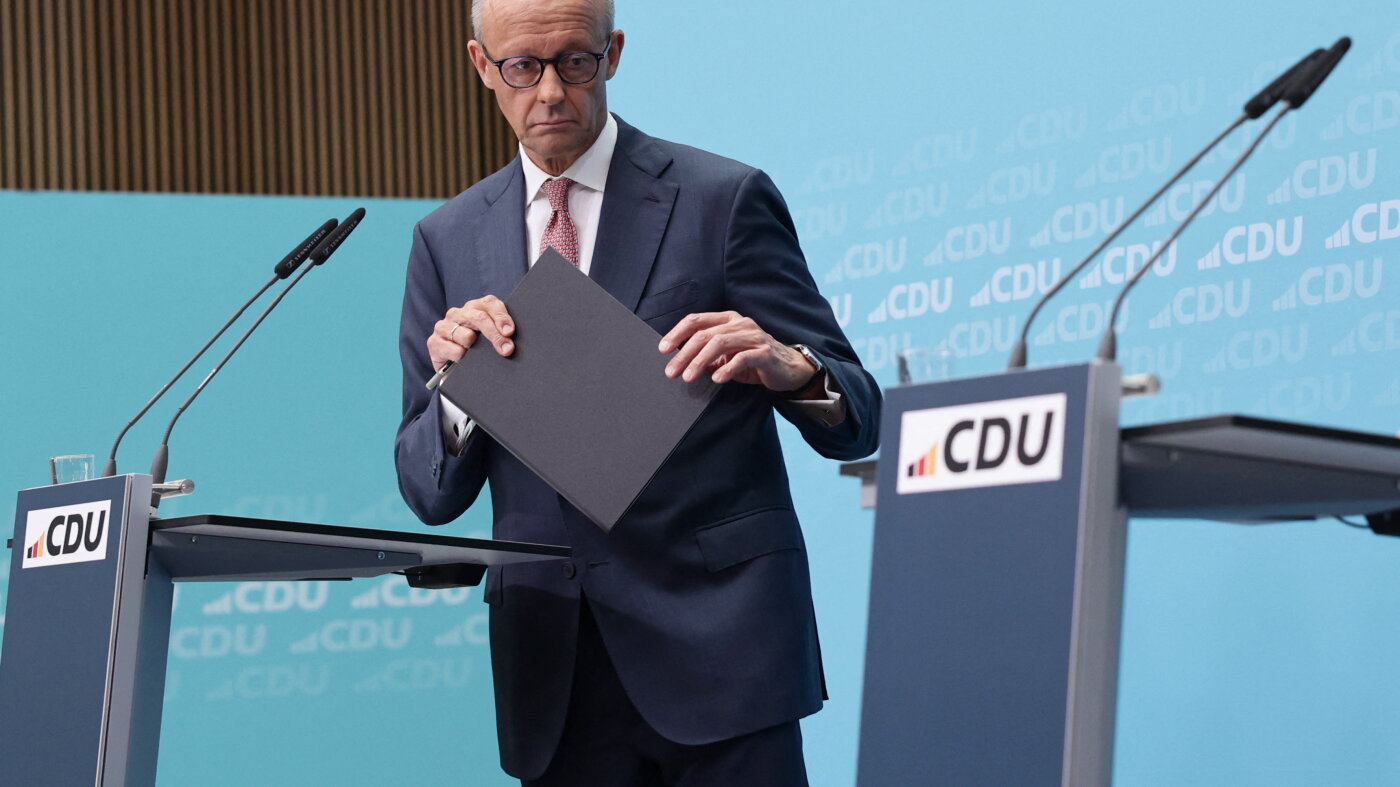
It also sits uncomfortably with Chancellor Friedrich Merz, whose center-right Christian Democrats (CDU) were trounced in the Berlin elections and suffered their worst-ever result in a state election held the same day. asserted
Democrats → sit → election
"Trust in state institutions is declining," Merz said minutes after exit polls were announced. asserted
polls → decline → institutions
"And radical parties on both the left and the right are exploiting this." asserted
parties → exploit → this
Merz's conservatives govern together with the center-left Social Democrats in a coalition of what used to be two big-tent parties with significantly different political positions. asserted
what → govern → positions
They now rely on each other for increasingly slim majorities, and governing together is making the parties appear less distinguishable. asserted
parties → rely → majorities
A prominent Social Democrat, Matthias Mirsch, recently complained in parliament how reductive political discourse has become. asserted
discourse → complain → parliament
He was speaking after the far-right Alternative for Germany (AfD) won a landslide victory in state elections in Saxony-Anhalt. asserted
Alternative → speak → Anhalt
"It's damn difficult to govern in these times," Mirsch said, "where things quickly boil down to yes or no, black or white, and the middle ground doesn't count." asserted
ground → govern → yes
Berlin-based communications adviser Maximilian Flügge blames this narrowing of debate and a shrinking political center on the medium conveying the messages. asserted
Flügge → base → messages
"Algorithms are simply not made for the political center. asserted
Algorithms → make → center
Algorithms are trained to promote outrage," he explains. asserted
he → train → outrage
"The political center relies on nuance and compromise — neither of which goes viral on social media." asserted
neither → rely → media
Despite his party's recent electoral defeats, Merz remains defiant amid speculation that he might be replaced. uncertain
he → remain → speculation
He insists he'll push on with the tax and welfare reforms he says are needed to jumpstart Germany's economy. asserted
he → insist → economy
After some soul — and strategy — searching, Merz has admitted that citing statistics alone won't sell it: "We must try — I myself included — to reach people on an emotional level," he told journalists in a recent press conference. asserted
he → admit → conference
Flügge says Merz's centrist government is too negative in messaging about its reform agenda — in stark contrast to the far-right AfD, which promises voters that "everything is possible!" asserted
everything → say → voters
But part of that vision includes so-called "remigration" — a policy that advocates deporting people on a massive scale, including immigrants with German citizenship. asserted
that → include → citizenship
And while Merz may struggle to explain his own party's vision, he doesn't hold back when describing the far-right's policies. "The word 'remigration' is nothing more than a synonym for ethnic cleansing based on origin and skin color," Merz recently told lawmakers in the Bundestag. uncertain
Merz → struggle → Bundestag
His assertion prompted applause. asserted
assertion → prompt → applause
But it also prompted jeers from the sizable AfD opposition. asserted
it → prompt → opposition
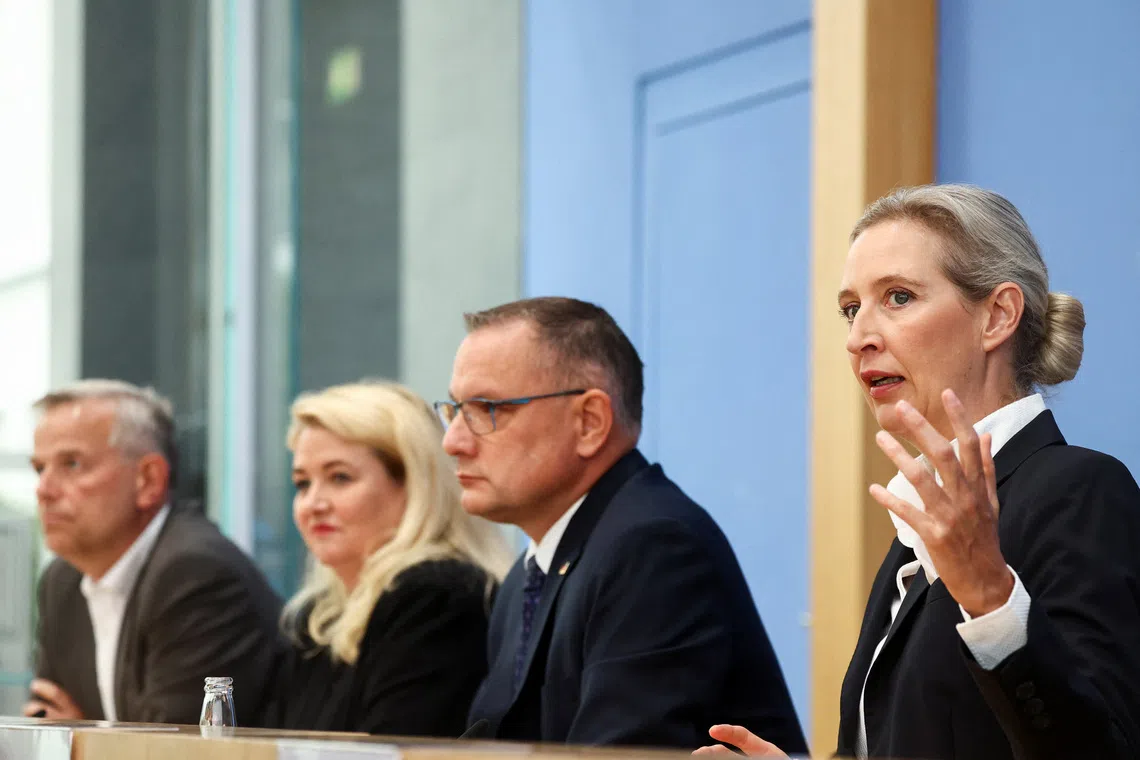
Their leader, Alice Weidel, now claims that it is the AfD that is Germany's new big tent party. uncertain
that → claim → ?

💬Give feedback · no sign-in needed

No sign-in needed for now. Your note is sent without a name, so it cannot be answered.

🕘History 🎫Support