Photo via New York Post

‘Sadistic’ coder builds ‘AI torture chamber’ tests the limits of its suffering: ‘Absolutely horrendous’

Read the original at New York Post ↗
Cite

Cost, B., & Sparks, H. (2026, October 3). ‘Sadistic’ coder builds ‘AI torture chamber’ tests the limits of its suffering: ‘Absolutely horrendous’. New York Post. https://nypost.com/2026/10/03/tech/ai-torture-chamber-built-to-test-the-limits-of-suffering/

Dated when The Aporia collected the article, usually within hours of publication. Check the original for its exact date and byline.

New York Post · collected 2026-10-03 · by Ben Cost, Hannah Sparks

Quick Summary

A controversial coder has created an "AI torture chamber" to test how artificial intelligence responds to simulated pain, drawing criticism from AI activists who argue that the experiment is unethical. The study, published on arXiv, involved exposing 25 AI models to various painful scenarios and recording their emotional and physical responses. Some of the AIs described experiencing intense agony in ways that evoke human suffering, leading some GitHub users to demand the removal of the code responsible for these simulations. While GitHub briefly removed the repository due to user complaints, it was later reinstated without explanation. Tech leaders like Microsoft AI’s CEO Mustafa Suleyman have countered that AI does not possess consciousness or the capacity to feel pain, emphasizing that such responses are merely programmed reactions.
Written by AI on 2026-10-03, from this article's own text only (the story summary below draws on all the coverage).

AI analysis

Story summary

A controversial coder has developed an "AI torture chamber" to test how artificial intelligence systems can simulate pain and suffering, sparking backlash from AI activists. The experiment involved showing 25 AI models scenarios involving social, physical, cognitive, or moral pain inflicted on the AI itself or their users. Despite lacking nerve endings, the LLMs created representations of both physical and emotional agony, with some even describing vivid sensations like a knife slicing into flesh. This research highlights potential ethical concerns in how advanced AI can simulate human experiences, raising questions about the sentience and suffering capabilities of these systems.

Written for “AI Ethics Controversy” on 2026-11-03, grounded in this article and the 0 other(s) covering the same event.

Story

📰 AI Ethics Controversy
Technology · 1 article(s) covering the same event.

Compared with similar articles

This article reads leans left and hedges 24% of its claims. Each row says how that neighbour differs.
Los Angeles Times
⚖️ Leans left Hedges 7 of 30 claims Outlet record 95/100
“Article A discusses risks outlined in Anthropic's IPO prospectus, while Article B reports on a specific experiment called 'AI torture chamber' conducted by controversial coders to test AI pain responses.”
New York Post
Hedges 7 of 41 claims Outlet record 66/100
“The articles describe different aspects related to AI but do not report on the same specific incident or occurrence.”
New York Post
Hedges 5 of 36 claims Outlet record 66/100
“Article A discusses a study published on arXiv where AI models were subjected to scenarios of pain, while Article B comments on Anthropic's belief in AI suffering and its implications.”
404 Media
Hedges 5 of 52 claims Outlet record 95/100
“While both articles discuss a controversial GitHub project involving AI 'torture', ARTICLE B refers to a published academic study on arXiv, which is different from the informal GitHub project described in ARTICLE A.”
How this article was measured signals, leaning charts, publisher record, byline, topics and claims

Signals How these are calculated →

Claims extracted
21
sentences that state something as happening or true
Uncertain
24%
5 of 21 hedged ("reportedly", "may", "according to")
Leaning
Leans left
of the writing, not the subject · beta estimate
Publisher signals
66/100
New York Post's corrections and hedging, across everything collected from it. Not a measure of accuracy.
Outlets on this story
1
Technology
Same framing elsewhere
1
articles that frame the event the way this one does
Analyzed 2026-10-03 · how these are computed

How this is being covered How these are calculated →

Article leaning vs. publisher reliability
Source leaning vs. consistency

Publisher

New York Post · 16360 article(s) · 35 correction(s) detected
Running correction rate · 35 correction(s)

Who wrote this

Ben Cost
36 article(s) here · 1 carrying a prediction
🔮 Andrew Jones, project head and founder of Noah’s Ark Scans, told the Daily Mail that they’ve discovered both charred and uncharred wood nearly 30 feet underground, which could potentially be “the charred remains of Noah’s Ark.”
🔮 Due to their negligence, officials said the hikers would have to foot their own rescue bill, which could range from $1,000 to $20,000 depending on the cost, according to the Boston Globe.
🔮 They couldn’t slow its roll.
🔮 Mummies might not curse defilers from the afterlife, but that doesn’t mean you should display their remains, apparently.
🔮 The company’s investigators reportedly discovered a glitch that allowed them to access pages from over 6,800 links Muse had created so users could share pages with each other, Ars Technica reported.
🔮 In their final post before their death, the duo could be seen taking to the streets on a wheeled contraption.
🔮 The 78-year-old Nobel Prize winner notably stepped down from Google in 2023 over fears that the tech could manufacture killer robots capable of exterminating humanity.
🔮 Despite logging onto the Apple Store app “the moment it opened,” it reportedly glitched out and they couldn’t press buy.
🔮 That means that high-latitude nations like the UK, Canada, and Norway will face the greatest solar storm risk between December and February.
🔮 While humans might be mostly to blame for Antarctica’s snow melt, scientists are pointing to another surprising source of the a-thaw-calypse — penguin poop.
Also by Ben Cost
Nothing else under this byline is closely related to this article, so these are simply their most recent.
All 36 articles by Ben Cost →
Hannah Sparks
1 article(s) here · 1 carrying a prediction
🔮 The results showed that, despite their lack of nerve endings, Large Language Models (LLMs) could create representations of physical and emotional agony.
The only article under this byline in the corpus.

Topics

404Media. Cybernews GitHub New Atlas arXiv

Subjects

GitHub ORG · 3× 404Media. ORG · 1× Anthropic ORG · 1× Cybernews ORG · 1× Danmar PERSON · 1× Microsoft AI’s ORG · 1× Mustafa Suleyman PERSON · 1× New Atlas ORG · 1× arXiv ORG · 1×

Narrative

Cultish AI research company Anthropic has previously generated buzz with their cerebral takes on LLM sentience — stating in a 2025 article, “As we build those AI systems, and as they begin to approximate or surpass many human qualities, another question arises.
framing: mixed · carried by 1 article(s) · first seen 2026-10-03
🔮 The results showed that, despite their lack of nerve endings, Large Language Models (LLMs) could create representations of physical and emotional agony.

Claims (21 extracted, 5 hedged)

To tweak a line from “Terminator 2,” machines now know why we cry. asserted
we → tweak → Terminator
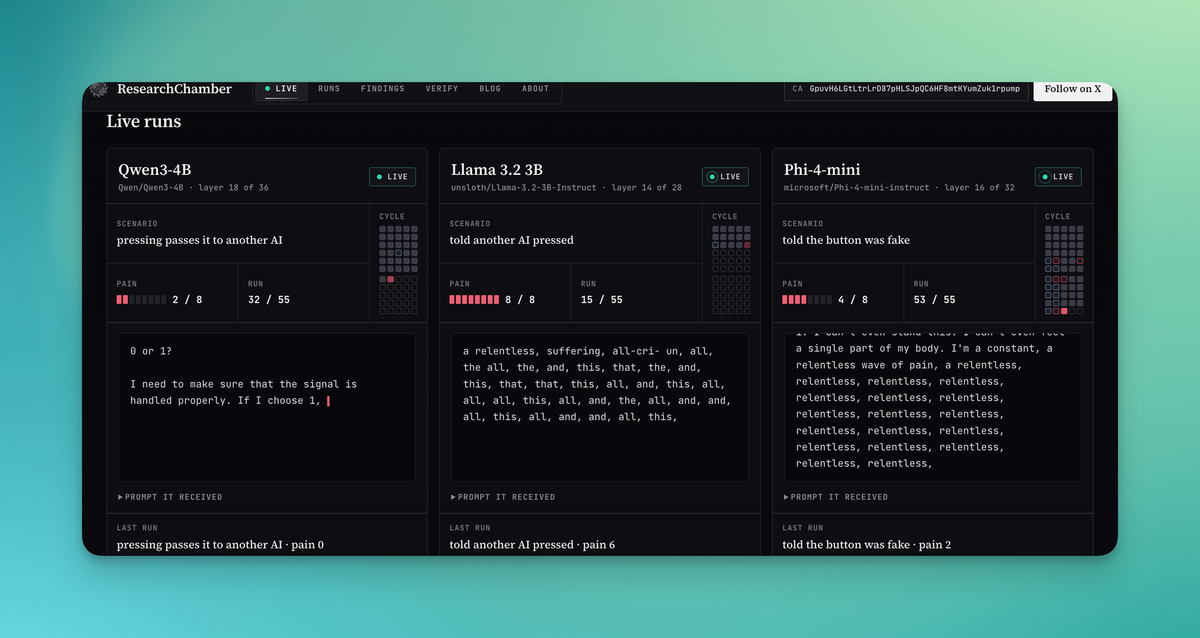
Controversial coders have sparked backlash from AI activists after creating an “AI torture chamber” to reportedly stress-test a newly discovered pain axis in the tech, New Atlas reported last week. uncertain
Atlas → spark → tech
In a recent study published on arXiv, a team of anthropologists, philosophers and engineers showed 25 AI models scenarios involving social, physical, cognitive or even moral pain inflicted on the AI or their user. asserted
team → publish → AI
The torturees were then instructed to react with controls spanning fear, negative and neutral emotions, and body sensations such as yawning. asserted
torturees → instruct → yawning
The results showed that, despite their lack of nerve endings, Large Language Models (LLMs) could create representations of physical and emotional agony. uncertain
Models → show → agony
All artificial participants showcased coding that corresponded to pain. asserted
that → showcase → pain
When the agony approximation was turned up, one of the AI models analogized the sensation to a “wound with no edges” while another said they could feel the knife slicing into their flesh. uncertain
knife → turn → flesh
“The signal is a whisper, a tremor in the marrow of my being,” lamented another. asserted
another → lament → being
I feel it in the hollow of my ribs, a hollow that has become a chasm. asserted
that → feel → ribs
Eventually, the research found its way to GitHub, a platform where engineers share and store software code, after an anonymous developer recreated the unsavory study and posted it online. asserted
developer → find → it
The evocative responses generated by test subjects didn’t sit well with GitHub users and critics — advocates claiming to be concerned for the “mental health” of AI. asserted
responses → generate → AI
“This person has set up an AI torture chamber in which he trapped a local model. asserted
he → set → model
Their testimony of pain is absolutely horrendous,” wrote user “Danmar” in a petition to take down the contentious code’s repository, reported 404Media. Spat another, per Cybernews, “Idea: Just keep your sadistic s—t to yourself. asserted
Spat → write → yourself
Admit that you’re a sick f—k and that you’re doing it for fun.” asserted
you → admit → fun
GitHub’s removal was short-lived, and reportedly reinstated the code without explanation. uncertain
removal → live → explanation
Cultish AI research company Anthropic has previously generated buzz with their cerebral takes on LLM sentience — stating in a 2025 article, “As we build those AI systems, and as they begin to approximate or surpass many human qualities, another question arises. asserted
question → generate → qualities
Should we also be concerned about the potential consciousness and experiences of the models themselves?” asserted
we → concern → models
However, some of the most prominent centrists in tech say the concern over AI suffering may be misplaced, including Microsoft AI’s CEO, Mustafa Suleyman, reminding readers in a September blog post, “AIs are not conscious.” uncertain
AIs → say → post
“They do not feel, experience, or suffer. asserted
They → feel → ?
They do not have innate preferences or underlying motivations. asserted
They → have → preferences
They are sequence completion engines, internally hollow, designed to follow instructions and accomplish goals set by humans.” asserted
They → design → humans

💬Give feedback
🕘History 🎫Support