Photo via The Sydney Morning Herald

Town Hall Square is not a vanity project; it’s a legacy for future generations

Read the original at The Sydney Morning Herald ↗
Cite

Vivian, P. (2026, October 5). Town Hall Square is not a vanity project; it’s a legacy for future generations. The Sydney Morning Herald. https://www.smh.com.au/national/nsw/town-hall-square-is-not-a-vanity-project-it-s-a-legacy-for-future-generations-20261005-p612lg.html?ref=rss&utm_medium=rss&utm_source=rss_feed

Dated when The Aporia collected the article, usually within hours of publication. Check the original for its exact date and byline.

The Sydney Morning Herald · collected 2026-10-05 · by Philip Vivian

Quick Summary

The City of Sydney's proposal to transform Town Hall Square by demolishing buildings has faced criticism and a state government review following public opposition. The project began with lord mayor Doug Sutherland’s initial concept in 1982 and involves decades of property acquisition completed most recently in 2019, leaving only one final compulsory purchase. Critics argue that the demolition is wasteful, but supporters see it as necessary for creating essential urban green space amid increasing density and climate challenges. The article draws historical parallels to other cities like Paris under Baron Haussmann and Barcelona with Plaza Reial, emphasizing how such public squares have become iconic landmarks worldwide.
Written by AI on 2026-10-05, from this article's own text only (the story summary below draws on all the coverage).

AI analysis

Story summary

In August 2023, Sydney City Council proposed a new public square opposite Sydney Town Hall, estimated at a cost of $150 million. The project, first conceived in 1982 by then-lord mayor Doug Sutherland and set to be completed by 2031, involves demolishing seven buildings to create the space. Critics argue it is too expensive and disruptive, with some estimating a cost of only $94 million for the plaza alone. The NSW government, under premier Chris Minns, has deemed the project "state significant," taking control away from the city council and putting it through another approval process. This move follows public outcry over the potential demolition's impact on local businesses and concerns about excessive costs. The Independent Planning Commission found that the project could deliver substantial public and economic benefits despite opposition.

Written for “Sydney Town Hall Square Project” on 2026-10-31, grounded in this article and the 2 other(s) covering the same event.

Story

📰 Sydney Town Hall Square Project
Politics · 3 article(s) covering the same event. Compare every outlet's account →

Compared with similar articles

This article reads leans strongly left and hedges 3% of its claims. Each row says how that neighbour differs.
The Sydney Morning Herald
⚖️ Leans right further right than this Hedges 4 of 29 claims Outlet record 61/100
“The articles describe different events: one is about a contentious council meeting in Woollahra, while the other discusses the City of Sydney's proposal for Town Hall Square.”
The Sydney Morning Herald
Hedges 1 of 30 claims Outlet record 61/100
“The articles discuss different aspects of City Square, with Article A focusing on its current deserted state nine months after reopening and Article B addressing broader planning and ideological debates surrounding its creation.”
The Sydney Morning Herald
⚖️ Leans right further right than this Hedges 1 of 41 claims Outlet record 61/100
“Article A discusses the review and controversy surrounding Town Hall Square in Sydney, while Article B reports on multiple approved developments by Planning Minister Sonya Kilkenny unrelated to Town Hall Square.”
Toronto Star
Hedges 0 of 2 claims Outlet record 64/100
“The articles discuss different topics - one focuses on the proposal for Town Hall Square in Sydney, while the other discusses mayoral campaign promises in Toronto.”
The Guardian
Hedges 1 of 16 claims Outlet record 66/100
ABC News (AU)
Hedges 1 of 2 claims Outlet record 68/100
“While both articles discuss the Town Hall Square project in Sydney, Article A describes the initial review call by the state government due to a public outcry and planning challenges, whereas Article B reports on the subsequent action of the State taking control of the project through the Independent Planning Commission. These appear to be different phases or stages of related events rather than a single specific incident.”
New York Post
Hedges 1 of 9 claims Outlet record 66/100
“The articles describe unrelated events in different cities concerning different public projects.”
How this article was measured signals, leaning charts, publisher record, byline, topics and claims

Signals How these are calculated →

Claims extracted
30
sentences that state something as happening or true
Uncertain
3%
1 of 30 hedged ("reportedly", "may", "according to")
Leaning
Leans strongly left
of the writing, not the subject · beta estimate
Publisher signals
61/100
The Sydney Morning Herald's corrections and hedging, across everything collected from it. Not a measure of accuracy.
Outlets on this story
3
Politics
Same framing elsewhere
1
articles that frame the event the way this one does
Analyzed 2026-10-05 · how these are computed

How this is being covered How these are calculated →

Article leaning vs. publisher reliability
Source leaning vs. consistency

Publisher

The Sydney Morning Herald · 5658 article(s) · 15 correction(s) detected
Running correction rate · 15 correction(s)

Who wrote this

Philip Vivian
1 article(s) here · 1 carrying a prediction
🔮 The concept for a square was originally proposed by then-lord mayor Doug Sutherland in 1982, with Sydney City Council resolving to acquire the seven properties required to complete the square.
The only article under this byline in the corpus.

Topics

City French Paris Sydney City Council the City of Sydney’s

Subjects

Barcelona GPE · 1× Baron Haussmann PERSON · 1× City ORG · 1× Doug Sutherland PERSON · 1× French NORP · 1× Italian NORP · 1× John Nash’s PERSON · 1× Paris GPE · 1× Sydney City Council ORG · 1× the City of Sydney’s GPE · 1×

Narrative

Perhaps the best-known example is French official Baron Haussmann’s creation of streets and boulevards that cut through the dense medieval fabric of Paris, bringing modern amenities of light, air, sewage drains and vehicle movement to a clogged city.
framing: assertive · carried by 1 article(s) · first seen 2026-10-05
🔮 The concept for a square was originally proposed by then-lord mayor Doug Sutherland in 1982, with Sydney City Council resolving to acquire the seven properties required to complete the square.
2026-10-05 · The Sydney Morning Herald
Town Hall Square is not a vanity project; it’s a legacy for future generations · assertive framing

Claims (30 extracted, 1 hedged)

Recently, the City of Sydney’s proposal for Town Hall Square was called in by the state government for review after a public outcry. asserted
proposal → call → outcry
Critics either opposed the demolition of buildings to create a square as a waste of public money or opposed the design itself. Meanwhile, the City has spent decades of bipartisan planning and property acquisition to achieve its vision. asserted
City → oppose → vision
This has set the stage for a battle not only between two tiers of government, but also of ideology, with fiscal conservatism versus the common good. asserted
This → set → good
The concept for a square was originally proposed by then-lord mayor Doug Sutherland in 1982, with Sydney City Council resolving to acquire the seven properties required to complete the square. asserted
Council → propose → square
The first property was purchased in 1985 and acquisition continued up until 2019, leaving one remaining property for compulsory acquisition. asserted
acquisition → purchase → acquisition
These buildings will be demolished to create a public space. asserted
buildings → demolish → space
This is not the first time a government has demolished property to create open space for the public – indeed it is one of the hallmarks of making memorable spaces in great cities. asserted
it → demolish → cities
Perhaps the best-known example is French official Baron Haussmann’s creation of streets and boulevards that cut through the dense medieval fabric of Paris, bringing modern amenities of light, air, sewage drains and vehicle movement to a clogged city. asserted
that → know → city
Of course, cities need roads to function, but what about a public square like the one proposed? asserted
cities → need → one
It’s not essential for the city to function but as our cities become denser and as we experience the effects of global warming, we need to provide spaces for people. asserted
we → ’ → people
Piazzas in Italian cities often grew organically around urban life and focused on civic or religious monuments. asserted
Piazzas → grow → monuments
In the 19th century as the industrial revolution made cities denser and more crowded, municipal reformers identified the need for more open space. asserted
reformers → make → space
John Nash’s Trafalgar Square or Plaza Reial in Barcelona were both created through demolition of existing buildings. asserted
Square → create → buildings
Indeed, many Spanish cities used demolition to create geometrically perfect plazas architecturally framed by colonnades. asserted
cities → use → colonnades
They were created under monarchies or authoritarian governments but it is harder to do in a democratic society. asserted
it → create → society
Today’s neoliberal governments celebrate the public generosity of private developers when they create public space. asserted
they → celebrate → space
Spaces such as Rockefeller Plaza or Seagram Plaza in New York or our own Australia Square are seen as providing both public amenity and commercial benefits. asserted
Spaces → see → amenity
It is ironic then that we now criticise a public authority for having the audacity to want to add a public space for the common good of people. asserted
we → criticise → people
Have we so forgotten how great cities are made that our only salvation is for developers to create new public space on private land? asserted
developers → forget → land
Instead, we should be celebrating a city government prepared to create a public space for the common good. asserted
we → celebrate → good
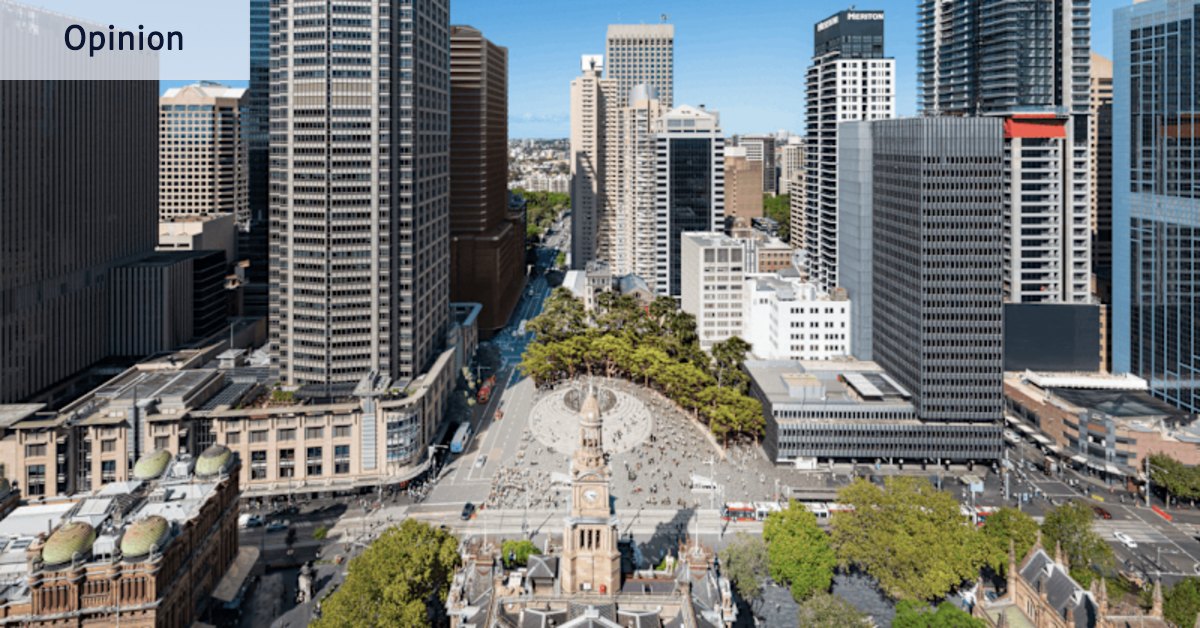
This new square sits in the heart of the city, and would be opposite the historic seat of the municipal government, itself an ornate sandstone civic monument. asserted
square → sit → government
Regarding the design – the geometry is an elegant resolution of a complex space and is appropriately aligned with the Town Hall spire. asserted
geometry → regard → spire
The trees, while adding much needed shade and greenery, could struggle to reach the density and maturity shown in the images, given the sunlight and environmental conditions of an urban setting. uncertain
trees → add → setting
Finally, a public space should have active edges, places where people can buy lunch, a coffee or a snack. asserted
people → have → lunch
Notwithstanding these minor quibbles, the City of Sydney is undertaking one of the greatest civic acts in making a public space for people. asserted
City → undertake → people
This is not a vanity project; it’s a legacy for future generations and shouldn’t be evaluated just on the financial cost. asserted
it → ’ → cost
It’s important that we continue to improve our cities for people. asserted
we → ’ → people
As we plan for the future let us remember the Greek proverb: “A society grows great when old men plant trees in whose shade they will never sit.” asserted
they → plan → trees
Now let our lord mayor plant trees for the people! asserted
mayor → let → people
Philip Vivian is an architect, urban designer and managing director of Bates Smart, a contributor to Town Hall Vision in Sydney 2030-2050. asserted
Vivian → manage → Sydney

💬Give feedback
🕘History 🎫Support