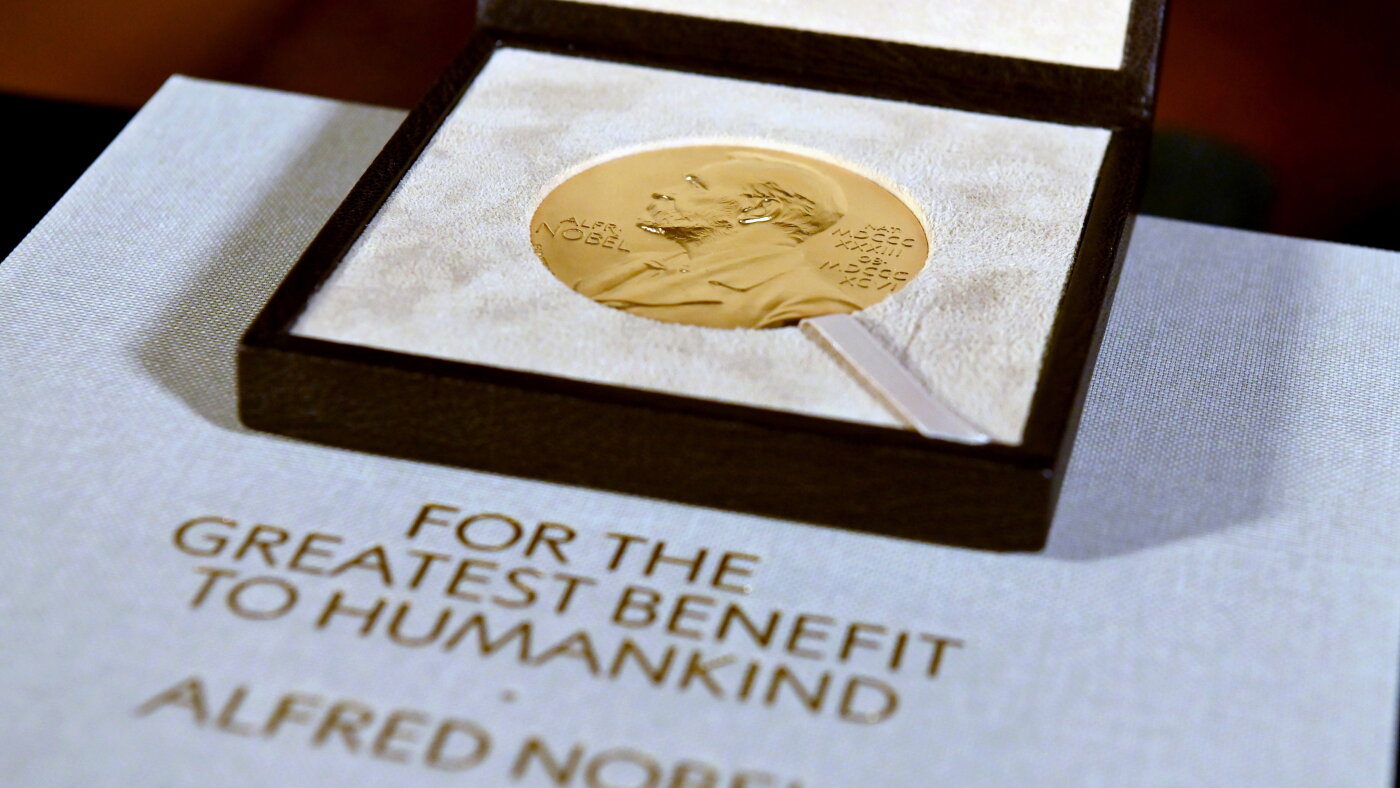
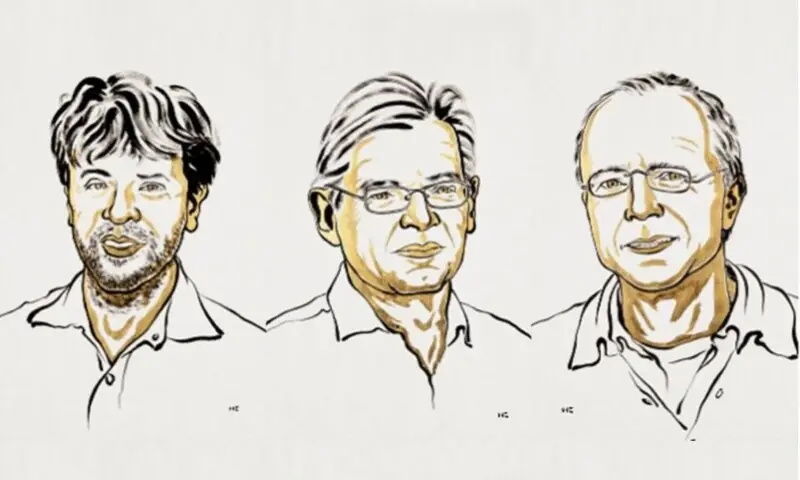
Photo via BBC News

'Ghost particles' from space telescope wins physics Nobel

Read the original at BBC News ↗
Cite

BBC News. (2026, October 6). 'Ghost particles' from space telescope wins physics Nobel. BBC News. https://www.bbc.co.uk/news/articles/cq203mymlvkeo?at_medium=RSS&at_campaign=rss

Dated when The Aporia collected the article, usually within hours of publication. Check the original for its exact date and byline.

BBC News · collected 2026-10-06 · by BBC News

Quick Summary

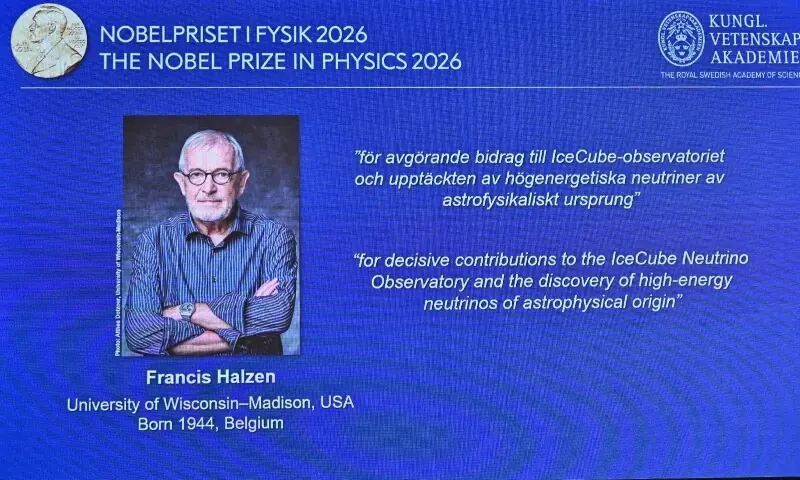
Belgian physicist Francis Halzen has received the Nobel Prize in Physics for his work on the IceCube observatory, located at the South Pole. The observatory uses a cubic kilometre of ice equipped with light sensors to detect cosmic neutrinos, which provide insights into high-energy phenomena in space. The Royal Swedish Academy of Sciences highlighted Halzen's visionary approach and leadership in developing this groundbreaking project, emphasizing its importance for understanding the distant universe.
Written by AI on 2026-10-06, from this article's own text only (the story summary below draws on all the coverage).

AI analysis

Story summary

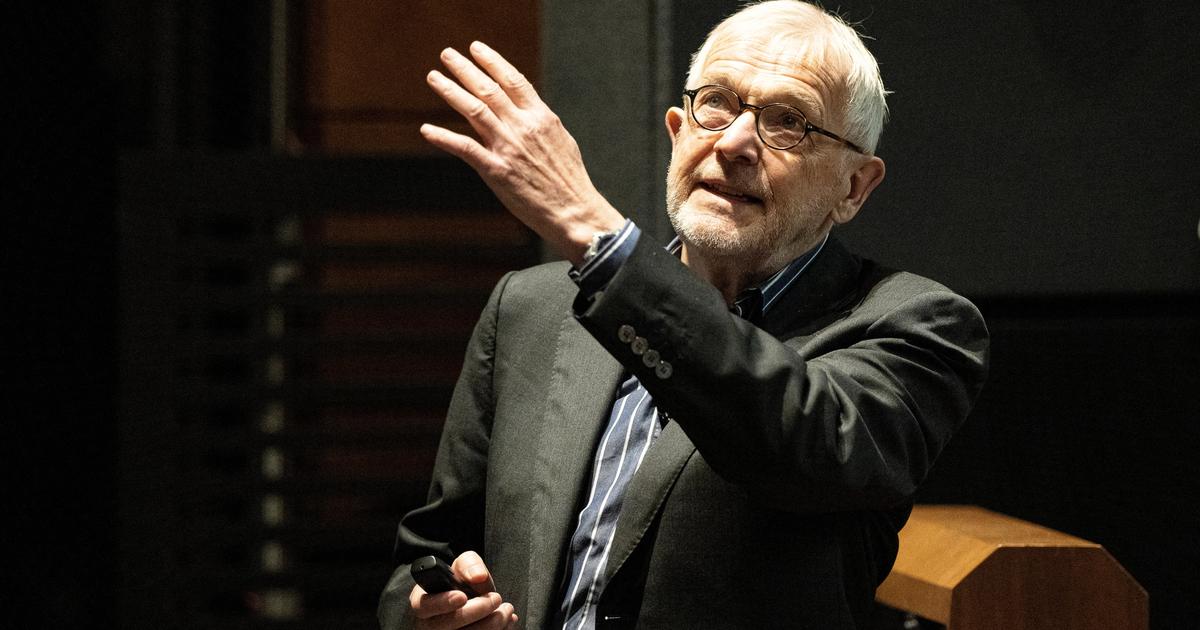
On Tuesday, Francis Halzen, a Belgian physicist and professor at the University of Wisconsin-Madison, was awarded the Nobel Prize in Physics for his groundbreaking work on the IceCube Neutrino Observatory located at the South Pole. The observatory uses a cubic kilometer of Antarctic ice to detect high-energy neutrinos from space, shedding light on distant cosmic phenomena. Halzen's contributions were recognized as "decisive" by the Royal Swedish Academy of Sciences, which noted his visionary approach and scientific leadership since first proposing the concept in 1988. The prize includes a sum of 12 million Swedish kronor (approximately $1.2 million).
Written for “Neutrino Research Nobel Prize” on 2026-11-01, grounded in this article and the 9 other(s) covering the same event.

Story

📰 Neutrino Research Nobel Prize
Science · 10 article(s) covering the same event. Compare every outlet's account →

Compared with similar articles

This article reads unscored and hedges 0% of its claims. Each row says how that neighbour differs.
Dawn
Hedges 1 of 19 claims Outlet record 72/100
Semafor
Hedges 1 of 4 claims Outlet record 60/100
NPR
Hedges 1 of 18 claims Outlet record 60/100
The Globe and Mail
Hedges 0 of 12 claims Outlet record 52/100
New York Post
Hedges 1 of 19 claims Outlet record 66/100
Dawn
Hedges 6 of 23 claims Outlet record 72/100
“Article A discusses potential winners including 'invisibility cloak' research, while Article B specifically reports on Prof Francis Halzen winning for his work with IceCube at the South Pole.”
How this article was measured signals, leaning charts, publisher record, byline, topics and claims

Signals How these are calculated →

Claims extracted
5
sentences that state something as happening or true
Uncertain
0%
0 of 5 hedged ("reportedly", "may", "according to")
Leaning
not political
takes no side on a contested political question
Publisher signals
68/100
BBC News's corrections and hedging, across everything collected from it. Not a measure of accuracy.
Outlets on this story
10
Science
Same framing elsewhere
1
articles that frame the event the way this one does
Analyzed 2026-10-06 · how these are computed

How this is being covered How these are calculated →

Article leaning vs. publisher reliability
Source leaning vs. consistency

Publisher

BBC News · 4818 article(s) · 6 correction(s) detected
Running correction rate · 6 correction(s)

Who wrote this

BBC News
204 article(s) here · 0 carrying a prediction
🔮 He warned that "things will not go back to the way they were," adding that the US had made clear it will no longer "bankroll" its European allies.
🔮 In the context of reindustrialisation, Burnham added this could be more devolution of innovation funding.
🔮 Richardson was also convicted of dangerous driving and will return to Manchester Minshull Street Crown Court to be sentenced on Monday.
2026-10-30 · assertive framing · Murderer dragged head teacher to his death in car
🔮 The Wildlife Trusts - a federation of 47 conservation charities - and Northumberland Wildlife Trust (NWT) plan to "enhance the rich natural heritage" of the Rothbury Estate, a 9,500-acre stretch of former grouse moor, woodland and farmland - having headed off fears it could be split among multiple owners.
2026-10-30 · assertive framing · Attenborough-backed appeal secures £30m estate
🔮 But Alfred Stewart had become a quick-tempered man, suffering from what would now be called post traumatic stress.
🔮 "We must firmly demand that the international community impose concrete sanctions against Rwanda and exert increased pressure, so that we may finally secure a lasting peace in our country," he said.
🔮 But if you were in the castle, which star would you play like?
🔮 This breaking news story is being updated and more details will be published shortly.
🔮 - Published Rapper Jay-Z will perform at the Super Bowl half-time show in February, the NFL has announced.
2026-10-27 · assertive framing · Jay-Z to perform at Super Bowl half-time show
🔮 Preliminary figures provided by Serbia's election commission indicated a record high turnout, which commentators had suggested would favour the student movement.
Wire or desk byline, not an individual reporter.
Also by BBC News
Nothing else under this byline is closely related to this article, so these are simply their most recent.
All 204 articles by BBC News →

Topics

Belgian The Royal Swedish Academy of Sciences

Subjects

Halzen ORG · 2× Belgian NORP · 1× Francis Halzen PERSON · 1× The Royal Swedish Academy of Sciences ORG · 1×

Narrative

- Published Belgian physicist Prof Francis Halzen has won the Nobel Prize in Physics for his pioneering work on an observatory that detects particles from space, shedding light on the distant universe.
framing: assertive · carried by 1 article(s) · first seen 2026-10-06
2026-10-06 · BBC News
'Ghost particles' from space telescope wins physics Nobel · assertive framing

Claims (5 extracted, 0 hedged)

- Published Belgian physicist Prof Francis Halzen has won the Nobel Prize in Physics for his pioneering work on an observatory that detects particles from space, shedding light on the distant universe. asserted
that → publish → universe
Halzen led the development of IceCube at the South Pole, which uses a cubic kilometre of Antarctic ice fitted with light sensors to detect particles called neutrinos. asserted
which → lead → particles
These carry information about violent, high-energy processes in the cosmos. asserted
These → carry → cosmos
The Royal Swedish Academy of Sciences said "his vision and scientific leadership have been fundamental for the IceCube Neutrino Observatory". asserted
vision → say → Observatory
Halzen first presented his vision for detecting neutrinos at the South Pole in 1988. asserted
Halzen → present → 1988
💬Give feedback
🕘History 🎫Support