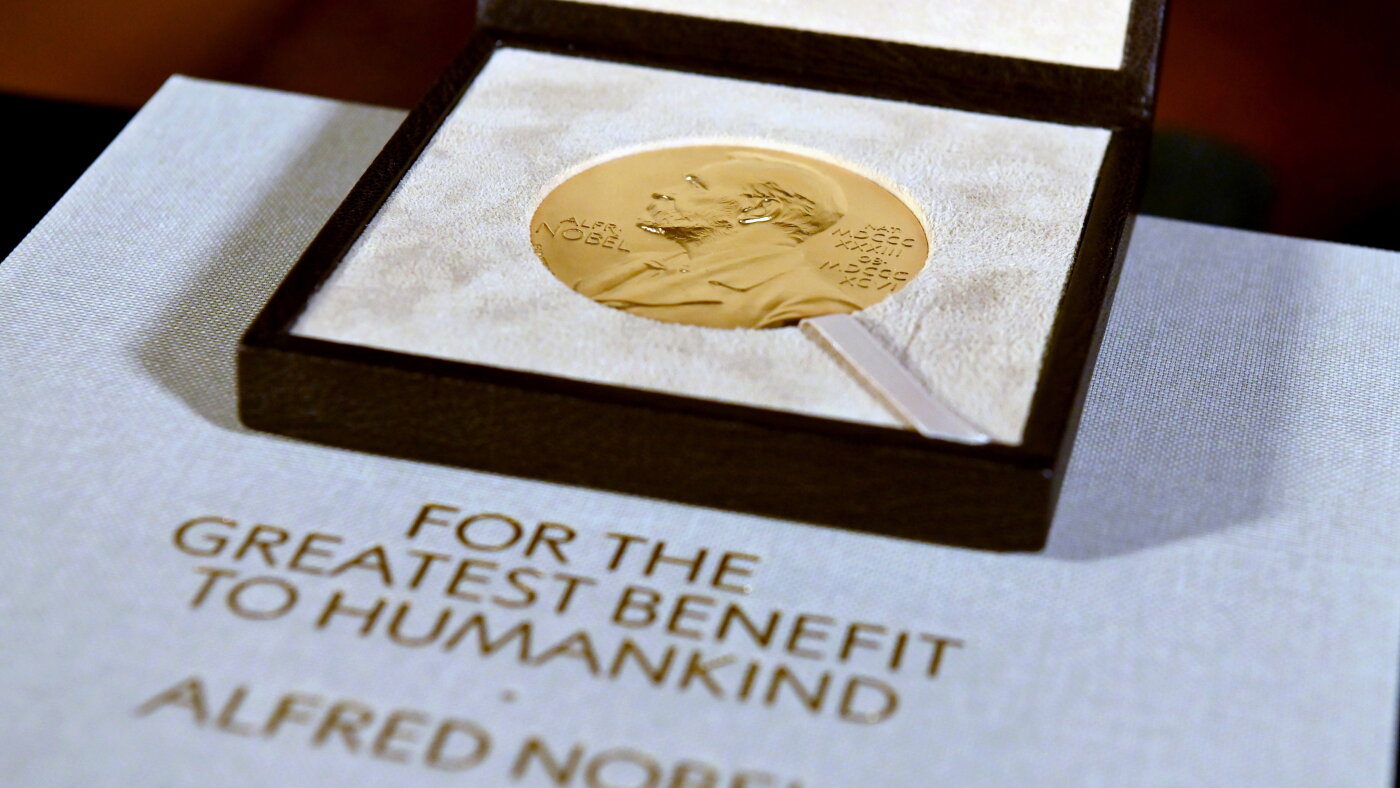
Photo via The Globe and Mail

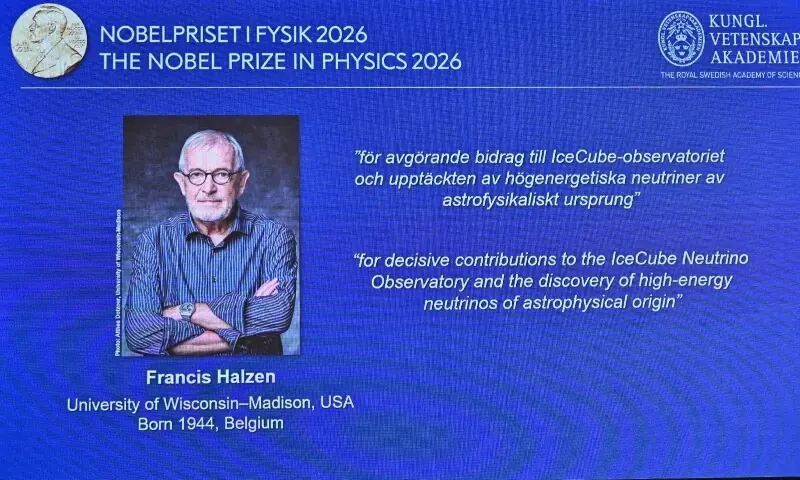
Neutrino experiment pioneer Francis Halzen wins Nobel Prize in Physics

Read the original at The Globe and Mail ↗
Cite

Semeniuk, I. (2026, October 6). Neutrino experiment pioneer Francis Halzen wins Nobel Prize in Physics. The Globe and Mail. https://www.theglobeandmail.com/canada/science/article-nobel-prize-physics-francis-halzen/

Dated when The Aporia collected the article, usually within hours of publication. Check the original for its exact date and byline.

The Globe and Mail · collected 2026-10-06 · by Ivan Semeniuk

Quick Summary

Francis Halzen, a University of Wisconsin-Madison professor, has been awarded the Nobel Prize in Physics for his pioneering work on the IceCube Neutrino Observatory at the South Pole. The observatory, completed in 2011 and using one cubic kilometer of Antarctic ice to detect high-energy neutrinos from space, marked a significant advancement in particle astrophysics. Halzen expressed surprise at winning, noting that many initially doubted the project's success when it began. This year’s prize follows previous recognitions for similar groundbreaking experiments, such as the 2015 award to Canadian scientist Arthur McDonald.
Written by AI on 2026-10-06, from this article's own text only (the story summary below draws on all the coverage).

AI analysis

Story summary

On Tuesday, Francis Halzen, a Belgian physicist and professor at the University of Wisconsin-Madison, was awarded the Nobel Prize in Physics for his groundbreaking work on the IceCube Neutrino Observatory located at the South Pole. The observatory uses a cubic kilometer of Antarctic ice to detect high-energy neutrinos from space, shedding light on distant cosmic phenomena. Halzen's contributions were recognized as "decisive" by the Royal Swedish Academy of Sciences, which noted his visionary approach and scientific leadership since first proposing the concept in 1988. The prize includes a sum of 12 million Swedish kronor (approximately $1.2 million).

Written for “Neutrino Research Nobel Prize” on 2026-11-01, grounded in this article and the 9 other(s) covering the same event.

Story

📰 Neutrino Research Nobel Prize
Science · 10 article(s) covering the same event. Compare every outlet's account →

Compared with similar articles

This article reads unscored and hedges 0% of its claims. Each row says how that neighbour differs.
New York Post
Hedges 1 of 19 claims Outlet record 66/100
NPR
Hedges 1 of 18 claims Outlet record 60/100
NBC News
Hedges 0 of 5 claims Outlet record 60/100
BBC News
Hedges 0 of 5 claims Outlet record 68/100
Dawn
Hedges 1 of 19 claims Outlet record 72/100
Semafor
Hedges 1 of 4 claims Outlet record 60/100
Dawn
Hedges 6 of 23 claims Outlet record 72/100
Toronto Star
Hedges 0 of 2 claims Outlet record 64/100
How this article was measured signals, leaning charts, publisher record, byline, topics and claims

Signals How these are calculated →

Claims extracted
12
sentences that state something as happening or true
Uncertain
0%
0 of 12 hedged ("reportedly", "may", "according to")
Leaning
not political
takes no side on a contested political question
Publisher signals
52/100
The Globe and Mail's corrections and hedging, across everything collected from it. Not a measure of accuracy.
Outlets on this story
10
Science
Same framing elsewhere
1
articles that frame the event the way this one does
Analyzed 2026-10-06 · how these are computed

How this is being covered How these are calculated →

Article leaning vs. publisher reliability
Source leaning vs. consistency

Publisher

The Globe and Mail · 1032 article(s) · 35 correction(s) detected
Running correction rate · 35 correction(s)

Who wrote this

Ivan Semeniuk
11 article(s) here · 1 carrying a prediction
🔮 Canada’s latest space traveller, Joshua Kutryk, may be far from home, but home is rarely out of sight, the astronaut said in his first conversation with reporters since arriving at the International Space Station.
🔮 “When I reflect on this moment I have to emphasize how lucky I was because when we started this project, everybody realized this was maybe a good idea but very few thought it would work, including myself.
🔮 Karl Deisseroth of Stanford University, Peter Hegemann of Humboldt University of Berlin and Georg Nagel of the University of Würzburg will share equally in the prize, worth approximately $1.74 million Canadian dollars.
🔮 Their arrival marks the start of a busy handoff period during which the population of the station will temporarily be at 11 – four of which will depart some time next week.
🔮 Once he arrives at the station, he is set to become the fourth Canadian astronaut to undertake a long-duration mission on the orbiting laboratory, which is expected to last about six months.
🔮 Canada’s next space traveller is fast approaching his scheduled departure – but the weather may have other ideas.
🔮 If someone threw a party for every type of mammal on Earth, a large portion of the guest list would be taken up by bats.
🔮 That one used to be so huge it would overhang along the edge,” says Larry Audlaluk, an elder who was a child when the Canadian government relocated his family in 1953 from northern Quebec to the hamlet, which is located 1,160 kilometres north of the Arctic Circle.
🔮 For some, this week’s news is another sign that, instead of competing with AI, their skills may be better put toward managing its risks.
🔮 Canadians are feeling the effects of climate change to a greater degree and facing more serious consequences than federal scientists projected less than a decade ago.
Also by Ivan Semeniuk
Nothing else under this byline is closely related to this article, so these are simply their most recent.
All 11 articles by Ivan Semeniuk →

Topics

Belgium Canadian KU-Leuven University of Wisconsin-Madison the Royal Swedish Academy of Sciences

Subjects

Halzen ORG · 4× Canadian NORP · 2× Arthur McDonald PERSON · 1× Belgium GPE · 1× Francis Halzen PERSON · 1× KU-Leuven ORG · 1× Sudbury GPE · 1× University of Wisconsin-Madison ORG · 1× Wisconsin GPE · 1× the Royal Swedish Academy of Sciences ORG · 1×

Narrative

Using a one cubic kilometre volume of the Antarctic ice sheet as its detection medium, the experiment has been able to spot flashes of light that occur when high-energy neutrinos from the distant universe occasionally interact with atoms in the ice.
framing: assertive · carried by 1 article(s) · first seen 2026-10-06
🔮 “When I reflect on this moment I have to emphasize how lucky I was because when we started this project, everybody realized this was maybe a good idea but very few thought it would work, including myself.
2026-10-06 · The Globe and Mail
Neutrino experiment pioneer Francis Halzen wins Nobel Prize in Physics · assertive framing

Claims (12 extracted, 0 hedged)

Francis Halzen, a University of Wisconsin-Madison professor who pioneered the detection of ghostly particles from outer space has been awarded the Nobel Prize in Physics. asserted
who → pioneer → Physics
On Tuesday, members of the Royal Swedish Academy of Sciences announced that Dr. Halzen is the sole winner of this year’s physics prize. asserted
Halzen → announce → prize
Dr. Halzen is best known for his work establishing the IceCube Neutrino Observatory at the South Pole. asserted
Halzen → know → Pole
Using a one cubic kilometre volume of the Antarctic ice sheet as its detection medium, the experiment has been able to spot flashes of light that occur when high-energy neutrinos from the distant universe occasionally interact with atoms in the ice. asserted
neutrinos → use → ice
Completed in 2011, the experiment ushered in a new era of particle astrophysics. asserted
experiment → complete → astrophysics
“It was a great surprise,” said Dr. Halzen when reached by phone during the announcement. asserted
Halzen → say → announcement
“When I reflect on this moment I have to emphasize how lucky I was because when we started this project, everybody realized this was maybe a good idea but very few thought it would work, including myself. asserted
it → reflect → myself
Born in Belgium in 1944, Dr. Halzen received his PhD from KU-Leuven university in 1969. asserted
Halzen → bear → 1969
In 1971, he began his research career in Wisconsin where he continues to lead the IceCube project asserted
he → begin → project
This year’s physics prize recalls the 2015 physics Nobel when Canadian scientist Arthur McDonald was named a co-recipient for leading an earlier neutrino experiment built in a mine under Sudbury, Ont. asserted
McDonald → recall → Sudbury
With today’s announcement, the physics prize has been awarded 120 times to 230 individuals since it was established in 1901. asserted
it → award → 1901
The most recent Canadian winner was Geoffrey Hinton, a University of Toronto professor and pioneer of artificial intelligence who was awarded the physics Nobel in 2024 for is work on neural networks. asserted
who → award → networks
💬Give feedback
🕘History 🎫Support