Photo via Los Angeles Times

War was supposed to crush Iran's 'Axis of Resistance.' Instead, it's bloodied but unbroken

Read the original at Los Angeles Times ↗
Cite

Bulos, N. (2026, September 6). War was supposed to crush Iran's 'Axis of Resistance.' Instead, it's bloodied but unbroken. Los Angeles Times. https://www.latimes.com/world-nation/story/2026-08-18/war-has-left-irans-axis-of-resistance-bloodied-but-unbroken

Dated when The Aporia collected the article, usually within hours of publication. Check the original for its exact date and byline.

Los Angeles Times · collected 2026-09-06 · by Nabih Bulos

Quick Summary

The US-led war against Iran's "Axis of Resistance" was supposed to weaken or eliminate its proxies in the Middle East, but nearly six months into the conflict, these groups have shown surprising resilience. Analysts say the axis' locally based fighters and shared battlefield know-how create a durable challenge for Washington and its allies. Despite some losses, key members such as Hamas and Hezbollah remain in place, and the Islamic Republic has even gained leverage by closing the Strait of Hormuz. The axis is now considered stronger than ever, with one Iranian parliament member claiming it's "in the strongest condition they have ever been in the history of their resistance."
Written by AI on 2026-09-07, from this article's own text only (the story summary below draws on all the coverage).

AI analysis

Story summary

Mohammad Ghaemi, an analyst, stated that Iran views its military actions primarily as a means for coercive negotiation rather than as a standalone objective. Iran's foreign minister is set to meet with Gulf state ministers in Oman next week to discuss ensuring the safety of commercial shipping through the Strait of Hormuz, though any agreement would likely require U.S. approval due to the ongoing naval blockade against Iran.

U.S. President Donald Trump declared that the war with Iran will end immediately after the midterms on November 3, asserting his defense of military actions aimed at preventing Tehran from developing a nuclear weapon. Despite these assurances, rising oil prices—Brent crude reached over $100 per barrel—are expected to negatively impact Republicans' electoral chances in upcoming midterms.

Vice President J.D. Vance confirmed that the U.S. is investigating reports of civilian casualties during a recent strike on a wedding celebration in Iran's Kuhestak region, where at least five people were killed and dozens injured. Iranian state media reported the incident, while Reuters independently verified footage showing a residential building attack during a wedding.

The United States and Iran have exchanged missile and drone attacks this week after an earlier lull in hostilities since July. Reports indicate that six Iranian military personnel, including three pilots, died in U.S.-led airstrikes; however, the U.S. has expressed skepticism about these casualty claims from Iranian state media. The investigation into the wedding strike is ongoing.

Oil prices surged following escalating conflicts between the United States and Iran. Brent crude reached its highest since May 22 at $101.21 per barrel on September 9, while West Texas Intermediate settled at $96.05. Despite these price increases, major oil companies like Chevron Corporation, TotalEnergies SE, Exxon Mobil Corporation, Eni S.p.A., and BP p.l.c. have been trading assets rather than adding new drilling operations in response to geopolitical tensions.

Written for “Iran Attacks After US Hits Tankers” on 2026-10-31, grounded in this article and the 107 other(s) covering the same event.

Story

📰 Iran Attacks After US Hits Tankers
Politics · 108 article(s) covering the same event. See how they differ ↓

Compared with similar articles

This article reads leans left and hedges 2% of its claims. Each row says how that neighbour differs.
Dawn
⚖️ Leans strongly right further right than this Hedges 12 of 30 claims Outlet record 72/100
Al Jazeera
⚖️ Leans left Hedges 7 of 55 claims Outlet record 60/100
The Independent
Hedges 1 of 16 claims Outlet record 59/100
ABC News (AU)
⚖️ Leans right further right than this Hedges 2 of 23 claims Outlet record 68/100
“The articles mention war on Iran but report different aspects of it: one discusses Iran's retaliation threat and its establishment of a 'prohibited zone', while the other focuses on the impact of the war on Iran's proxies”
Al Jazeera
Hedges 5 of 31 claims Outlet record 60/100
“Article A describes Iranian tankers being hit by US military force, while Article B discusses the impact of war on Iran's proxies in the Middle East and their resilience”
Los Angeles Times
Hedges 5 of 47 claims Outlet record 95/100
CBS News
Hedges 32 of 290 claims Outlet record 66/100
“Article A discusses a general assessment of Iran's 'Axis of Resistance' after nearly six months of war, while Article B specifically reports on an incident where Iranian strikes damaged US jets in Jordan”
Euronews
Hedges 2 of 60 claims Outlet record 60/100
“Article A discusses the military impact of the war on Iran's proxies, while Article B focuses on its economic impact on Iranian citizens”
Deutsche Welle
⚖️ Leans left Hedges 10 of 45 claims Outlet record 95/100
Persuasion
⚖️ Leans left Hedges 1 of 45 claims
“Article A discusses general US foreign policy mistakes, while Article B focuses on a specific conflict with Iran and its proxies”
How this article was measured signals, leaning charts, publisher record, byline, topics and claims

Signals How these are calculated →

Claims extracted
45
sentences that state something as happening or true
Uncertain
2%
1 of 45 hedged ("reportedly", "may", "according to")
Leaning
Leans left
of the writing, not the subject · beta estimate
Publisher signals
95/100
Los Angeles Times's corrections and hedging, across everything collected from it. Not a measure of accuracy.
Outlets on this story
108
Politics
Same framing elsewhere
1
articles that frame the event the way this one does
Analyzed 2026-09-07 · how these are computed

How this is being covered How these are calculated →

Article leaning vs. publisher reliability
Source leaning vs. consistency

Publisher

Los Angeles Times · 252 article(s) · 0 correction(s) detected
No corrections detected for this publisher. That may mean careful reporting, or simply that nothing has been checked.

Who wrote this

Nabih Bulos
9 article(s) here · 1 carrying a prediction
🔮 The lineup was announced months ago, with top-flight stars in tennis, DJing, comedy and more set to descend on the Saudi capital for a 10-week run of events known as Riyadh Season.
🔮 The operation would continue, he said, “until the country is liberated from the control of terrorist militias.”
🔮 For decades, the relationship between Saudi Arabia and the U.S. has centered on an often-mentioned but rarely tested supposition: If the kingdom were attacked, America would come to its rescue.
🔮 Central Command said the anti-ISIS mission would continue, with the coalition now headquartered in Jordan.
🔮 “You hear so much about Bab el-Mandeb, you’d think we would be like New York, with skyscrapers and money,” said Saleh, a 58-year-old resident who, like all people interviewed here, refused to give their full name to avoid reprisals.
🔮 BEIRUT — It had been one year, eight months and 27 days since Atallah al-Drimly said goodbye to his son that Saturday morning in 2024, when Mahmoud insisted he could no longer stay away from the home he had fled and started walking north toward Gaza City.
🔮 They entered the depots and stole everything they could,” said Umaima Abdul-Rahman Al-Sanusi, one of the museum’s curators, as her eyes scanned a shattered display case.
🔮 The thinking was that with the axis’ “tentacles” weakened, if not vanquished, all that would remain, as Israeli and U.S. officials often said, would be the “head of the octopus” — Iran. But it now appears reports of the axis’ unraveling are exaggerated.
🔮 - Click here to listen to this article - - Iranian officials downplayed the significance of the pressure campaign, and suggested it could shut down all oil exports through the Strait of Hormuz. -
Also by Nabih Bulos
Nothing else under this byline is closely related to this article, so these are simply their most recent.
All 9 articles by Nabih Bulos →

Topics

Hamas Hezbollah Iran Syria U.S.

Subjects

Iran GPE · 10× Israel GPE · 6× U.S. GPE · 6× Hamas ORG · 5× Hezbollah ORG · 4× Syria GPE · 4× Gaza GPE · 2× Israeli NORP · 2× Lebanon GPE · 2× Yemen GPE · 2×

Narrative

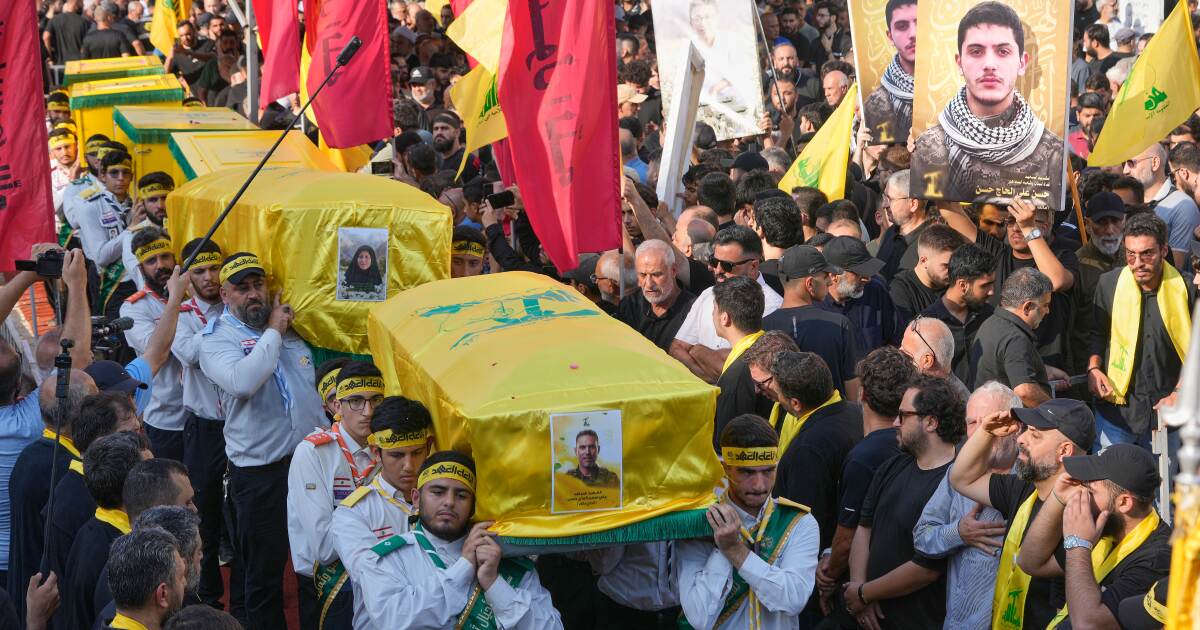
Hamas and Hezbollah remain stubbornly in place, with the latter maintaining its lethality, even as Iraqi militias — defying Baghdad’s attempts at defanging them — have launched attacks on America’s Persian Gulf allies. And though Assad has been ousted from Syria, the Houthis in Yemen now threaten to restart their long-running feud with Saudi Arabia and seal another crucial choke point — the Bab al Mandab strait linking the Red Sea and Gulf of Aden.
framing: assertive · carried by 1 article(s) · first seen 2026-09-07
🔮 The thinking was that with the axis’ “tentacles” weakened, if not vanquished, all that would remain, as Israeli and U.S. officials often said, would be the “head of the octopus” — Iran. But it now appears reports of the axis’ unraveling are exaggerated.

Claims (45 extracted, 1 hedged)

War was supposed to crush Iran’s ‘Axis of Resistance.’ asserted
War → suppose → Resistance
Instead, it’s bloodied but unbroken - Click here to listen to this article - - One goal of the war on Iran was to weaken, if not eliminate, its proxies in the Middle East, such as Hezbollah in Lebanon and Hamas in Gaza. asserted
goal → ’ → Gaza
Iran’s proxies have definitely been weakened in nearly six months of war, but they also have proved to be surprisingly resilient. - asserted
they → weaken → war
Analysts say the axis’ locally based fighters and shared battlefield know-how create a durable, multifront challenge that Washington and its allies struggle to confront. asserted
Washington → say → that
When the U.S. launched the Iran war nearly six months ago, it was to be the coup de grace in dismantling the “Axis of Resistance,” an Iran-led alliance of armed groups and governments arrayed against the United States and Israel. asserted
it → launch → States
The axis included not just the militant groups Hamas and Hezbollah, but Yemen’s Houthi rebels, militias in Syria and Iraq and the government of Syria’s then-dictator Bashar Assad. asserted
axis → include → dictator
The thinking was that with the axis’ “tentacles” weakened, if not vanquished, all that would remain, as Israeli and U.S. officials often said, would be the “head of the octopus” — Iran. But it now appears reports of the axis’ unraveling are exaggerated. asserted
reports → weaken → unraveling
The Islamic Republic, far from capitulating under the U.S. and Israel’s withering assault, has compounded its leverage by closing the Strait of Hormuz. asserted
Republic → capitulate → Hormuz
Hamas and Hezbollah remain stubbornly in place, with the latter maintaining its lethality, even as Iraqi militias — defying Baghdad’s attempts at defanging them — have launched attacks on America’s Persian Gulf allies. And though Assad has been ousted from Syria, the Houthis in Yemen now threaten to restart their long-running feud with Saudi Arabia and seal another crucial choke point — the Bab al Mandab strait linking the Red Sea and Gulf of Aden. asserted
Houthis → remain → Aden
Such a move would further roil already skittish energy markets. asserted
move → roil → markets
A day after Trump hailed the two-week ceasefire, reversing course on his threat to escalate, the only country spared from attack appeared to be Iran itself. “Never has the Resistance Axis been as strong as it is today,” wrote Ali Khezrian, a hard-liner who is a member of the Iranian parliament’s National Security and Foreign Policy Committee, in a post on X on Saturday. asserted
who → hail → Saturday
Though Syria was a big loss “that must be compensated,” he said, the rest of the axis’ members were “in the strongest condition they have ever been in the history of their resistance.” asserted
they → compensate → resistance
Analysts say statements such as Khezrian’s overstate the case, but they nevertheless acknowledge the axis has proved more resilient than expected. asserted
axis → say → case
Although there is little doubt the axis is diminished compared with what it was a few years ago, “there’s now a period of a slow dawning realization that the way it’s built has made it able to match the moment,” said Peter Salisbury, a professor at Columbia University’s School of International and Public Affairs who recently published a report on the axis’ evolution for the Century Foundation think tank. asserted
who → be → tank
In June, the U.S. and Iran signed a memorandum of understanding that called for a 60-day end of hostilities to allow time to negotiate an end to the conflict. asserted
that → sign → conflict
The memorandum expired Monday and efforts to end the war appear to be at a standstill. asserted
efforts → expire → standstill
But when the U.S. and Israel attacked Iran on Feb. 28, it appeared to be an opportune moment to strike. asserted
it → attack → Feb.
For decades, Tehran had poured billions of dollars funding, training and arming militias across the Middle East that shared its enmity toward the U.S. and Israel, establishing what analysts called a “ring of fire” around Israel, along with a forward line of defense that would help defend Iran in case of American or Israeli attack. But after the Hamas-led attack on Oct. 7, 2023, Israel went on the offensive. asserted
Israel → pour → offensive
Even as it annihilated Hamas in Gaza, it pummeled Hezbollah in Lebanon, decimating the group’s much-vaunted arsenal and killing the upper echelons of its leadership. asserted
it → annihilate → leadership
Since an October ceasefire, Israel has shifted the Yellow Line west, boosting its control from 53% to about 64% of the Gaza Strip. asserted
Israel → shift → Strip
When the Houthis began hitting Israel and Red Sea shipping, the U.S. deployed its navy to fight back, leading the rebel group to accept a truce, and Israeli strikes forced the group’s senior leaders underground. asserted
strikes → begin → leaders
In Iraq, militias did little more than the occasional halfhearted attack on U.S. bases in the country. asserted
militias → do → country
Assad’s Syria, meanwhile, collapsed in 2024 under the weight of a rebel offensive, denying Tehran an essential land corridor to Hezbollah and the only state partner in the axis aside from Iran. “Our actions are taking apart the axis brick by brick,” said a triumphant-sounding Israeli Prime Minister Benjamin Netanyahu near the end of 2024. asserted
Minister → collapse → 2024
By June 2025, Netanyahu and President Trump had launched the 12-day war against Iran, and with only a feeble response from the axis’ other members, the decades of blood and treasure Iran invested in the axis seemed a waste. asserted
Iran → launch → axis
Then in February, Netanyahu attacked once more, Trump in tow. asserted
Trump → attack → tow
All of which is why the axis’ resurgence has come as a surprise. asserted
resurgence → come → surprise
Since the start of Epic Fury, as the war on Iran was called, the various axis members have swung into action: Iraqi militias have lobbed drones and rockets on U.S. bases in the country and have been blamed for attacks on Saudi Arabia, a claim they deny. uncertain
they → call → Arabia
The Houthis, though they mostly stayed out of the fight in the beginning, started their own blockade on Saudi shipping in July. asserted
they → stay → July
Iran says it is working to finalize a joint statement with Oman on a plan to manage shipping through the Strait of Hormuz. asserted
it → say → Hormuz
But the most unexpected turn has come from Hezbollah. asserted
turn → come → Hezbollah
Thought to be an all but spent force only a few months ago, it has put up a vigorous defense against Israel’s ground invasion in Lebanon, incorporated new tactics and weapons — including drones — in its combat doctrine. asserted
it → think → doctrine
It also appears to have largely sidestepped the Israeli intelligence infiltration that killed its senior leadership in recent years. asserted
that → appear → years
That regeneration power, said Ramzy Mardini, the founder of Geopol Labs, a Middle East-based geopolitical risk advisory firm, is the central and most important characteristic of the axis. asserted
Mardini → say → axis
Although many dismiss the members as mere proxies of Iran, they are instead “deeply rooted groups embedded within social bases, political movements and state institutions.” asserted
they → dismiss → bases
“What looks like a resurgence is better understood as resilience. asserted
looks → look → resilience
These organizations have the capacity to absorb enormous losses, adapt, and revive their capabilities and membership, even when it appears they have been permanently degraded or destroyed,” Mardini said. asserted
Mardini → have → capabilities
“We tend to assume their resilience and capabilities are externally procured when, in fact, much of that power is locally produced,” he said. asserted
he → tend → power
Salisbury agreed, adding that axis members are also able to call on the pool of knowledge shared among them; experience fielding weapons in one theater can inform fighting in another. asserted
experience → agree → another
The collective result has been a multifront conundrum that the U.S. and Israel cannot easily solve without incurring costs their allies are unwilling to bear. asserted
allies → solve → costs
“Iran has a hybrid strategy in the current war,” wrote Mahdi Mohammadi, a senior advisor to Iran’s chief negotiator, in a post on X. “We are not fighting on one front and we are not using one tool. asserted
we → have → tool
…and 5 more, not listed.

💬Give feedback
🕘History 🎫Support