Photo via Toronto Star

How Canada's fractured immigration consensus is starting to show up at ballot boxes

Read the original at Toronto Star ↗
Cite

Baxter, D. (2026, October 17). How Canada's fractured immigration consensus is starting to show up at ballot boxes. Toronto Star. https://www.thestar.com/politics/federal/how-canada-s-fractured-immigration-consensus-is-starting-to-show-up-at-ballot-boxes/article_07018eb3-ee35-5506-9eff-fe8a7a7c0ada.html

Dated from the outlet's own feed. Check the original for its byline.

Toronto Star · collected 2026-10-17 · by David Baxter

Quick Summary

In Canada, growing concerns about immigration are influencing electoral politics. The Parti Québécois won a minority government in Quebec with promises of tighter immigration controls linked to preserving French culture and easing pressure on public services and housing. In Alberta, voters will face ballot questions proposed by Premier Danielle Smith’s government, including more provincial control over economic immigration and restrictions on accessing services for non-permanent residents. Jason Kenney advocates for a fact-based national debate on immigration but warns against it becoming racially charged. Some community leaders oppose the ballot measures, concerned about their impact on immigrant communities.
Written by AI on 2026-10-17, from this article's own text only (the story summary below draws on all the coverage).

AI analysis

Story summary

As of October 17, 2026, Canada's long-standing consensus on immigration is fracturing due to a surge in new arrivals post-pandemic and affordability challenges. This division is evident in recent elections: the Parti Québécois won a minority mandate in Quebec with promises of tighter immigration controls linked to protecting French culture and easing pressure on public services and housing. In Alberta, voters are set to answer five questions on immigration proposed by Premier Danielle Smith's government when they vote on whether to hold a future referendum on separation from Canada. These questions include whether the province should have more control over economic immigration, restrict provincially funded services to citizens and permanent residents with "Alberta-approved" status, charge non-permanent immigrants fees for accessing health care and education, require non-permanent residents to reside in Alberta for at least 12 months before qualifying for social supports, and mandate proof of citizenship when voting provincially.

Written for “Canadian Immigration Consensus Fractures” on 2026-11-04, grounded in this article and the 0 other(s) covering the same event.

Story

📰 Canadian Immigration Consensus Fractures
Politics · 1 article(s) covering the same event.

Compared with similar articles

This article reads leans right and hedges 2% of its claims. Each row says how that neighbour differs.
The Globe and Mail
⚖️ Leans left further left than this Hedges 1 of 39 claims Outlet record 52/100
“The articles discuss different aspects of the broader political situation in Canada: one focuses on Prime Minister Carney's campaign to urge Albertans to vote against separation, while the other discusses how immigration policies are influencing votes across various regions including Quebec.”
The Globe and Mail
⚖️ Leans left further left than this Hedges 3 of 51 claims Outlet record 52/100
“The articles discuss different political contexts and events in Quebec and Alberta, not the same specific incident.”
CBC News
Hedges 2 of 44 claims Outlet record 74/100
“The articles discuss different topics: one focuses on family relationships strained by Alberta separatism debates, while the other addresses how immigration policies are influencing political outcomes across Canada.”
Global News
Hedges 6 of 31 claims Outlet record 63/100
“The articles discuss different events: one about the Parti Québécois winning in Quebec and immigration policies, while the other is about an upcoming referendum in Alberta on separation from Canada.”
Global News
Hedges 5 of 25 claims Outlet record 63/100
“The articles discuss different events related to political votes in Canada, one about Quebec's election focusing on immigration and the other about an Alberta referendum on separation.”
The Guardian
Hedges 9 of 66 claims Outlet record 66/100
“The articles describe different aspects of upcoming votes in Canada, one focusing on Quebec's election results and another on Alberta's referendum vote.”
NPR
Hedges 5 of 54 claims Outlet record 60/100
“Article A mentions Albertans voting on whether to hold a future referendum, while Article B describes the actual vote taking place on Monday.”
The Guardian
⚖️ Leans left further left than this Hedges 5 of 22 claims Outlet record 66/100
“The articles describe different events: one discusses Quebec's election results and promises of tighter immigration controls, while the other covers Alberta's referendum vote rejecting a process towards independence.”
Toronto Star
⚖️ Leans left further left than this Hedges 4 of 41 claims Outlet record 64/100
“The articles describe different voting events: one in Quebec regarding tighter immigration controls and another in Alberta about remaining in Canada.”
Global News
⚖️ Leans strongly right further right than this Hedges 12 of 52 claims Outlet record 63/100
“The articles refer to different events within the broader context of political changes in Canada, one about the Parti Québécois victory in Quebec and the other about a referendum in Alberta.”
How this article was measured signals, leaning charts, publisher record, byline, topics and claims

Signals How these are calculated →

Claims extracted
55
sentences that state something as happening or true
Uncertain
2%
1 of 55 hedged ("reportedly", "may", "according to")
Leaning
Leans right
of the writing, not the subject · beta estimate
Publisher signals
64/100
Toronto Star's corrections and hedging, across everything collected from it. Not a measure of accuracy.
Outlets on this story
1
Politics
Same framing elsewhere
1
articles that frame the event the way this one does
Analyzed 2026-10-17 · how these are computed

How this is being covered How these are calculated →

Article leaning vs. publisher reliability
Source leaning vs. consistency

Publisher

Toronto Star · 11416 article(s) · 28 correction(s) detected
Running correction rate · 28 correction(s)
2026-10-26
Correction
2026-10-24
Correction
2026-10-07
Correction
2026-09-24
Correction

Who wrote this

David Baxter
27 article(s) here · 1 carrying a prediction
🔮 OTTAWA - The annual immigration levels update will be included in the federal budget being released Thursday, a government source with knowledge of the plan confirmed.
🔮 MONTREAL - A major summit Prime Minister Mark Carney is hosting with European Union leaders is set to conclude today with announcements on digital trade and academic exchanges.
🔮 OTTAWA - Prime Minister Mark Carney is set to welcome European Commissioner Ursula von der Leyen to Montreal today after months of pursuing closer ties with the EU.
🔮 A stronger alliance between Canada and the European Union would only include a financial commitment if either side joins specific programs in either jurisdiction, a senior government official said Wednesday.
🔮 Canada and the EU are expected to use the summit to announce a new agreement that could touch on a number of issues including labour, critical minerals and energy.
🔮 Prime Minister Mark Carney said Wednesday the government “will not budge” on its goal of making immigration numbers sustainable and its plan is “getting them to that level now.”
🔮 “If you listen to the key separatist leaders like Mitch Sylvestre, who’s the leader of the primary separatist organization, he says that in his republic of Alberta, no one will have citizenship unless you’re born there,” Kenney said.
🔮 The policies, which will take effect on Nov. 3, will apply to applicants who already have Canadian work experience, or who have a job offer in a high-wage field such as engineering.
🔮 OTTAWA - Conservative Leader Pierre Poilievre said Friday he will be in Alberta next week to deliver a speech on Canadian unity ahead of the province’s referendum on separation.
Also by David Baxter
EU alliance name doesn't matter, Carney says
2026-10-29 · The Globe and Mail
Nothing else under this byline is closely related to this article, so these are simply their most recent.
All 27 articles by David Baxter →

Topics

Alberta Canada Canadian OTTAWA The Parti Québécois

Subjects

Alberta GPE · 10× Kenney PERSON · 4× Canada GPE · 3× Danielle Smith PERSON · 2× Albertans NORP · 1× Canadian NORP · 1× French NORP · 1× OTTAWA GPE · 1× Quebec GPE · 1× The Parti Québécois ORG · 1×

Narrative

Those questions include: — Should the province should have more say over economic immigration? — Should provincially funded services should be restricted to citizens, permanent residents and those with “Alberta-approved” immigration status? — Should non-permanent immigrants should be charged a fee for accessing health care and education services? — Should non-permanent residents should have to reside in Alberta for at least 12 months before qualifying for provincially funded social supports? — Should voters should have to present proof of citizenship when voting provincially?
framing: assertive · carried by 1 article(s) · first seen 2026-10-17
🔮 “If you listen to the key separatist leaders like Mitch Sylvestre, who’s the leader of the primary separatist organization, he says that in his republic of Alberta, no one will have citizenship unless you’re born there,” Kenney said.

Claims (55 extracted, 1 hedged)

It’s no secret the long-held Canadian consensus on immigration has fractured — pulled apart by a rapid increase in new arrivals post-pandemic and growing affordability challenges. asserted
consensus → ’ → arrivals
Now, that fracture is starting to show up at the ballot box. asserted
fracture → start → box
The Parti Québécois won a minority mandate in Quebec on a platform that included promises of tighter immigration controls, which the party linked to protecting French culture and easing pressure on public services and housing. asserted
party → win → services
And when Albertans head to the polls Monday to vote on whether to hold a future referendum on separation from Canada, they’ll also be answering five separate questions on immigration being pushed by the government of Alberta Premier Danielle Smith. asserted
they → head → Smith
Those questions include: — Should the province should have more say over economic immigration? — Should provincially funded services should be restricted to citizens, permanent residents and those with “Alberta-approved” immigration status? — Should non-permanent immigrants should be charged a fee for accessing health care and education services? — Should non-permanent residents should have to reside in Alberta for at least 12 months before qualifying for provincially funded social supports? — Should voters should have to present proof of citizenship when voting provincially? asserted
voters → include → citizenship
Jason Kenney, a former Alberta premier and federal immigration minister, said Canada needs a broader debate on immigration policy based on facts. asserted
Canada → say → facts
“We do need a serious debate on immigration because demography is destiny. asserted
demography → need → immigration
There are very few things that are more important,” Kenney told The Canadian Press in an interview. asserted
Kenney → be → interview
“But we have to do it in a disciplined and respectful, thoughtful way, as much as possible, based on evidence and data and experience around the world.” asserted
we → have → world
Kenney warned that debates on immigration policy can easily become sidetracked by more extreme political views — by accusations of racism from the far left and by actual racism on the far right. asserted
debates → warn → right
While Kenney said he doesn’t see the immigration questions on the Alberta ballot as race-based or xenophobic, the Alberta separatist movement itself is something else entirely. asserted
movement → say → ballot
“If you listen to the key separatist leaders like Mitch Sylvestre, who’s the leader of the primary separatist organization, he says that in his republic of Alberta, no one will have citizenship unless you’re born there,” Kenney said. asserted
Kenney → listen → citizenship
“So I do think there are some currents on the extreme right of Alberta politics that we should all be concerned about. asserted
we → think → that
I do not think that necessarily means we cannot have an adult, grown-up conversation about immigration policy. asserted
we → think → policy
But the immigration questions on the ballot are not sitting well with some diaspora communities in the province. asserted
questions → sit → province
Lawyer Avnish Nanda, co-founder of the advocacy group Our Alberta Advantage, is campaigning for people to vote “no” on the immigration-related questions. asserted
people → campaign → questions
He said reactions to the questions from Alberta’s cultural communities and from individuals who have considered running for the United Conservative Party have been overwhelmingly negative. asserted
who → say → Party
“They view these questions as targeting them, their journey here and the roots they’ve established over the past 60 years,” he said. asserted
he → view → years
They think this is not necessary. asserted
this → think → ?
They think it’s wrapped up in the separatism effort. asserted
it → think → effort
They think that Danielle Smith is scapegoating them to continue to maintain the support of the more extreme separatist elements that brought her to power.” asserted
that → think → power
Nanda said the referendum is bringing out some ugly undercurrents in Alberta. asserted
referendum → say → Alberta
He said his parents were recently “jeered by a couple of white guys in a car” while out for a walk — something that had never happened to them since coming to Canada in the 1970s. asserted
that → say → 1970s
“There’s a notion that it impacts us all, whether you’re a citizen or not, these questions,” he said. asserted
he → ’ → questions
“Because the people who are mobilized around this issue, in support of it, a lot of them don’t differentiate between people who have been here 40 years [and] people who came here a week ago, because we all look the same to them.” asserted
we → mobilize → them
Nanda said if the immigration ballot measures pass on Monday, they could undermine Canada’s multicultural identity, while restricting access to provincial services would make it harder for newcomers to integrate. uncertain
newcomers → say → services
Across the country in Quebec, the new minority Parti Québécois government campaigned on a promise to tighten immigration controls. asserted
government → campaign → controls
Quebec has maintained far more control over the immigration system than other provinces since 1991. asserted
Quebec → maintain → 1991
The PQ immigration platform included, among other things, promises to reduce annual permanent resident admissions from 45,000 to 35,000, to impose a moratorium on permanent immigration from outside Quebec, to prioritize permanent status for temporary residents already in the province, and to tighten the selection criteria for temporary workers. asserted
platform → include → workers
Catherine Xhardez, a political-science professor at the University of Montreal, said the outgoing Coalition Avenir du Quebec government politicized Quebec’s immigration debate by introducing restrictions the new government now wants to strengthen. asserted
government → say → restrictions
“Before that, they have kind of a consensus between political parties, how migration is good for the economy … good for demography, but even for French language,” she said. asserted
she → have → language
Xhardez said before 2018, Quebec’s main parties generally agreed on the positive role immigration played in strengthening francophone culture by prioritizing certain immigrants. asserted
immigration → say → immigrants
“But then (the CAQ) broke this consensus between the parties by saying it was too much, too quickly, they needed less,” she said. asserted
she → break → less
Xhardez said there’s a key difference between the Quebec and Alberta immigration debates — the debate in Alberta is built around populist pushback blaming social service shortages on immigrants, while the debate in Quebec puts identity and culture at the forefront. asserted
debate → say → forefront
She added immigration has also become a bargaining chip for the Quebec government in its engagements with Ottawa. asserted
immigration → add → Ottawa
Premier Smith wants a bargaining chip of her own. asserted
Smith → want → own
In a video released Wednesday, Smith encouraged Albertans to vote in favour of the nine immigration and constitutional questions in the referendum to “send Ottawa a message.” asserted
Smith → release → message
She said the goal of one question on the ballot is to “give us the same power as Quebec to recruit economic migrants.” asserted
goal → say → migrants
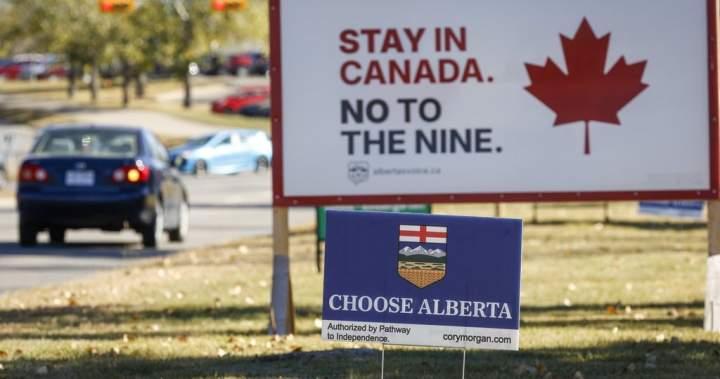
During a pro-unity campaign stop in Calgary on Thursday, Prime Minister Mark Carney urged his audience to vote “no to the nine” — repeating a phrase that has become a rallying cry among those opposed to separatism. asserted
that → urge → separatism
Kenney said he’s a “skeptic when it comes to greater provincial control” over a “sensitive” matter like immigration policy. asserted
it → say → policy
…and 15 more, not listed.

💬Give feedback
🕘History 🎫Support