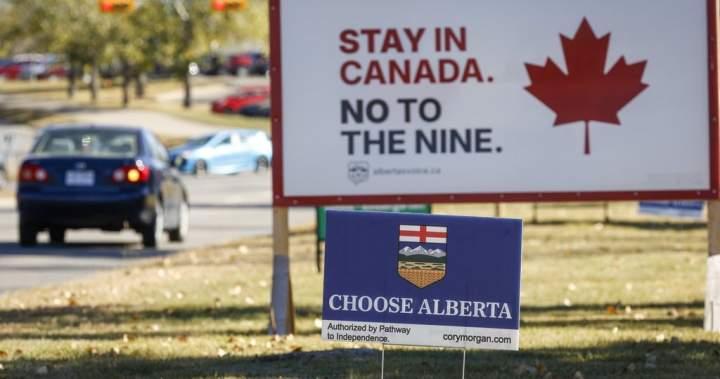
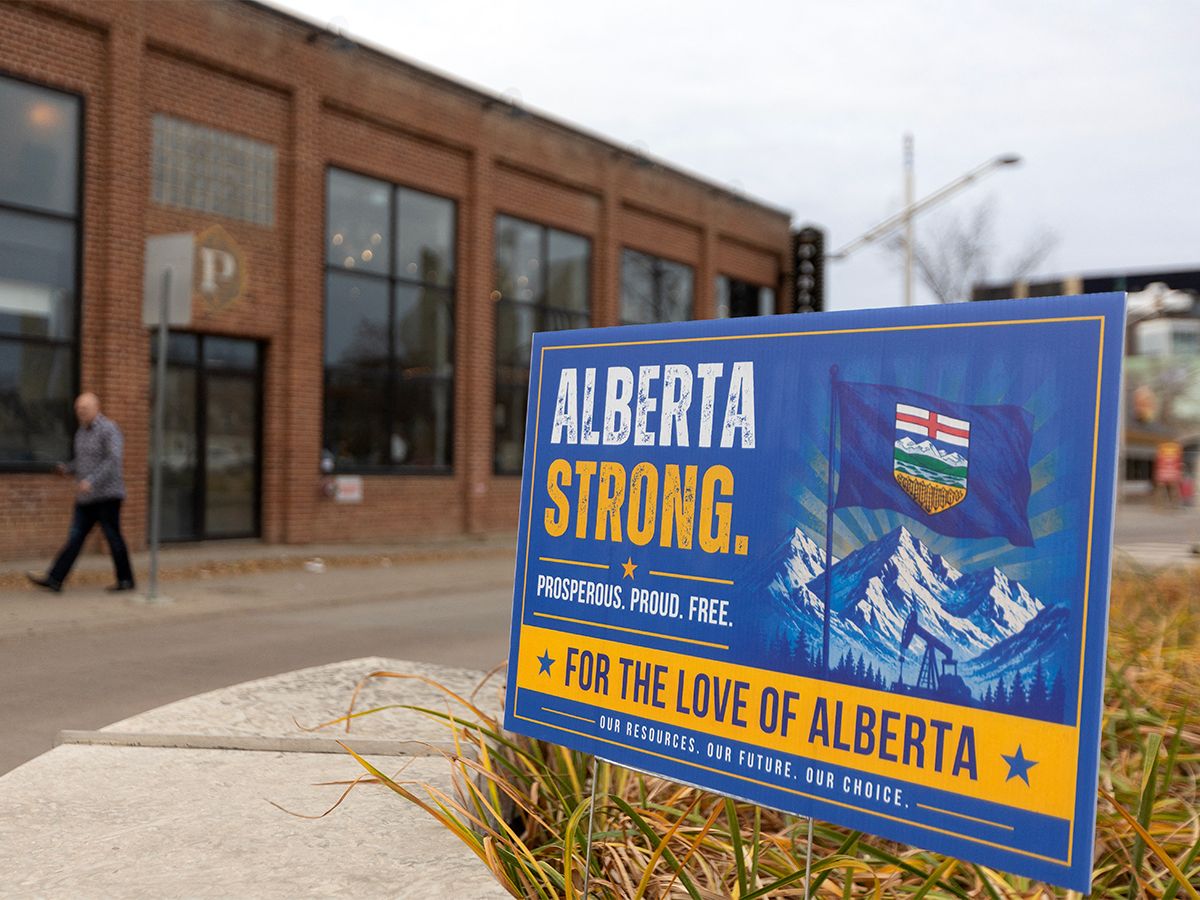
Photo via The Globe and Mail

Carney hails Alberta’s rejection of separation, but other referendum questions muddy the waters

Read the original at The Globe and Mail ↗
Cite

Levitz, S. (2026, October 20). Carney hails Alberta’s rejection of separation, but other referendum questions muddy the waters. The Globe and Mail. https://www.theglobeandmail.com/politics/article-carney-alberta-separation-referendum-results-immigration-constitution/

Dated from the outlet's own feed. Check the original for its byline.

The Globe and Mail · collected 2026-10-20 · by Stephanie Levitz

Quick Summary

Prime Minister Mark Carney celebrated Alberta's rejection of separation in a recent referendum, viewing it as a positive step for Canada’s unity. However, voters also expressed support for more provincial control over immigration and proposed changes to the Constitution, including abolishing the Senate and reforming judicial selection processes. Despite these tensions, Carney emphasized that any constitutional reforms would require careful negotiation between federal and provincial governments. Conservative leader Pierre Poilievre criticized Carney’s approach to the referendum, arguing that it was inappropriate for him to discourage voters from supporting greater control over immigration policies.
Written by AI on 2026-10-20, from this article's own text only (the story summary below draws on all the coverage).

AI analysis

Story summary

On October 19, 2026, Albertans voted in a referendum that included ten questions, primarily focusing on immigration and constitutional issues. The last question asked if the Government of Alberta should commence legal steps to hold a second binding referendum on separation from Canada. Voting began with advance polls on October 13 at 311 polling stations.

The results released later showed that three-quarters of Albertans voted against pursuing separation, with strong support for remaining in Canada. However, there was a noticeable rural-urban divide, where questions pertaining to immigration and constitutional changes garnered more support from rural areas compared to urban centers like Calgary and Edmonton.

Premier Danielle Smith's request for "strong mandates" on the nine ballot questions did not materialize as expected, with most provincial ridings rejecting many of the proposed measures. This has left her government hesitant about swift action despite winning majorities in some areas related to immigration policies.

Written for “Alberta Referendum Results” on 2026-11-05, grounded in this article and the 104 other(s) covering the same event.

Story

📰 Alberta Referendum Results
Politics · 105 article(s) covering the same event. Compare every outlet's account →

Compared with similar articles

This article reads leans left and hedges 0% of its claims. Each row says how that neighbour differs.
Euronews
⚖️ Leans left Hedges 2 of 39 claims Outlet record 60/100
The Guardian
⚖️ Leans left Hedges 5 of 22 claims Outlet record 66/100
Global News
⚖️ Leans strongly right further right than this Hedges 12 of 52 claims Outlet record 63/100
CBS News
⚖️ Leans left Hedges 2 of 18 claims Outlet record 65/100
National Post
Hedges 2 of 29 claims Outlet record 60/100
The Globe and Mail
⚖️ Leans left Hedges 5 of 33 claims Outlet record 52/100
The Globe and Mail
⚖️ Leans right further right than this Hedges 1 of 29 claims Outlet record 52/100
Al Jazeera
Hedges 2 of 34 claims Outlet record 60/100
Global News
⚖️ Leans strongly right further right than this Hedges 12 of 52 claims Outlet record 63/100
The Independent
Hedges 4 of 44 claims Outlet record 59/100
“Article A describes PM Carney's warning ahead of the Alberta referendum, while Article B discusses the results and aftermath of the same referendum.”
How this article was measured signals, leaning charts, publisher record, byline, topics and claims

Signals How these are calculated →

Claims extracted
21
sentences that state something as happening or true
Uncertain
0%
0 of 21 hedged ("reportedly", "may", "according to")
Leaning
Leans left
of the writing, not the subject · beta estimate
Publisher signals
52/100
The Globe and Mail's corrections and hedging, across everything collected from it. Not a measure of accuracy.
Outlets on this story
105
Politics
Same framing elsewhere
1
articles that frame the event the way this one does
Analyzed 2026-10-20 · how these are computed

How this is being covered How these are calculated →

Article leaning vs. publisher reliability
Source leaning vs. consistency

Publisher

The Globe and Mail · 1095 article(s) · 39 correction(s) detected
Running correction rate · 39 correction(s)

Who wrote this

Stephanie Levitz
1 article(s) here · 1 carrying a prediction
🔮 But despite Albertans soundly rejecting the idea of splintering off from the country, the results on the other nine questions put before voters point to continued tension in federal-provincial relations that Ottawa will now be under pressure to address.
The only article under this byline in the corpus.

Topics

Alberta Albertans Canada Canadians Conservative

Subjects

Alberta GPE · 7× Albertans NORP · 7× Carney PERSON · 5× Canada GPE · 3× Canadians NORP · 3× Conservative NORP · 3× Senate ORG · 3× Ottawa GPE · 2× Poilievre PERSON · 2× Mark Carney PERSON · 1×

Narrative

While both Mr. Poilievre and Mr. Carney campaigned in Alberta against separation, the Conservative leader said it was “inappropriate” for the Prime Minister to tell Albertans to vote “no” to the referendum questions on immigration. “For the Prime Minister to suggest that Albertans vote in favour of continued mass, unvetted, out-of-control immigration was a mistake,” he told reporters at a news conference in Calgary.
framing: assertive · carried by 1 article(s) · first seen 2026-10-20
🔮 But despite Albertans soundly rejecting the idea of splintering off from the country, the results on the other nine questions put before voters point to continued tension in federal-provincial relations that Ottawa will now be under pressure to address.

Claims (21 extracted, 0 hedged)

Prime Minister Mark Carney hailed the results of the Alberta referendum on separation as great for Canada, saying the federal government is ready to forge ahead in its work with the province in the spirit of co-operative federalism. asserted
government → hail → federalism
But despite Albertans soundly rejecting the idea of splintering off from the country, the results on the other nine questions put before voters point to continued tension in federal-provincial relations that Ottawa will now be under pressure to address. asserted
Ottawa → reject → pressure
Though ballots are still being counted, Albertans appear largely in favour of having more control over immigration and reopening the Constitution to abolish the Senate, grant provinces more powers over judicial selection and prioritize provincial rights. asserted
Albertans → count → rights
Mr. Carney told reporters Tuesday that the government takes note of those results, but that making changes doesn’t necessarily mean starting with a sweeping overhaul of Canada’s foundational power-sharing agreement. asserted
making → tell → agreement
It’s long,” he said. asserted
he → ’ → ?
“We have an amending formula generated originally out of Alberta, and where we can find solutions that work for Canadians, we should find those solutions that work for Canadians.” asserted
that → have → Canadians
Mr. Carney pointed to the steps Ottawa has already taken to curb immigration into Canada in recent years. asserted
Ottawa → point → years
He said what will happen next does need to be dealt with in co-operation with the provinces, something he called very much in the spirit of one of the referendum questions. asserted
he → say → questions
By law, the federal government must table an updated immigration levels plan by Nov. 1 each year. asserted
government → table → Nov.
Conservative Leader Pierre Poilievre accused the Carney Liberals of misleading Canadians about the state of the immigration system. asserted
Poilievre → accuse → system
He said he supports those Albertans who have voted to take more control over the system, including changing how social and economic supports are provided to newcomers. asserted
supports → say → newcomers
While both Mr. Poilievre and Mr. Carney campaigned in Alberta against separation, the Conservative leader said it was “inappropriate” for the Prime Minister to tell Albertans to vote “no” to the referendum questions on immigration. “For the Prime Minister to suggest that Albertans vote in favour of continued mass, unvetted, out-of-control immigration was a mistake,” he told reporters at a news conference in Calgary. asserted
he → campaign → Calgary
The Conservative Leader – who represents an Alberta riding – said it also concerns him that in the last three weeks, a quarter of Albertans and a third of Quebeckers chose a separatist option for their province. asserted
quarter → represent → province
Earlier in October, the separatist Parti Québécois won a minority government. asserted
Québécois → win → government
“I think the message is it’s time to deliver real results in people’s real lives,” he said. asserted
he → think → lives
Mr. Poilievre declined to offer his thoughts on the other questions put to Albertans and whether he’d be open to constitutional reform if his party formed government. asserted
party → decline → government
Frustration from the provinces over Senate and judicial appointments is long-standing. asserted
Frustration → stand → Senate
Alberta has held non-binding elections for senators from that province for close to 40 years, but only five elected senators have actually gone on to be appointed to the Senate. asserted
senators → hold → Senate
While there are currently 13 vacancies in that chamber, none are in Alberta. asserted
none → be → Alberta
On judicial reform, earlier this year, Alberta Premier Danielle Smith, Saskatchewan Premier Scott Moe, Ontario Premier Doug Ford, and Quebec Premier François Legault wrote to Mr. Carney asking for more control over how provincial judges are appointed. asserted
judges → write → control
But Federal Justice Minister Sean Fraser rejected their demands, saying the current appointment process takes into account input from provincial governments and the local legal community. asserted
process → reject → governments

💬Give feedback · no sign-in needed

No sign-in needed for now. Your note is sent without a name, so it cannot be answered.

🕘History 🎫Support