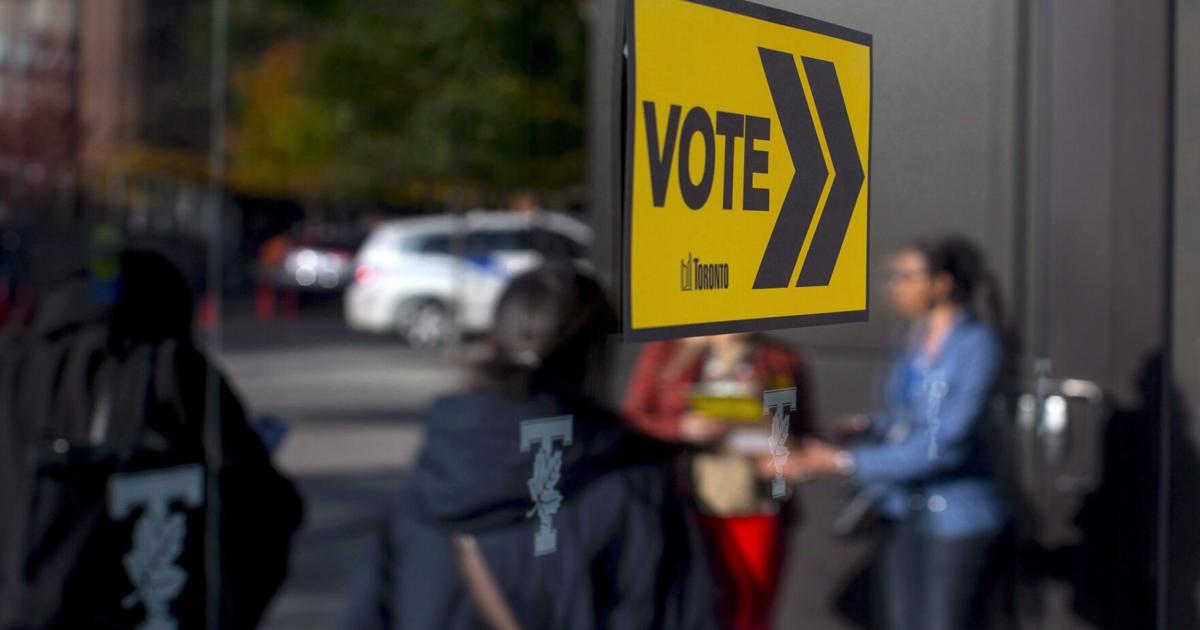
Photo via Toronto Star

The fallout from the Alberta referendum is far from over. Take it from me, someone who left Quebec after '95

Read the original at Toronto Star ↗
Cite

Drakes-Tull, S. (2026, October 21). The fallout from the Alberta referendum is far from over. Take it from me, someone who left Quebec after '95. Toronto Star. https://www.thestar.com/opinion/contributors/beware-alberta-of-blaming-others-after-the-1995-vote-i-realized-i-d-never-been-seen-as-a-real-quebecer-and-left-montreal-soon-after/article_7a9ba3c0-e66c-4f95-9150-9c6fe44b8906.html

Dated from the outlet's own feed. Check the original for its byline.

Toronto Star · collected 2026-10-21 · by Shellene Drakes-Tull

Quick Summary

The recent Alberta referendum included multiple ballots, one of which addressed potential separation from Canada. Three-quarters of voters supported staying within Canada, but other questions focused on reducing immigration and restricting access to social services for certain immigrants. The author draws parallels between this event and the 1995 Quebec referendum, highlighting how both reflect concerns about who is included in visions of separatist movements.
Written by AI on 2026-10-21, from this article's own text only (the story summary below draws on all the coverage).

AI analysis

Story summary

The recent Alberta referendum in Canada concluded with three-quarters of voters supporting the province's continued union with Canada, but the results also highlighted significant concerns about immigration policies. Among nine additional questions posed to Albertans were proposals to reduce the number of immigrants settled in Alberta and restrict their access to social services. The outcome echoes historical tensions seen during the 1995 Quebec referendum, where close results led to intense political debates. Notably, critics argue that such divisive rhetoric can marginalize already vulnerable immigrant communities within Canada.

Written for “Alberta Referendum Fallout” on 2026-10-31, grounded in this article and the 0 other(s) covering the same event.

Story

📰 Alberta Referendum Fallout
Politics · 1 article(s) covering the same event.

Compared with similar articles

This article reads leans left and hedges 8% of its claims. Each row says how that neighbour differs.
NPR
Hedges 5 of 54 claims Outlet record 60/100
“Article A describes the actual referendum vote taking place in Alberta on October 19, while Article B discusses the aftermath and compares it to a past Quebec referendum.”
Toronto Star
⚖️ Leans right further right than this Hedges 4 of 42 claims Outlet record 64/100
“The articles describe different time periods and events related to referendums in Alberta, not the same specific incident.”
National Post
⚖️ Leans left Hedges 5 of 34 claims Outlet record 60/100
“The articles refer to different events: one discusses ongoing changes in Canada due to Alberta's actions, while the other describes the aftermath and comparison of a recent referendum in Alberta with an older Quebec referendum.”
CBC News
Hedges 4 of 96 claims Outlet record 74/100
“Article A discusses the context and background of the Alberta referendum, while Article B focuses on the aftermath and reactions following the release of the results.”
Global News
⚖️ Leans strongly right further right than this Hedges 12 of 52 claims Outlet record 63/100
“The articles refer to different events: Article A discusses the outcomes of Alberta's referendum, while Article B reflects on the broader political context and draws a comparison with the Quebec referendum of 1995.”
Global News
⚖️ Leans strongly right further right than this Hedges 12 of 52 claims Outlet record 63/100
“The articles discuss different moments in time and outcomes, Article A focusing on the results of Alberta's referendum on October 20th, while Article B reflects on the broader implications and compares it to a past event in Quebec.”
The Guardian
Hedges 9 of 66 claims Outlet record 66/100
“The articles describe different stages of the political process: Article A discusses the upcoming referendum, while Article B refers to the results and aftermath of a recent referendum.”
Toronto Star
Hedges 1 of 55 claims Outlet record 64/100
“While both articles discuss the Alberta referendum, they describe different aspects of it: Article A provides a broader historical and personal context, while Article B focuses on the reaction of a specific individual to the results.”
The Globe and Mail
Hedges 12 of 116 claims Outlet record 52/100
“While both articles discuss the Alberta referendum, they describe different aspects and timeframes of the event.”
How this article was measured signals, leaning charts, publisher record, byline, topics and claims

Signals How these are calculated →

Claims extracted
26
sentences that state something as happening or true
Uncertain
8%
2 of 26 hedged ("reportedly", "may", "according to")
Leaning
Leans left
of the writing, not the subject · beta estimate
Publisher signals
64/100
Toronto Star's corrections and hedging, across everything collected from it. Not a measure of accuracy.
Outlets on this story
1
Politics
Same framing elsewhere
1
articles that frame the event the way this one does
Analyzed 2026-10-21 · how these are computed

How this is being covered How these are calculated →

Article leaning vs. publisher reliability
Source leaning vs. consistency

Publisher

Toronto Star · 10661 article(s) · 27 correction(s) detected
Running correction rate · 27 correction(s)
2026-10-26
Correction
2026-10-24
Correction
2026-10-07
Correction
2026-09-24
Correction

Who wrote this

Shellene Drakes-Tull
2 article(s) here · 1 carrying a prediction
🔮 While I can understand some of the criticisms Albertans have of the federal government, I can’t ignore how these questions and debates affect people who may already feel pushed to the margins of our society.
🔮 For us, the voters of Ontario, I would hope that we already knew about the levels of government. As municipal elections are coming up next month, it is important that we understand who to hold responsible for what.
Also by Shellene Drakes-Tull
Nothing else under this byline is closely related to this article, so these are simply their most recent.

Topics

Alberta Albertans Canada Canadian Quebec

Subjects

Alberta GPE · 8× Quebec GPE · 5× Albertans NORP · 4× Canada GPE · 3× Canadian NORP · 2× Canadians NORP · 1× Jacques Parizeau PERSON · 1× Ontario GPE · 1× Ottawa ORG · 1× Parti Québécois ORG · 1×

Narrative

Pointing fingers at immigrants Questions No. 1 through No. 4 sought a mandate to reduce the number of immigrants settled in Alberta and restrict their access to pricey social Questions No. 1 through No. 4 sought a mandate to reduce the number of immigrants settled in Alberta and restrict their access to pricey social There are valid grievances, but when times get tough, too often we point fingers at immigrants; the people who are already some of the most marginalized in our communities.
framing: assertive · carried by 1 article(s) · first seen 2026-10-21
🔮 While I can understand some of the criticisms Albertans have of the federal government, I can’t ignore how these questions and debates affect people who may already feel pushed to the margins of our society.

Claims (26 extracted, 2 hedged)

One of those ballots was to begin the process to rend Alberta from Canada. asserted
One → begin → Canada
It reminded me of almost 31 years ago. asserted
It → remind → me
I was a 20-year-old student-journalist, covering the 1995 Quebec referendum. asserted
I → cover → referendum
The night was stressful — with the No side scraping by with a 50.6 per cent win to the Yes side’s 49.4 per cent. asserted
side → scrap → cent
Three-quarters of those who voted want to stay in Canada, but the referendum wasn’t just about separation. asserted
referendum → vote → separation
There were nine other questions that Albertans had to wrestle with, including giving their provincial government greater control over immigration, prioritizing Albertans for employment opportunities, restricting access to some publicly funded services for people with certain immigration statuses and demanding proof of citizenship to vote in elections. asserted
Albertans → be → elections
Pointing fingers at immigrants Questions No. 1 through No. 4 sought a mandate to reduce the number of immigrants settled in Alberta and restrict their access to pricey social Questions No. 1 through No. 4 sought a mandate to reduce the number of immigrants settled in Alberta and restrict their access to pricey social There are valid grievances, but when times get tough, too often we point fingers at immigrants; the people who are already some of the most marginalized in our communities. asserted
who → point → communities
While I can understand some of the criticisms Albertans have of the federal government, I can’t ignore how these questions and debates affect people who may already feel pushed to the margins of our society. uncertain
who → understand → society
The 1995 Quebec referendum was about protecting of language, history, culture and national identity. asserted
referendum → protect → language
Alberta’s referendum was based in economic anger and the province’s relationship with Ottawa. asserted
referendum → base → Ottawa
Both events ask the same question: Who is included in the vision of Canadian separatist movements? asserted
Who → ask → movements
Because very often, it’s a distinct group of people. asserted
it → ’ → people
While Canadians have a reputation for being polite, these debates highlight ugly attitudes about who belongs. asserted
who → have → attitudes
Back in 1995, when the No side eked by with a razor-thin win, then Quebec Premier and Parti Québécois leader Jacques Parizeau blamed “money and the ethnic vote” for their defeat. asserted
Parizeau → eke → defeat
While I wasn’t an immigrant, I was still seen as an outsider. asserted
I → see → outsider
As I sat at my local No headquarters, just a few blocks away from my parents’ home, I realized that I would never be seen as a real Quebecer, although I had been born and raised in Montreal. asserted
I → sit → Montreal
I understood what the separatist movement wanted to preserve; I just don’t think they saw me as part of that vision. asserted
they → understand → vision
Three decades later, immigrant-serving organizations in Alberta have raised concerns about a similar sense of exclusion and rising hostility toward newcomers and racialized communities. asserted
organizations → serve → newcomers
University of Alberta political scientist Jared Wesley told Global News in August that discussions about immigrants’ future treatment would inevitably extend beyond economics. asserted
discussions → tell → economics
“When you have politicians that create this rhetoric in the level of government, what happens as it trickles down into the community level is that it creates a lot of anti-immigrant sentiments — it creates a lot of anti-South Asian sentiments,” said Samya Hasan, the executive director of the Council of Agencies Serving South Asians, to CityNews in May 2026. uncertain
Hasan → have → May
Alberta Premier Danielle Smith’s office disagreed that these referendum questions about immigration constitute racism. asserted
questions → disagree → racism
There is a problem While some of the discussions that Albertans were asked to contemplate are valid — economic independence, fair representation, immigration — when people base those discussions in the ideology of othering, there is a problem. asserted
people → be → othering
Back in 1995, I had already decided to leave Quebec, but Parizeau’s comments were the tipping point for me. asserted
comments → decide → me
In February 1998, two months after finishing my degree, I left Montreal for Toronto. asserted
I → finish → Toronto
Today, I wonder if Alberta’s referendum will be that tipping point for young, racialized people who don’t feel included in this movement. asserted
who → wonder → movement
So, Alberta is staying in Canada for the foreseeable future, but the question remains: what does Canada in 2026 look like and who is it for? asserted
it → stay → who

💬Give feedback
🕘History 🎫Support