Photo via Dawn

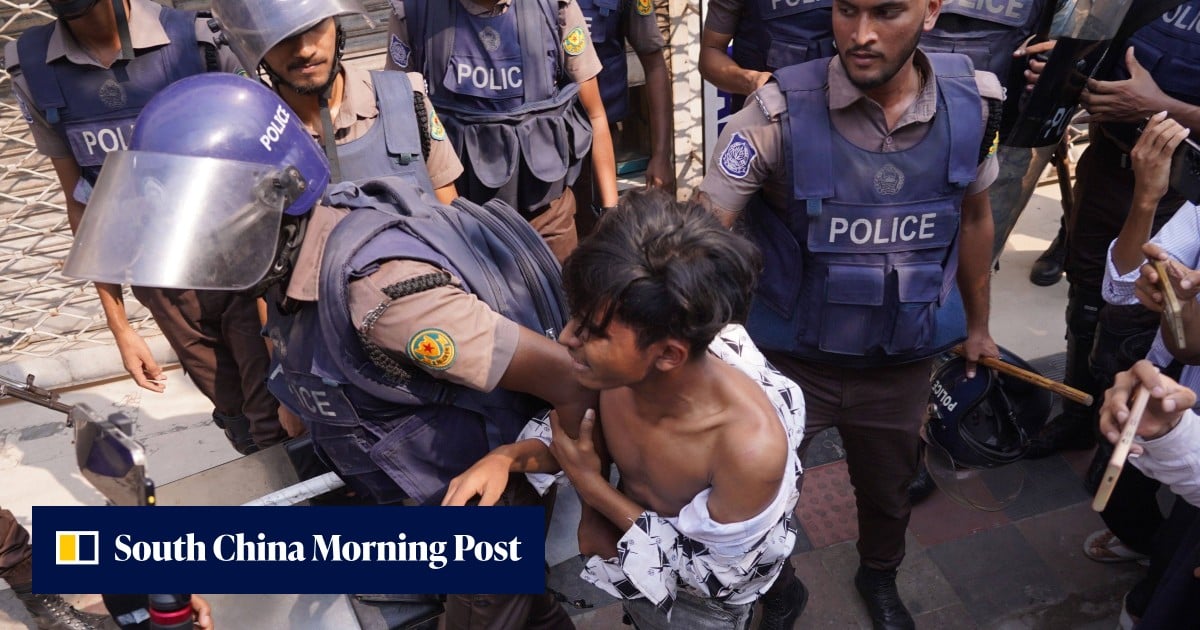
Bangladesh garment workers protesting for higher wages clash with police

Read the original at Dawn ↗
Cite

AFP. (2026, November 2). Bangladesh garment workers protesting for higher wages clash with police. Dawn. https://www.dawn.com/news/2041608/bangladesh-garment-workers-protesting-for-higher-wages-clash-with-police

Dated from the outlet's own feed. Check the original for its byline.

Dawn · collected 2026-11-02 · by AFP

Quick Summary

Bangladesh garment workers protested in several cities on Monday, demanding a monthly minimum wage increase from 13,000 taka to 30,000 taka. The demonstrations involved blocking highways and clashing with police, leading to vandalism and use of tear gas by authorities. Despite the government’s announcement of forming a wage board for review, protesters were unsatisfied, citing rising costs and inflation.
Written by AI on 2026-11-02, from this article's own text only (the story summary below draws on all the coverage).
See how they differ ↓

AI analysis

Story summary

As of November 3, 2026, garment workers in Bangladesh have staged a fourth day of protests demanding a significant increase in their minimum monthly wage from 12,500 taka to 30,000 taka. Thousands of protesters have clashed with police and vandalized factories across Dhaka and Gazipur, prompting authorities to deploy paramilitary forces and close hundreds of garment factories. The unrest has disrupted transportation links and factory operations, raising concerns among industry officials about potential delays in shipments and damage to Bangladesh’s reputation as a reliable sourcing hub for global apparel orders. Despite the government forming a new wage board on November 1st, protests continue, defying calls from authorities to end demonstrations.

Written for “Bangladesh Garment Workers Protests” on 2026-11-21, grounded in this article and the 10 other(s) covering the same event.

How they differ

6 outlets covered “Bangladesh Garment Workers Protests”.

What each outlet says

One AI summary per outlet of its latest article on this story, written from that article alone and checked against it. Open the article for the outlet's own words.

DawnThis outlet2 Nov

Bangladesh garment workers protested in several cities on Monday, demanding a monthly minimum wage increase from 13,000 taka to 30,000 taka. The demonstrations involved blocking highways and clashing with police, leading to vandalism and use of tear gas by authorities. Despite the government’s announcement of forming a wage board for review, protesters were unsatisfied, citing rising costs and inflation.

Bangladesh garment workers protesting for higher wages clash with police (this article)2 articles from Dawn on this story
Al Jazeera2 Nov

Worker protests over low wages and rising living costs have disrupted hundreds of garment factories in Bangladesh for three consecutive days, with thousands taking to the streets despite police use of tear gas and sound grenades. About 500 factories were temporarily closed after protests began on Saturday. In response, Prime Minister Tarique Rahman formed a wage board to review minimum wages, currently set at 12,500…

Bangladesh garment factories disrupted as protests continue for third day →3 articles from Al Jazeera on this story
The Hindu3 Nov

Garment workers in Bangladesh have continued their protests into a fourth day, demanding a significant wage increase despite government efforts to curb the unrest. Clashes between protesters and police resulted in property damage and injuries; over 58 police officers were hurt while protesters reported numerous injuries as well. The demonstrations, occurring in industrial suburbs around Dhaka including Gazipur and…

Bangladesh garment workers clash with police, defy call to end protests →3 articles from The Hindu on this story
Times of India1 Nov

Garment workers in Bangladesh are staging violent protests demanding a significant increase in their minimum monthly wage from 12,500 taka to 30,000 taka. Clashes have occurred in industrial areas like Mirpur and Konabari, leading to vandalism and road blockages that prompted authorities to deploy police and Border Guard Bangladesh units to restore order. The protests began on Saturday and intensified over the…

Violent protests rock Bangladesh garment hubs as workers demand a steep pay hike →
South China Morning Post2 Nov

Thousands of Bangladeshi garment workers protested on Monday for a significant wage increase, blocking major highways and clashing with police. The protests occurred across industrial hubs like Gazipur and Mirpur, with some workers vandalizing vehicles and others being dispersed by tear gas. With around 4 million people employed in the country’s garment sector, which contributes more than 80% of Bangladesh's export…

Cheap fashion under pressure as Bangladeshi garment workers protest for pay hike →
BBC3 Nov

In Bangladesh, hundreds of garment factories have closed due to worker protests demanding higher minimum wages, with demonstrators blocking roads and clashing violently with police. Workers are seeking a monthly wage increase from 13,000 taka ($105) to 30,000 taka ($242), citing rising living costs. The unrest has affected production in an industry employing four million workers and generating nearly $40 billion…

Wage protests force hundreds of Bangladesh garment factories to close →

Where they agree and split

Agreed

Reported by outlets on both sides of the middle

Violent protests have erupted in Bangladesh's garment industry as workers demand a sharp increase in their minimum monthly wage from 12,500 taka to 30,000 taka.

4 outlets

Framing

How the first headlines put it

Stated as fact3
The headlines (3)

Bangladesh forms wage board as garment workers protest Al Jazeera · stated as fact

Violent protests rock Bangladesh garment hubs as workers demand a steep pay hike Times of India · stated as fact

Bangladesh forms wage board as garment workers keep up protests The Hindu · stated as fact

The full story: what happened, how it changed, and all 11 articles →

Compared with similar articles

This article reads leans left and hedges 10% of its claims. Each row says how that neighbour differs.
South China Morning Post
Leans left Hedges 0 of 2 claims Outlet record 62/100
Times of India
Leans left Hedges 1 of 17 claims Outlet record 59/100
Al Jazeera
Hedges 0 of 20 claims Outlet record 60/100
Al Jazeera
Leans left Hedges 0 of 1 claims Outlet record 60/100
The Hindu
Hedges 2 of 17 claims Outlet record 78/100
BBC News
Leans left Hedges 3 of 21 claims Outlet record 65/100
Al Jazeera
Leans left Hedges 2 of 53 claims Outlet record 60/100
“Article A describes a specific incident where workers clashed with police on November 2nd, while Article B provides context and ongoing details of the wage issues but does not clearly refer to the same specific day's events.”
Dawn
Leans left Hedges 2 of 23 claims Outlet record 67/100
“While both articles describe ongoing protests by garment workers in Bangladesh demanding higher wages, Article A describes the events on Monday (November 2nd), while Article B reports on a fourth day of protests (Tuesday, November 3rd). These are related but distinct protest events.”
Al Jazeera
Hedges 2 of 15 claims Outlet record 60/100
“While both articles describe protests by garment workers demanding higher wages and clashes with police, they report on different days (Sunday vs. Monday) which suggests distinct protest events.”
The Hindu
Hedges 1 of 10 claims Outlet record 78/100
“The articles describe protests and police action on different days (Sunday vs. Monday), indicating they cover related but distinct events.”

Story

Bangladesh Garment Workers Protests
Politics · 11 article(s) covering the same event. Compare every outlet's account →
How this article was measured signals, leaning charts, publisher record, byline, topics and claims

Signals How these are calculated →

Claims extracted
21
sentences that state something as happening or true
Uncertain
10%
2 of 21 hedged ("reportedly", "may", "according to")
Leaning
Leans left
of the writing, not the subject · beta estimate
Publisher signals
67/100
Dawn's corrections and hedging, across everything collected from it. Not a measure of accuracy.
Outlets on this story
11
Politics
Same framing elsewhere
1
articles that frame the event the way this one does
Analyzed 2026-11-02 · how these are computed

How this is being covered How these are calculated →

Article leaning vs. publisher reliability
Source leaning vs. consistency

Publisher

Dawn · 3487 article(s) · 5 correction(s) detected
Running correction rate · 5 correction(s)

Who wrote this

AFP
1298 article(s) here · 1 carrying a prediction
“I would love to see him be back.
A full written argument would be extremely long, he said, adding that he had not yet mastered all of the mathematics involved and planned to write it up properly.
US federal prosecutors alleged that an Indian intelligence officer, who remains at large, directed the plot and recruited Gupta in May 2023 to hire a hitman to carry out the murder.
Huang resigned as chief of the chip giant at the centre of the artificial intelligence (AI) revolution after revelations of extramarital affairs, including one with an alleged Chinese spy who may have funnelled restricted chips to that country.
Mr. Kobir said Dhaka would deal with attacks "very firmly".
They were referring to recursive self-improvement (RSI) — a term the industry uses to describe building advanced AI models that can autonomously create newer versions of themselves, which critics worry will hasten doomsday scenarios.
And Ukraine fears this winter could be the worst yet.
World champions Spain will face France while England will play Norway in the quarterfinals of the UEFA Nations League after the draw took place on Friday.
In March, South Korea’s then-prime minister Kim Min-seok said that Trump thought a meeting with Kim would be “good”.
Rohingya refugees will undergo a Technical and Vocational Education and Training (TVET) programme in Turkiye which would last three to six months.
2026-11-20 · assertive framing · Malaysia plans to resettle 10,000 Rohingya in Turkiye
Wire or desk byline, not an individual reporter.
Also by AFP
Nothing else under this byline is closely related to this article, so these are simply their most recent.
All 1298 articles by AFP →

Topics

AFP Ashulia Bangladesh Bangladeshi Dhaka

Subjects

Dhaka GPE · 4× Ashulia GPE · 3× Bangladesh GPE · 3× AFP ORG · 2× Gazipur GPE · 2× Bangladeshi NORP · 1× China GPE · 1× Mirpur GPE · 1× South Asian NORP · 1× Tangail GPE · 1×

Narrative

The protests came despite the government’s announcement on Sunday that it would establish a wage board to review the minimum wage in the vital garment industry, which employs millions of people and generates the bulk of Bangladesh’s export earnings. However, labour leaders say workers’ grievances extend beyond the formation of the board, citing inflation and rising household expenses.
framing: assertive · carried by 1 article(s) · first seen 2026-11-02
The protests came despite the government’s announcement on Sunday that it would establish a wage board to review the minimum wage in the vital garment industry, which employs millions of people and generates the bulk of Bangladesh’s export earnings. However, labour leaders say workers’ grievances extend beyond the formation of the board, citing inflation and rising household expenses.

Claims (21 extracted, 2 hedged)

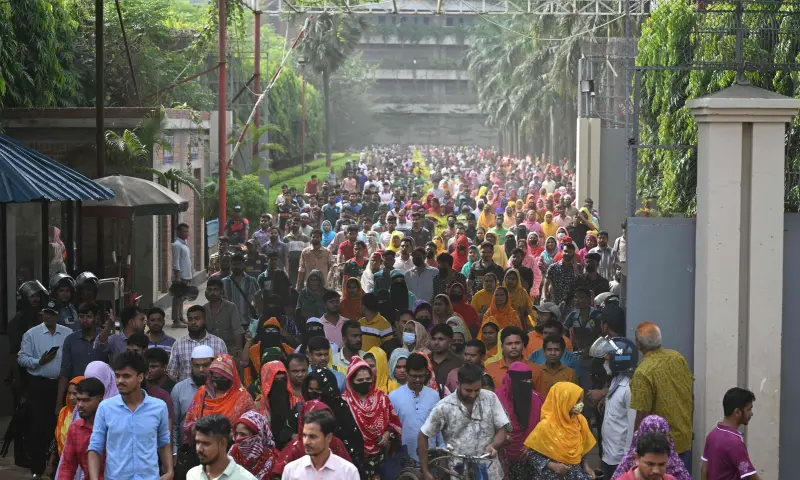
Thousands of Bangladeshi garment workers blocked a major highway and clashed with police on Monday, demanding a monthly minimum wage more than double their current pay, as protests spread across industrial hubs. asserted
protests → block → hubs
The South Asian nation of 170 million people is the world’s second-biggest garment exporter behind China, manufacturing clothes for some of the largest international brands. asserted
nation → manufacture → brands
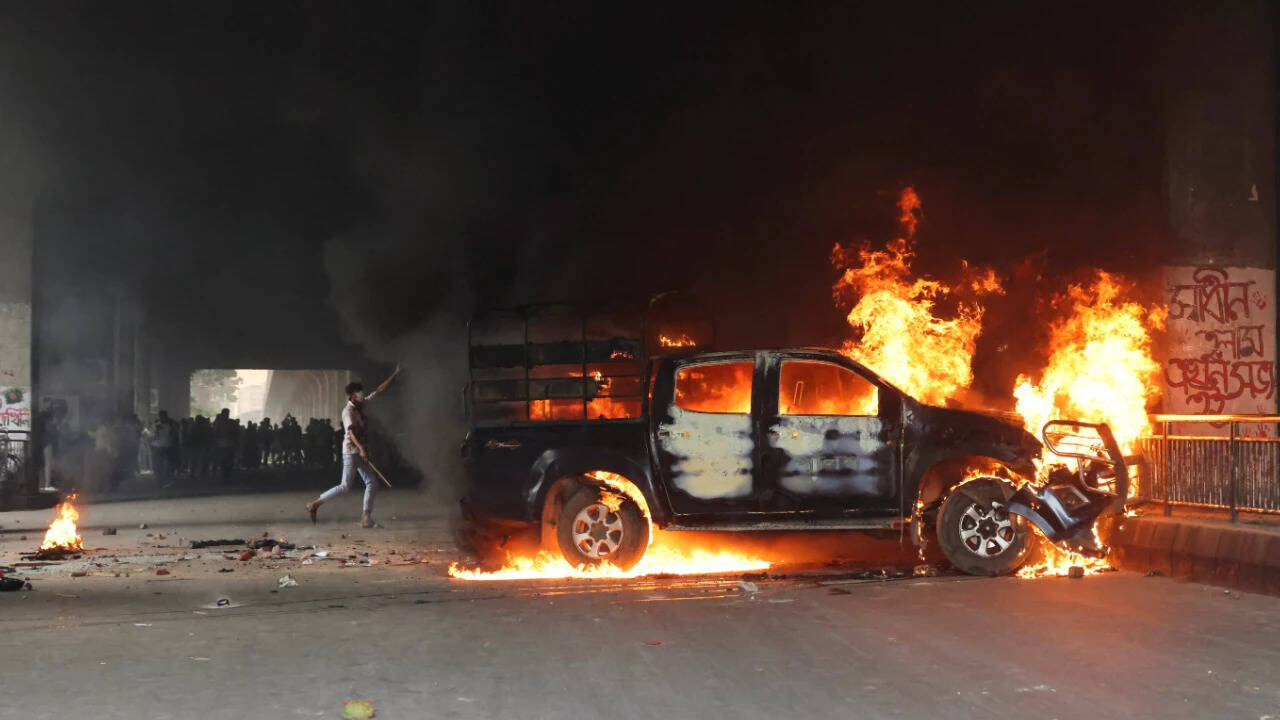
Hundreds of workers in Gazipur, north of the capital Dhaka, blocked the Dhaka-Tangail highway, vandalising several vehicles, while large groups took to the streets in the Mirpur district, where police dispersed demonstrators with tear gas, AFP reporters saw. asserted
reporters → block → gas
Angry workers also set fire to a police vehicle. asserted
workers → set → vehicle
The protests came despite the government’s announcement on Sunday that it would establish a wage board to review the minimum wage in the vital garment industry, which employs millions of people and generates the bulk of Bangladesh’s export earnings. However, labour leaders say workers’ grievances extend beyond the formation of the board, citing inflation and rising household expenses. asserted
grievances → come → inflation
The protesters demand a 30,000-taka monthly wage, more than double their current pay. asserted
protesters → demand → wage
Workers currently earn about 13,000 taka a month, according to Kalpona Akter of the Bangladesh Centre for Workers Solidarity. uncertain
Workers → earn → Solidarity
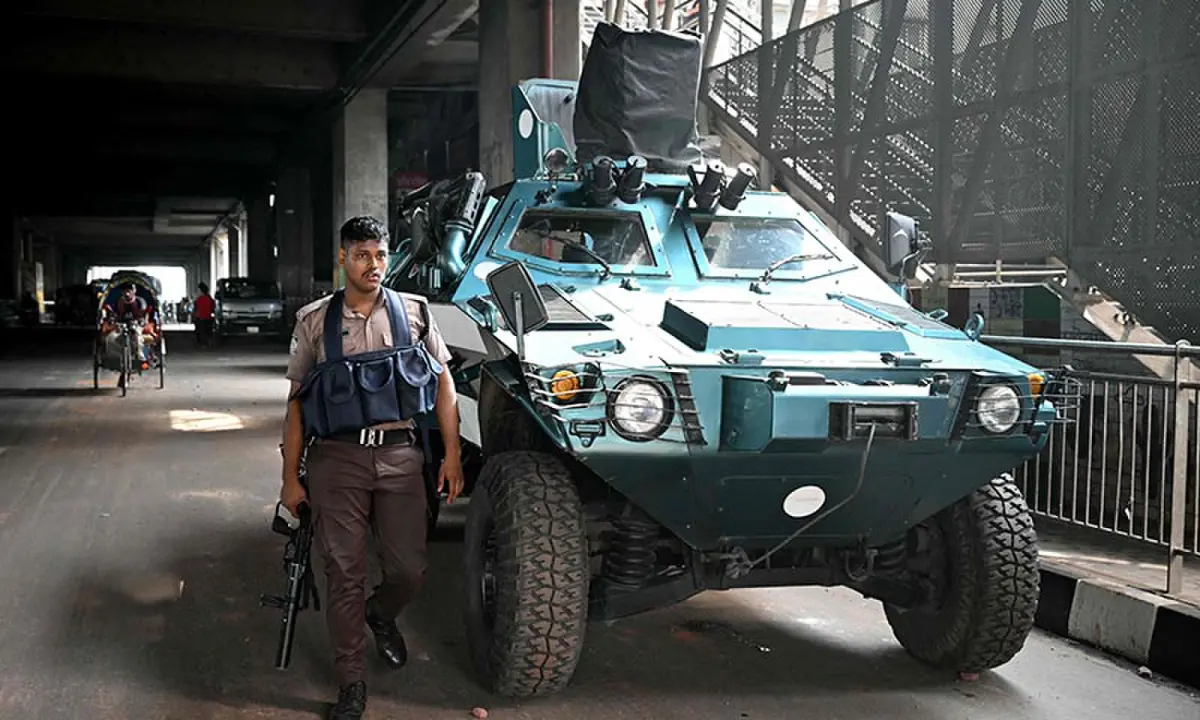
Police fired stun grenades and tear gas canisters to disperse crowds in Ashulia, a Dhaka suburb and the site of some of the country’s largest factories. asserted
Police → fire → factories
“Food prices, cooking gas and electricity bills have all gone up — the government must either bring down the prices of essential commodities or raise our wages,” said Mamum, 28, a factory worker. asserted
Mamum → go → wages
Machine operator Sharmin, 24, said: “We keep the wheels of the economy turning. asserted
We → say → economy
They must listen to us.” asserted
They → listen → us
Home Minister Salahuddin Ahmed warned that the government was taking strong action to stop the protests. asserted
government → warn → protests
“Those engaging in unlawful activities and conspiracies under the guise of labour movements will be tackled with an iron hand,” he said after meeting industry leaders on Monday. asserted
he → engage → Monday
‘Crack down’ However, Ahmed also said earlier Prime Minister Tarique Rahman had instructed officials after hosting an emergency cabinet meeting late on Sunday to “ensure workers’ rights and improve their living standards”. He said Rahman had told them to make sure production and exports continued “unhindered”. asserted
production → crack → them
Bangladesh’s main manufacturer associations for garments and knitwear warned that “prolonged unrest could disrupt production, delay export shipments and affect Bangladesh’s commitments to international buyers”, the state-run BSS news agency said on Monday. uncertain
agency → warn → Monday
Kamrul Hasan, general secretary of the Ekota Garments Sramik Federation, told AFP some labour leaders had gone into hiding. asserted
leaders → tell → hiding
“We were not prepared for this unrest either, as the wage board has already been formed,” he said. asserted
he → prepare → unrest
“But workers are now protesting over wages and other unresolved issues.” In Ashulia, security officers chased protesters as they scattered down narrow side streets, with the choking tear gas drifting into densely packed housing where families often live crammed into single rooms. asserted
families → protest → rooms
“Police fired tear gas shells inside our compound,” said Kamona, 24, who gave only one name. asserted
who → fire → name
“We have children, but they don’t care.” asserted
they → have → children
Industry representatives said workers from at least 529 factories in Dhaka and its surrounding industrial areas, including Savar, Ashulia, Jirani and Gazipur, had left their workplaces on Sunday. asserted
workers → say → Sunday
Give feedback · no sign-in needed

No sign-in needed for now. Your note is sent without a name, so it cannot be answered.

History Support