Photo via Daily Mail

Global carbon emissions from fossil fuels are projected to decrease by 0.4% in 2026, promising study reveals

Read the original at Daily Mail ↗
Cite

Leatham, X. (2026, November 10). Global carbon emissions from fossil fuels are projected to decrease by 0.4% in 2026, promising study reveals. Daily Mail. https://www.dailymail.com/sciencetech/article-16278201/Global-carbon-emissions-fossil-fuels-decrease.html?ns_mchannel=rss&ns_campaign=1490&ito=1490

Dated from the outlet's own feed. Check the original for its byline.

Daily Mail · collected 2026-11-10 · by Xantha Leatham

Quick Summary

A new report by the Global Carbon Project forecasts a 0.4% decrease in global carbon emissions from fossil fuels in 2026, marking a potential turning point in reducing reliance on coal, oil, and gas. The projected decline stems largely from a significant drop of 1.9% in oil emissions due to disruptions in energy markets linked to the Iran conflict, alongside rapid growth in renewable energy sources like solar and wind power, as well as electric vehicles. While this reduction is modest, researchers highlight that nearly two-thirds of increased global energy demand is now met by clean technologies, indicating a shift towards sustainable practices despite continued deforestation emissions pushing total CO2 levels up to 43.3 billion tonnes.
Written by AI on 2026-11-10, from this article's own text only (the story summary below draws on all the coverage).
See how they differ ↓

AI analysis

Story summary

Global fossil fuel emissions from coal, oil, and gas are projected to decrease by 0.4% in 2026, according to a new report by the Global Carbon Project. This decline is primarily attributed to a combination of the rapid expansion of wind and solar power and an energy shock caused by the Iran war. While the report indicates a slight drop, scientists from the University of Exeter warn that a reduction driven by geopolitical shocks is not a sustainable long-term climate solution. Specifically, China is expected to reduce its emissions by 0.9% this year as it continues its rollout of renewable energy. Despite this minor decrease, the world remains on track to reach 1.5 degrees Celsius of warming within four years. Research published in Nature suggests the drop is more sudden than a steady decline from energy progress, noting that oil emissions spiked before falling significantly due to the conflict. These findings come as world leaders gather in Turkey for climate talks to discuss accelerating the electrification of the global economy.

Written for “Global fossil fuel emissions fall” on 2026-11-21, grounded in this article and the 8 other(s) covering the same event.

How they differ

9 outlets covered “Global fossil fuel emissions fall”.

What each outlet says

One AI summary per outlet of its latest article on this story, written from that article alone and checked against it. Open the article for the outlet's own words.

Daily MailThis outlet10 Nov

A new report by the Global Carbon Project forecasts a 0.4% decrease in global carbon emissions from fossil fuels in 2026, marking a potential turning point in reducing reliance on coal, oil, and gas. The projected decline stems largely from a significant drop of 1.9% in oil emissions due to disruptions in energy markets linked to the Iran conflict, alongside rapid growth in renewable energy sources like solar and…

Global carbon emissions from fossil fuels are projected to decrease by 0.4% in 2026, promising study reveals (this article)
Time10 Nov

Global fossil fuel emissions are projected to decrease by 0.4% in 2026, according to a report from the Global Carbon Project. This reduction stems from an energy shock caused by the Iran war and increased adoption of renewable energy sources like wind and solar power. Notably, China’s emissions are expected to drop by 0.9%, while those of the U.S. will decrease by 1.3%. India is a notable exception, with its…

Fossil Fuel Emissions Are Expected to Decrease in 2026 →
ABC News (AU)10 Nov

The Global Carbon Project’s latest report indicates that fossil fuel emissions are projected to decrease by 0.4% in 2026 compared to 2025 levels, primarily due to a reduction in oil emissions linked to the Iran war. However, lead researcher Pierre Friedlingstein warns that this drop is not sustainable without significant acceleration in renewable energy capacity and electrification efforts. Total global carbon…

Renewables and Iran war help drive fall in global fossil fuel emissions →
Toronto Star10 Nov

Global carbon dioxide emissions dropped by 0.4% in 2026 to 42.2 billion tons (38.2 billion metric tons), according to scientists at the Global Carbon Project. This slight decline is attributed to disruptions caused by the Iran war, particularly affecting oil shipments through the Strait of Hormuz, rather than significant progress in climate change mitigation efforts. Scientists warn that these reductions are…

Heat-trapping carbon pollution drops, but scientists cite the Iran war rather than energy progress →
The Hindu10 Nov

Global carbon dioxide emissions from fossil fuels dropped by 0.4% to 42.2 billion tonnes in 2026, according to a study by the Global Carbon Project. This slight decrease is attributed more to disruptions caused by the Iran war and the closure of the Strait of Hormuz than to efforts against climate change. The war has led to significant price increases for oil and gas, causing emissions from these sources to drop…

Heat-trapping carbon pollution drops, but scientists cite Iran war rather than energy progress →
The Straits Times10 Nov

Global fossil fuel emissions are projected to decrease by 0.4% in 2026 due to a combination of renewable energy expansion and an oil price shock caused by the Iran war, according to the Global Carbon Budget report released on November 10 during the COP31 climate summit in Antalya, Turkey. This marks the first annual decline since the pandemic-driven drop in 2020. The report attributes the decrease largely to reduced…

Fossil fuel emissions fall due to Iran war, renewables: Research →
Show 3 more outlets
Sydney Morning Herald10 Nov

Global carbon emissions are expected to drop by 0.4% in 2026 according to a report from the Global Carbon Project, as world leaders convene for climate talks in Turkey. Despite this reduction, August 2026 was recorded as one of the warmest months ever, with global temperatures reaching 1.65°C above pre-industrial levels. The decline is attributed partly to geopolitical issues like the closure of the Strait of…

Greenhouse pollution down but global warming surges as climate talks begin →
Dawn10 Nov

Global fossil fuel emissions are projected to decrease by 0.4% in 2026, marking the first decline since 2020 due to a combination of increased renewable energy deployment and disruptions caused by the Iran war, according to researchers presenting at COP31 in Antalya, Turkiye. The Global Carbon Budget report indicates that emissions from oil are expected to drop by 1.9%, while gas emissions will fall by 0.3% and coal…

Fossil fuel emissions fall due to Iran war, renewables: research →
Semafor10 Nov

Global fossil fuel emissions are forecasted to decrease by 0.4% in 2026, largely due to increased renewable energy production and disruptions caused by the Iran war affecting oil supplies through the Strait of Hormuz. However, the decline is not considered sustainable according to a study published in Nature, which emphasizes that oil emissions might only be temporarily reduced by 1.9%. The increase in…

More renewables and Hormuz disruption drive emissions fall →

Compared with similar articles

This article reads unscored and hedges 26% of its claims. Each row says how that neighbour differs.
TIME
Hedges 4 of 24 claims Outlet record 60/100
Semafor
Hedges 1 of 6 claims Outlet record 64/100
Dawn
Leans left Hedges 1 of 21 claims Outlet record 67/100
The Straits Times
Hedges 1 of 20 claims Outlet record 64/100
ABC News (AU)
Hedges 6 of 42 claims Outlet record 67/100
Mother Jones
Leans left Hedges 0 of 34 claims Outlet record 60/100
“The articles discuss different aspects of climate and fossil fuels but do not describe the same specific incident or occurrence.”
Al Jazeera
Hedges 2 of 21 claims Outlet record 60/100
“The articles cover different events related to climate change but do not describe the same specific incident.”
Toronto Star
Leans left Hedges 2 of 29 claims Outlet record 64/100
“While both articles discuss a decrease in global carbon emissions for 2026, Article A attributes this decline to oil shocks from the Iran war rather than efforts to fight climate change, whereas Article B credits renewable energy growth and electric vehicle adoption.”
The Hindu
Leans left Hedges 2 of 29 claims Outlet record 78/100
“While both articles discuss a decrease in global carbon emissions by 0.4% in 2026, they attribute this decline to different factors: Article A cites the Iran war, while Article B attributes it to the expansion of renewable energy and electric vehicles.”
The Sydney Morning Herald
Hedges 0 of 25 claims Outlet record 61/100
“While both articles discuss the projection of a 0.4% decrease in global carbon emissions for 2026, Article B includes additional information about climate talks and temperature data, indicating it covers more than just the emission projections.”

Story

Global fossil fuel emissions fall
Environment · 9 article(s) covering the same event. See how they differ ↑
How this article was measured signals, leaning charts, publisher record, byline, topics and claims

Signals How these are calculated →

Claims extracted
31
sentences that state something as happening or true
Uncertain
26%
8 of 31 hedged ("reportedly", "may", "according to")
Leaning
not political
takes no side on a contested political question
Publisher signals
69/100
Daily Mail's corrections and hedging, across everything collected from it. Not a measure of accuracy.
Outlets on this story
9
Environment
Same framing elsewhere
1
articles that frame the event the way this one does
Analyzed 2026-11-10 · how these are computed

How this is being covered How these are calculated →

Article leaning vs. publisher reliability
Source leaning vs. consistency

Publisher

Daily Mail · 12223 article(s) · 25 correction(s) detected
Running correction rate · 25 correction(s)

Who wrote this

Xantha Leatham
17 article(s) here · 1 carrying a prediction
As AI becomes increasingly embedded in everyday life and we rely on cutting-edge technology more and more, you could be forgiven for thinking the tide is turning against the humble human.
The relentless rise in the world's carbon emissions may finally be slowing, according to a major new report.
The author is believed to have installed mirrors upstairs so he could practise performances and perfect the voices and mannerisms of his characters.
They are noticeably bigger than native ladybirds and may bite if handled, leaving a red mark.
If you've ever wondered why your pooch turns into a trembling wreck the moment a firework goes off, a new audio simulation may finally provide the answer.
Doing so could help families weather everything from extreme storms and widespread power outages to terrorist attacks and even a nuclear emergency.
A merchant who oversaw the murders of 100 men, women and children after a shipwreck 400 years ago may have been the world's first corporate psychopath, scientists say.
The findings may help explain why accomplished women, ranging from Margaret Thatcher and Angela Merkel to Hillary Clinton and Kamala Harris, have often been called unlikeable despite being widely regarded as highly capable leaders.
Britain is facing its biggest adoption shortfall in decades, with experts warning the growing popularity of IVF is contributing to a widening gap between children needing permanent homes and families willing to adopt them.
Whether you're happily coupled up or endlessly swiping through dating apps, your postcode could have more influence on your love life than you think.
Also by Xantha Leatham
Nothing else under this byline is closely related to this article, so these are simply their most recent.
All 17 articles by Xantha Leatham →

Topics

China India Royal Society the Global Carbon Project the University of East Anglia's

Subjects

China GPE · 3× India GPE · 3× the Global Carbon Project ORG · 2× the United States GPE · 2× Corinne Le Quéré PERSON · 1× Iran GPE · 1× Nature Climate Change ORG · 1× Royal Society ORG · 1× School of Environmental Sciences ORG · 1× the University of East Anglia's ORG · 1×

Narrative

The long-term answer remains the rapid deployment of clean energy technologies.' China, which produces almost a third of the world's fossil fuel pollution, is expected to cut emissions by 0.9 per cent this year while continuing its huge rollout of renewable energy. The United States is projected to reduce emissions by 1.3 per cent, while emissions across the European Union are forecast to fall by 1.5 per cent. Japan is also expected to record a one per cent decline.
framing: mixed · carried by 1 article(s) · first seen 2026-11-10
The relentless rise in the world's carbon emissions may finally be slowing, according to a major new report.

Claims (31 extracted, 8 hedged)

The relentless rise in the world's carbon emissions may finally be slowing, according to a major new report. uncertain
rise → slow → report
Global emissions from coal, oil and gas are projected to fall by 0.4 per cent in 2026, according to the Global Carbon Project. uncertain
emissions → project → Project
Researchers say this would mark one of the clearest signs yet that the rapid expansion of renewable energy and electric vehicles is beginning to curb the world's reliance on fossil fuels. asserted
expansion → say → fuels
And while the decline is small, researchers say it could signal an important turning point in the fight against climate change. uncertain
it → say → change
Professor Corinne Le Quéré, Royal Society Research Professor at the University of East Anglia's School of Environmental Sciences, said: 'Clean technologies are making a real difference in reducing global emissions. asserted
technologies → say → emissions
Solar and wind power and electric vehicles are expanding rapidly, led by China. asserted
power → expand → China
Countries on every continent are decreasing their emissions while growing their economies. asserted
Countries → decrease → economies
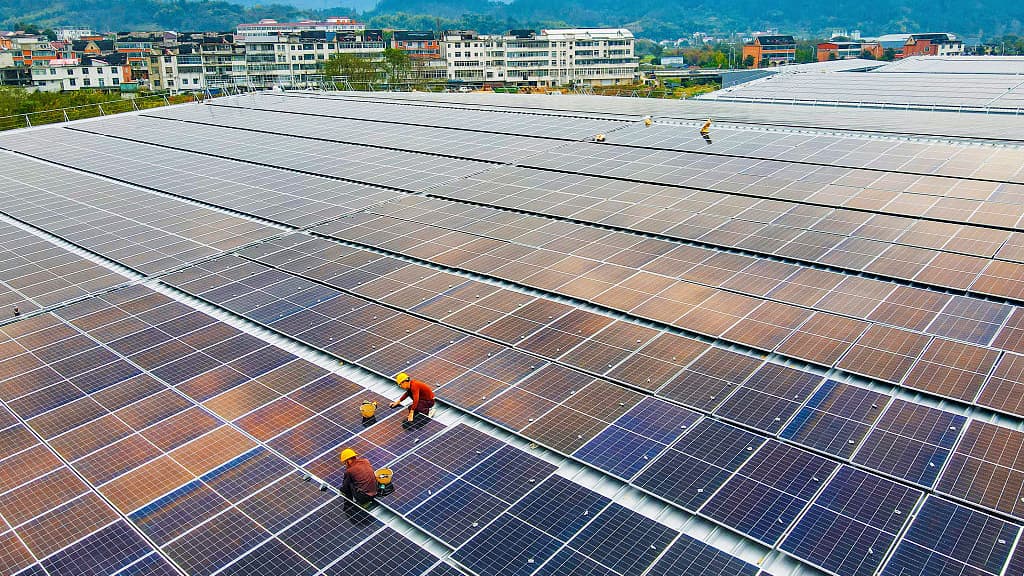
'A further acceleration could turn the tide on global emissions within a few years.' Global emissions from coal, oil and gas are projected to fall by 0.4 per cent in 2026, according to the Global Carbon Project Investment in solar panels (pictured), wind farms and electric vehicles is helping to meet rising demand for energy without a matching surge in carbon pollution The study, published in Nature Climate Change, forecasts 38.2 billion tonnes of CO2 emissions from coal, oil and gas this year – slightly down on 2025 levels. uncertain
study → turn → levels
A sharp 1.9 per cent drop in emissions from oil is expected to be a major driver of the decline. asserted
drop → expect → decline
Scientists say this is partly linked to disruption in global energy markets caused by the conflict involving Iran. asserted
this → say → Iran
At the same time, booming investment in solar panels, wind farms and electric vehicles is helping to meet rising demand for energy without a matching surge in carbon pollution. asserted
investment → help → pollution
According to the report, almost two-thirds of the increase in global energy demand is now being covered by clean technologies. But the experts, consisting of more than 140 international scientists, warn the world is far from being in the clear. uncertain
world → accord → clear
While fossil fuel emissions are expected to fall slightly, emissions from land-use change such as deforestation are forecast to rise. asserted
emissions → expect → deforestation
As a result, total CO2 emissions are projected to reach 43.3 billion tonnes in 2026, up from 42.8 billion tonnes last year. asserted
emissions → project → tonnes
China is expected to cut emissions by 0.9 per cent this year while the United States is projected to reduce emissions by 1.3 per cent India's emissions are projected to rise by 4.4 per cent, reflecting the country's continued economic growth and increasing energy demand. asserted
emissions → expect → growth
The researchers also warned that the remaining carbon budget for limiting global warming to 1.5°C (2.7°F) now stands at just 150 billion tonnes. asserted
budget → warn → tonnes
At current emission rates, that equates to less than four years before the budget is exhausted. asserted
budget → equate → years
Lead author Professor Pierre Friedlingstein, from the University of Exeter, said: 'A decline in fossil CO2 emissions is encouraging, but a reduction driven partly by geopolitical shocks is not a sustainable climate solution. ' asserted
reduction → say → shocks
The long-term answer remains the rapid deployment of clean energy technologies.' China, which produces almost a third of the world's fossil fuel pollution, is expected to cut emissions by 0.9 per cent this year while continuing its huge rollout of renewable energy. The United States is projected to reduce emissions by 1.3 per cent, while emissions across the European Union are forecast to fall by 1.5 per cent. Japan is also expected to record a one per cent decline. asserted
Japan → remain → decline
On the other hand, India's emissions are projected to rise by 4.4 per cent, reflecting the country's continued economic growth and increasing energy demand. asserted
emissions → project → growth
Emissions from international aviation and shipping are both projected to decrease by one per cent. asserted
Emissions → project → cent
However, aviation's decline is partly due to reduced activity in the Middle East. asserted
decline → reduce → East
An exceptionally strong El Niño could drive CO2 levels in the atmosphere to record highs in 2027, the Met Office recently warned Despite the cautiously optimistic outlook, the authors concluded that only a much faster rollout of solar power, wind energy, batteries and electric vehicles will ensure global emissions have truly peaked and begin a sustained decline within the next few years. uncertain
emissions → drive → years
Glen Peters, Research Professor at the CICERO Centre for International Climate Research, said: 'A drop in emissions in one year is not a peak unless it is driven by structural change. ' asserted
it → say → change
Accelerated deployment of solar, wind, batteries, and electric vehicles are pushing emissions down in dozens of countries, and slowing emissions growth in many more, but the changes are not sufficient to lock in a peak in global emissions.' asserted
changes → push → emissions
Last week, the Met Office warned that an exceptionally strong El Niño could drive CO2 levels in the atmosphere to record highs. uncertain
Niño → warn → highs
El Niño amplifies human sources of emissions while also making it harder for the planet to absorb those greenhouse gases. asserted
planet → amplify → gases
Climate forecasts predict that the concentration of CO2, as recorded at the Mauna Loa Observatory in Hawaii, will rise by around 3.51 parts per million (ppm) next year. asserted
concentration → predict → million
That is the largest year-on-year increase ever forecast by the Met Office and rivals the record increase recorded in 2024 when exceptional wildfires boosted emissions. asserted
wildfires → forecast → emissions
If this forecast is accurate, it would bring the total atmospheric concentration to a record-breaking 432.2 ppm. asserted
it → bring → ppm
That could make it significantly harder for the world to keep global warming below the 1.5°C threshold set out in the Paris Agreement, with potentially devastating consequences. uncertain
world → make → consequences
Give feedback · no sign-in needed

No sign-in needed for now. Your note is sent without a name, so it cannot be answered.

History Support