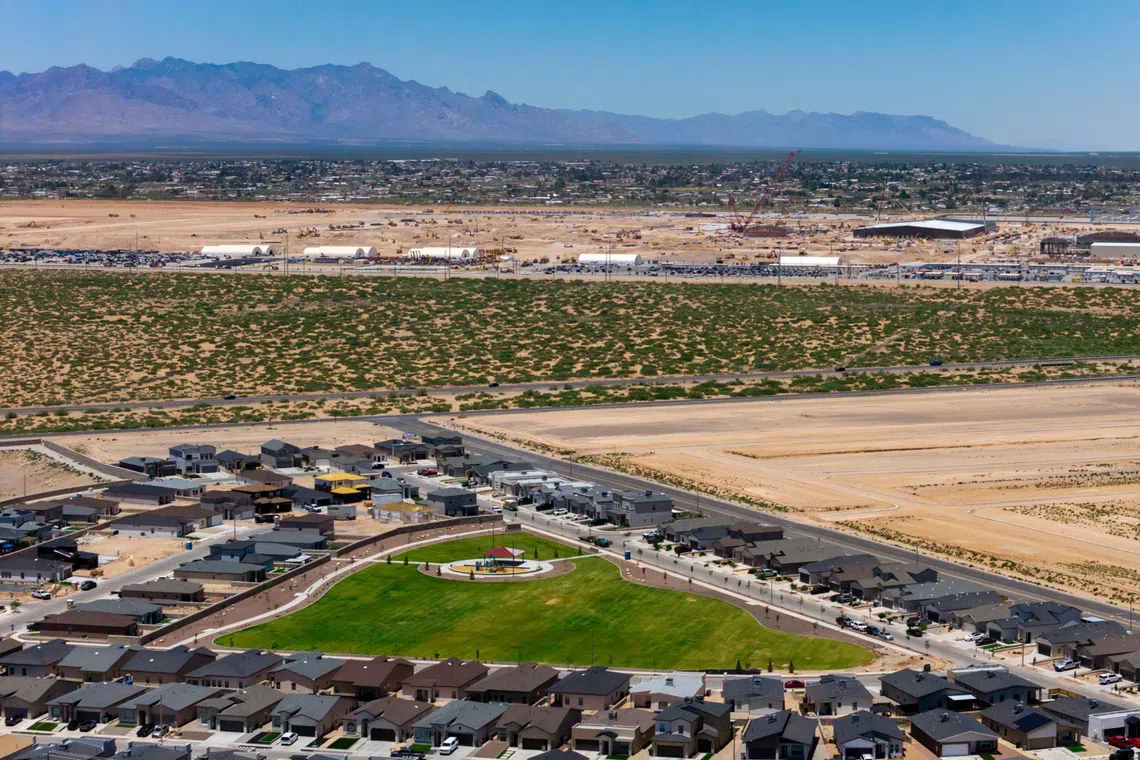
Photo via The Straits Times

US House advances first Bill addressing economic impact of data centre boom

Read the original at The Straits Times ↗
Cite

The Straits Times. (2026, September 17). US House advances first Bill addressing economic impact of data centre boom. The Straits Times. https://www.straitstimes.com/world/united-states/us-house-advances-first-bill-addressing-economic-impact-of-data-centre-boom

Dated when The Aporia collected the article, usually within hours of publication. Check the original for its exact date and byline.

The Straits Times · collected 2026-09-17 · by The Straits Times

Quick Summary

On September 16, the U.S. House of Representatives passed the Ratepayer Protection Act with a vote of 417 to three, aiming to address concerns over rising electricity costs caused by data center expansion. The bill requires state utility regulators to consider whether large power users like data centers should cover additional infrastructure costs related to their operations. This action highlights the conflicting views on data center development between President Trump’s support and public concern over increased energy bills.
Written by AI on 2026-09-17, from this article's own text only (the story summary below draws on all the coverage).
See how they differ ↓

AI analysis

Story summary

The U.S. House of Representatives voted 417-3 on September 16, passing the bipartisan *Ratepayer Protection Act*. This act aims to shield households from rising energy costs linked to data center expansion by requiring state utility regulators to consider whether large electricity users like data centers should cover incremental infrastructure costs. The bill was introduced by Reps. Gabe Evans (R-CO) and Kathy Castor (D-FL). While the House passed it, similar legislation faces an uphill battle in the Senate before the November midterm elections. Environmental groups argue that the bill only addresses electricity costs without addressing broader concerns like water use and pollution. Despite this, the measure received broad bipartisan support as lawmakers sought to address growing constituent concerns over data center energy demands ahead of the elections.

Written for “Data Center Legislation Push” on 2026-11-20, grounded in this article and the 7 other(s) covering the same event.

How they differ

7 outlets covered “Data Center Legislation Push”.

What each outlet says

One AI summary per outlet of its latest article on this story, written from that article alone and checked against it. Open the article for the outlet's own words.

The Straits TimesThis outlet17 Sep

On September 16, the U.S. House of Representatives passed the Ratepayer Protection Act with a vote of 417 to three, aiming to address concerns over rising electricity costs caused by data center expansion. The bill requires state utility regulators to consider whether large power users like data centers should cover additional infrastructure costs related to their operations. This action highlights the conflicting…

US House advances first Bill addressing economic impact of data centre boom (this article)
Washington Examiner17 Sep

The House of Representatives passed the Ratepayer Protection Act with a vote of 417-3, requiring data centers consuming over 100 megawatts of electricity to cover costs for grid and energy upgrades. Introduced by Reps. Gabe Evans (R-CO) and Kathy Castor (D-FL), the bill aims to protect households from rising energy prices but faces criticism from some Democrats who argue it does not go far enough in regulating data…

House passes bill to shield households from data center energy costs →2 articles from Washington Examiner on this story
Semafor15 Sep

Republicans in Congress face a tight schedule before midterm elections to address voter concerns with legislation like the Ratepayer Protection Act and the crypto market structure bill, while also considering bipartisan measures such as the Protect College Sports Act. The Senate is likely to prioritize the college sports bill, which has support from both parties but may consume significant time due to potential…

Republicans’ time crunch: Data centers, sports, crypto →
The Independent16 Sep

The US House of Representatives plans to vote on the Ratepayer Protection Act, which would require state utility regulators to consider whether large energy consumers like data centers should cover costs related to new electrical infrastructure. Introduced by Representative Kathy Castor and Gabe Evans, this bipartisan bill aims to address growing concerns over rising electricity bills linked to data center…

US House to vote on ‘Ratepayer Protection Act’ as data center fury grows →
Fox News17 Sep

The U.S. House passed the Ratepayer Protection Act with bipartisan support, amending existing energy law to require large data centers (those consuming 100 megawatts or more) to cover additional costs for electricity infrastructure upgrades and provide financial assurances if projects are canceled. The bill aims to prevent increased utility rates for local communities while not banning data center expansion. Both…

First data center bill clears House as both parties scramble for answers on affordability →
CBS News17 Sep

The House passed the Ratepayer Protection Act with a vote of 417 to 3, aiming to prevent data center energy costs from being added to Americans' electricity bills. The bipartisan bill requires tech companies to cover expenses for new power infrastructure serving data centers rather than passing them on to consumers. Introduced by Republican Representative Gabe Evans, the legislation responds to concerns over rising…

House passes bill to shield Americans from data center energy costs →
Show 1 more outlets
Toronto Star17 Sep

The House of Representatives passed a bill on Wednesday that seeks to address the high energy costs associated with artificial intelligence data centers, requiring state utility regulators to ensure these facilities pay for the full cost of new power and transmission upgrades needed to serve them. The bill was approved overwhelmingly by a vote of 417-3, reflecting lawmakers' efforts to tackle an issue of growing…

House passes bill aimed at addressing impact of data centers on energy costs →

Where they agree and split

Framing

How the first headlines put it

Stated as fact2
The headlines (2)

House faces Iran, Russia, impeachment, and data center fights in final week before midterm elections Washington Examiner · stated as fact

Republicans’ time crunch: Data centers, sports, crypto Semafor · stated as fact

The full story: what happened, how it changed, and all 8 articles →

Compared with similar articles

This article reads unscored and hedges 5% of its claims. Each row says how that neighbour differs.
Fox News
Hedges 0 of 25 claims Outlet record 67/100
CBS News
Leans right Hedges 4 of 23 claims Outlet record 67/100
CBS News
Leans left Hedges 3 of 120 claims Outlet record 67/100
“The articles discuss different aspects of the impact and concerns around data center expansion, but do not describe the same specific occurrence.”
Mother Jones
Leans strongly left Hedges 5 of 22 claims Outlet record 60/100
“The articles discuss different aspects related to data centers but describe distinct events: one involves former EPA officials criticizing Trump's EPA policies regarding pollution safeguards, while the other reports on a bill passed by the US House addressing economic impacts of data center expansion.”
New York Post
Leans right Hedges 2 of 36 claims Outlet record 66/100
“Article A describes a political ad campaign by Rep. Mike Lawler against his rival Cait Conley, while Article B reports on a bill passed in the US House regarding economic impacts of data centers.”
Semafor
Leans right Hedges 0 of 4 claims Outlet record 64/100
“Article A discusses calls for AI regulation in general and mentions a bill concerning data center buildout, while Article B specifically reports on the passage of the Ratepayer Protection Act regarding economic impact of data centers. These are different specific legislative actions.”
Reason
Leans right Hedges 14 of 41 claims Outlet record 67/100
“Article A discusses the concept of seasteading for AI infrastructure, while Article B reports on a bill passed by the US House addressing economic impacts of data center growth.”
The Straits Times
Hedges 4 of 14 claims Outlet record 64/100
“The articles discuss different aspects related to the data center boom but describe separate events occurring on different dates.”
The Guardian
Leans left Hedges 5 of 47 claims Outlet record 64/100
“The articles describe different events: one about a local ban on datacenter construction in Monterey Park and another about federal legislation passed by the US House addressing economic impacts of data centers.”
The Guardian
Leans strongly left Hedges 1 of 33 claims Outlet record 64/100
“Article A discusses opposition and concerns about AI datacenters, while Article B reports on a specific bill passed by the US House addressing economic impacts of data centers.”

Story

Data Center Legislation Push
Politics · 8 article(s) covering the same event. Compare every outlet's account →
How this article was measured signals, leaning charts, publisher record, byline, topics and claims

Signals How these are calculated →

Claims extracted
21
sentences that state something as happening or true
Uncertain
5%
1 of 21 hedged ("reportedly", "may", "according to")
Leaning
withheld
no quote in the article backed the model's score
Publisher signals
64/100
The Straits Times's corrections and hedging, across everything collected from it. Not a measure of accuracy.
Outlets on this story
8
Politics
Same framing elsewhere
1
articles that frame the event the way this one does
Analyzed 2026-09-17 · how these are computed

How this is being covered How these are calculated →

Article leaning vs. publisher reliability
Source leaning vs. consistency

Publisher

The Straits Times · 5570 article(s) · 7 correction(s) detected
Running correction rate · 7 correction(s)

Who wrote this

The Straits Times
3829 article(s) here · 1 carrying a prediction
The European leaders were meeting as part of the so-called coalition of the willing, which regularly gathers to discuss ways to protect a postwar Ukraine from future Russian aggression.
US peace negotiator Jared Kushner, at the same event, also said that he and fellow negotiator Steve Witkoff had “gotten the Russians comfortable with the concept that any security guarantee for Ukraine would be based on Article 5”.
Takaichi’s China trip this week was her first since suggesting in 2025 that Japan might intervene militarily if China attempted to take Taiwan by force.
But while some believe the success of the meeting could have a stabilising effect on an international order in turmoil, the broad consensus among analysts is that this first-of-its-kind meeting worked more as a confidence-building exercise between the rival nations rather than an immediate, concrete cure to the world’s ills.
Iraqi security forces will deploy in Jurf al-Sakhar, a stronghold of the Kataib Hezbollah armed group, on Friday, security officials told a press conference, under a compromise deal designed to ease tensions with Iran's most powerful Shi'ite militia ally in the country.
Some analysts said the outcome of the Shenzhen summit may actually diminish Trump’s stature on the world stage as he enters the lame-duck phase of his presidency, while bolstering two of Washington’s main adversaries.
Whether or not the allegation is true, “just the news will definitely influence people’s opinions of women who have broken the ceiling or are trying to.” Asian American women working in tech, civil rights advocacy and academia have felt a sense of dread that this ordeal will diminish how their peers are viewed and treated in their workplaces. It is a reminder that no accomplishments will completely dispel centuries-old stereotypes.
Three killed in missile strikes on Kyiv, mayor says, in biggest attack on bridges
The Bill is backed by both the oil and gas industry and clean energy groups, but opposed by many major environmental organisations. The measure now proceeds to the House of Representatives, where Speaker Mike Johnson, a supporter of the initiative, has predicted he has the votes to pass it. But members on both sides of the aisle, including Minority Leader Hakeem Jeffries, have said they want to make changes to the Bill. Some Republicans, including Representative Chip Roy, policy chair of the ultraconservative House Freedom Caucus, have wavered in their support, saying they have concerns about the legislation’s electric transmission provisions. Some progressive Democrats, meanwhile, have said they oppose the Senate version of the Bill, contending it would weaken environmental laws. Representative Bruce Westerman, the chairman of the House Natural Resources Committee, said on Nov 19 he doubted there would be time to make changes to the Bill before Congress’s term expires at the end of December. “If the Senate gets it done then I think that’s what we’ll have to pass in the House,” Westerman said in an interview before the vote.
Their complaint alleged that supervisors had warned that objections would result in “trouble.”
Also by The Straits Times
Nothing else under this byline is closely related to this article, so these are simply their most recent.
All 3829 articles by The Straits Times →

Topics

Americans House Republican The United States House of Representatives WASHINGTON

Subjects

House ORG · 3× Republican NORP · 3× Americans NORP · 2× WASHINGTON GPE · 2× Derrick Van Orden PERSON · 1× Donald Trump PERSON · 1× The United States House of Representatives ORG · 1× Van Orden PERSON · 1× Wisconsin GPE · 1× the University of Massachusetts Amherst ORG · 1×

Narrative

“The Ratepayer Protection Act has very limited ability to actually protect consumers from higher utility rates, as it simply asks states to ‘consider’ requiring data centres to pay for certain grid interconnection costs,” Tyson Slocum, director of the group’s energy programme, said in a statement.
framing: assertive · carried by 1 article(s) · first seen 2026-09-17
The Republican-majority House voted 417 to three in favour of the Ratepayer Protection Act, which would require state utility regulators to consider whether large electricity users, including data centres, should bear the incremental costs of power infrastructure built to serve them.
2026-09-17 · The Straits Times
US House advances first Bill addressing economic impact of data centre boom · assertive framing

Claims (21 extracted, 1 hedged)

US House advances first Bill addressing economic impact of data centre boom AI generated asserted
House → advance → boom
The United States House of Representatives on Sept 16 passed a Bill aimed at protecting households from electricity cost increases tied to the expansion of data centres, the first time the chamber has advanced legislation directly addressing economic concerns linked to the industry’s growth. asserted
chamber → pass → growth
The Republican-majority House voted 417 to three in favour of the Ratepayer Protection Act, which would require state utility regulators to consider whether large electricity users, including data centres, should bear the incremental costs of power infrastructure built to serve them. asserted
users → vote → them
The vote underscores the complicated politics surrounding the US data centre boom. asserted
vote → underscore → boom
US President Donald Trump strongly backs data centre development as critical to leadership in artificial intelligence (AI). asserted
Trump → back → intelligence
Earlier this week, he said data centres make people and states wealthy, calling them the “oil of the next 20, 25 years”. asserted
people → say → years
At the same time, lawmakers from both parties have faced growing constituent concerns over rising electricity costs associated with the industry’s surging power demand. asserted
lawmakers → face → demand
Just 11 per cent of Americans would support construction of an AI data centre in their community, according to a poll by the University of Massachusetts Amherst published this week. uncertain
cent → support → Massachusetts
House Republican leaders moved the Bill before lawmakers leave Washington ahead of the Nov 3 midterm elections. asserted
lawmakers → move → elections
US representative Derrick Van Orden, a Wisconsin Republican seeking re-election in a competitive district, said the Bill’s passage bolsters his record as he heads into the final stretch of his campaign. asserted
he → seek → campaign
Van Orden said he has worked with the Department of Defence for months to build data centres on military bases while his Democratic opponent, Rebecca Cooke, has called for a moratorium. asserted
opponent → say → moratorium
“The Chinese Communist Party understands that whoever wins the AI war either wins or prevents the next war,” he said. asserted
he → understand → war
“The Chinese are not going to quit. asserted
Chinese → go → ?
And so we have to do this responsibly, and that ameliorates all these very, very valid concerns.” asserted
that → have → concerns
Consumer rights non-profit Public Citizen said the legislation did not go far enough to protect Americans. asserted
legislation → say → Americans
“The Ratepayer Protection Act has very limited ability to actually protect consumers from higher utility rates, as it simply asks states to ‘consider’ requiring data centres to pay for certain grid interconnection costs,” Tyson Slocum, director of the group’s energy programme, said in a statement. asserted
Slocum → have → statement
“While a federal mandate forcing states to consider such a step provides opportunities for advocates to press for consumer protections, there are a myriad of other consumer and community impacts from data centres unaddressed in this Bill.” asserted
advocates → force → Bill
US Representative Robert Garcia, a California Democrat, said in advance of the vote the measure does not go far enough, but would garner significant support from members who are hopeful more reforms will follow. asserted
reforms → say → members
“Clearly, they’re trying to get in front of the data centre issue, but the reality is they’ve done nothing, really, on that,” he said of House Republicans. asserted
he → try → Republicans
“I think a lot of their base voters are really angry. asserted
lot → think → voters
There has to be actual real protections put in place for people, and this is not it.” asserted
this → have → people
Give feedback · no sign-in needed

No sign-in needed for now. Your note is sent without a name, so it cannot be answered.

History Support