Photo via Blaze Media

Electoral College coming to an end? Blue wave gives Democrats’ decades-old scheme new life

Read the original at Blaze Media ↗
Cite

Williamson, C. (2026, November 11). Electoral College coming to an end? Blue wave gives Democrats’ decades-old scheme new life. Blaze Media. https://www.theblaze.com/news/electoral-college-coming-to-an-end-blue-wave-gives-democrats-decades-old-scheme-new-life

Dated from the outlet's own feed. Check the original for its byline.

Blaze Media · collected 2026-11-11 · by Cooper Williamson

Quick Summary

The National Popular Vote Interstate Compact is gaining momentum as 18 blue states and D.C., totaling 222 electoral votes, have already joined. The article discusses how the compact needs just 48 more electors to reach the threshold of 270, which would effectively override the Electoral College system. Key to this push are swing states like Arizona, Pennsylvania, Michigan, Nevada, and Wisconsin, whose combined 61 electoral votes could bring the total to 270 by the next presidential election if they join the compact. Democrats see this as a strategic move following recent midterm elections, aiming to shift the presidential election process toward a national popular vote system.
Written by AI on 2026-11-11, from this article's own text only (the story summary below draws on all the coverage).

AI analysis

Story summary

As of November 11, 2026, the National Popular Vote Interstate Compact (NPVIC) is nearing 270 electoral votes, which could allow it to override the Electoral College system for presidential elections. This development follows recent midterm elections that have given Democratic states a stronger position to push forward with their long-standing plan to replace the current electoral system with one based on popular vote totals. The NPVIC aims to ensure the presidency goes to the candidate who receives the most votes nationwide, rather than through the Electoral College. With the deadline for joining the compact for the 2028 election being July 20, 2028, some states are considering this as a viable option to implement by then. The NPVIC would not legally abolish the Electoral College but instead render it ineffective by having participating states allocate their electoral votes to the national popular vote winner.

Written for “Electoral College Scheme Revived” on 2026-11-11, grounded in this article and the 0 other(s) covering the same event.
Why this leaning score
The model judged this article politically coded and scored it -0.35, but every quote it verified points right, so the score is not published.
Written under an earlier scoring contract, which gave a paragraph rather than checkable quotes. Re-analysing this article replaces it.
Leaning score withheld for article 144805: score contradicts its own evidence · logged 2026-11-11

Story

Electoral College Scheme Revived
Politics · 1 article(s) covering the same event.

Compared with similar articles

This article reads unscored and hedges 24% of its claims. Each row says how that neighbour differs.
Washington Examiner
Leans strongly right Hedges 0 of 7 claims Outlet record 68/100
“Both articles discuss the National Popular Vote Interstate Compact but do not describe a single specific event occurring at a particular time and place. They provide background information and long-term trends rather than reporting on an immediate incident.”
Toronto Star
Leans left Hedges 6 of 48 claims Outlet record 64/100
“Both articles discuss the potential impact of Democratic gains in state governments on the Electoral College but describe different aspects and timelines.”
The Daily Wire
Leans left Hedges 2 of 16 claims Outlet record 59/100
“The articles discuss related strategies and sentiments but do not describe a single specific occurrence at a particular time.”
How this article was measured signals, leaning charts, publisher record, byline, topics and claims

Signals How these are calculated →

Claims extracted
29
sentences that state something as happening or true
Uncertain
24%
7 of 29 hedged ("reportedly", "may", "according to")
Leaning
withheld
no quote in the article backed the model's score
Publisher signals
95/100
Blaze Media's corrections and hedging, across everything collected from it. Not a measure of accuracy.
Outlets on this story
1
Politics
Same framing elsewhere
1
articles that frame the event the way this one does
Analyzed 2026-11-11 · how these are computed

How this is being covered How these are calculated →

Article leaning vs. publisher reliability
Source leaning vs. consistency

Publisher

Blaze Media · 89 article(s) · 0 correction(s) detected
No corrections detected for this publisher. That may mean careful reporting, or simply that nothing has been checked.

Who wrote this

Cooper Williamson
2 article(s) here · 1 carrying a prediction
The midterms may have given blue states the opening they've been waiting for.
The Charlie Kirk murder trial has been scheduled — but not in a way his family and supporters would like.
Also by Cooper Williamson
Nothing else under this byline is closely related to this article, so these are simply their most recent.

Topics

Democratic Pennsylvania The National Popular Vote the District of Columbia the Electoral College

Subjects

the Electoral College ORG · 5× Democratic NORP · 3× Democrats NORP · 3× Democrat NORP · 2× Michigan GPE · 2× Nevada GPE · 2× Pennsylvania GPE · 2× Republican NORP · 2× The National Popular Vote ORG · 2× the District of Columbia GPE · 2×

Narrative

The Save Our States spokesman also argued that the compact is “seriously flawed” for a number of procedural reasons, saying “It has no provisions for a nationwide recount, says nothing about how to combine votes from states using ranked-choice voting, and relies on cooperation from states not in the compact.”
framing: mixed · carried by 1 article(s) · first seen 2026-11-11
The midterms may have given blue states the opening they've been waiting for.

Claims (29 extracted, 7 hedged)

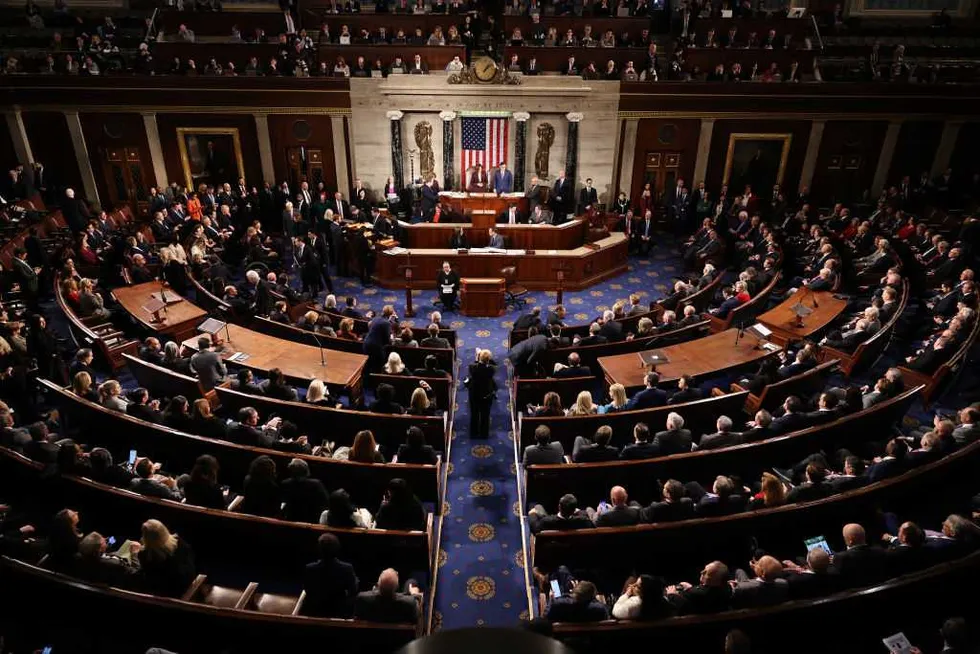
Photo by Chip Somodevilla/Getty Images The National Popular Vote Interstate Compact is closing in on 270 electors. asserted
Compact → close → electors
The midterms may have given blue states the opening they've been waiting for. uncertain
they → give → opening
Some Democratic states have long planned to override the Electoral College in favor of a popular vote, and these fantasies are closer to coming to fruition than ever before. asserted
fantasies → plan → fruition
In fact, some are eyeing 2028 as the earliest window to implement the plan that could change the way the United States elects its presidents. uncertain
States → eye → presidents
The deadline to join the compact for 2028 is July 20, 2028. asserted
deadline → join → 2028
They call the plan the National Popular Vote Interstate Compact, and analysts have found a feasible path to activating it by the next presidential election. asserted
analysts → call → election
The National Popular Vote Interstate Compact is an agreement between a growing number of states that "guarantees the Presidency to the candidate who receives the most popular votes in all 50 states (and the District of Columbia)," according to the National Center for Interstate Compacts. uncertain
who → grow → Compacts
The basic idea behind the compact isn’t to legally remove the Electoral College from the Constitution, advocates say. asserted
advocates → remove → Constitution
Rather, the Electoral College would essentially be rendered moot when the number of states’ electors equals 270 or more. asserted
number → render → 270
Currently, 18 states — California, Colorado, Connecticut, Delaware, Hawaii, Illinois, Massachusetts, Maryland, Maine, Minnesota, New Jersey, New Mexico, New York, Oregon, Rhode Island, Virginia, Vermont, and Washington — and the District of Columbia have enacted the compact, according to National Popular Vote. uncertain
states → enact → Vote
The states' electors add up to a total of 222, meaning the state equivalent of 48 electors would have to join the compact prior to election season in order to activate the agreement. asserted
equivalent → add → agreement
The deadline to join the compact for 2028 is July 20, 2028. asserted
deadline → join → 2028
The National Popular Vote, which would undermine the Electoral College while leaving it intact, has been floated as an idea for several years, though it was not treated as a viable option because the number of states and electors never came close to 270. asserted
number → undermine → 270
The blue wave that swept the nation last week, however, may bring the compact into more serious conversation going forward as it is widely believed that the National Popular Vote would benefit Democrats and harm Republicans at the ballot box. uncertain
Vote → sweep → box
Multiple articles published in the months leading up to the midterms identified very similar paths to 270 votes, that is, five states that could realistically be on the verge of joining the compact. uncertain
that → publish → compact
The identified pathway to 270 consists in having Arizona (11 electoral votes), Pennsylvania (19 votes), Michigan (15 votes), Nevada (6 votes), and Wisconsin (10 votes) join the compact. asserted
Arizona → identify → compact
The elector vote total for all five states is 61, so Pennsylvania and Michigan plus two of the three other states would have to join to make it an option for the next presidential election. asserted
it → have → election
Previously, the problem with this path was that none of the states had a Democratic trifecta, the most favorable condition for getting the compact signed into law. asserted
compact → have → law
For context, the 18 states in the compact are or were blue trifecta states when they joined. asserted
they → join → compact
The midterms changed the landscape in these other five states dramatically. asserted
midterms → change → states
Nevada, the only state on the list with a Republican governor, flipped blue. asserted
Nevada → flip → governor
All of the House and Senate chambers, which were generally a mix of blue and red before the midterms, flipped to the Democrats without exception. asserted
which → flip → exception
The result: All five states, which were previously mixed Republican and Democratic, are now Democrat trifectas. asserted
which → mix → ?
Democrat control, however, does not guarantee the successful passage of the law entering the state into the compact, and other large obstacles remain even if they do pass the laws. asserted
they → guarantee → laws
Trent England, a spokesman for Save Our States, told Blaze News that voters should be “very worried about this attempt to hijack the Electoral College.” asserted
voters → tell → College
England pointed out that many Democrats do not want to make this change, arguing that the importance of certain states, like Pennsylvania for example, would dramatically change for the worse for Democrats under the compact. asserted
importance → point → compact
The Save Our States spokesman also argued that the compact is “seriously flawed” for a number of procedural reasons, saying “It has no provisions for a nationwide recount, says nothing about how to combine votes from states using ranked-choice voting, and relies on cooperation from states not in the compact.” asserted
It → argue → compact
Fox News, "Absent a constitutional amendment, the legal and practical barriers are insurmountable," noting that the results of a popular vote will likely have surprising and unintended effects that may essentially cancel out votes. uncertain
that → note → votes
It is believed that if enough states join the compact to officially activate the agreement, the case would quickly be elevated to the Supreme Court to determine if it is constitutional. asserted
it → believe → Court

Give feedback · no sign-in needed

No sign-in needed for now. Your note is sent without a name, so it cannot be answered.

History Support