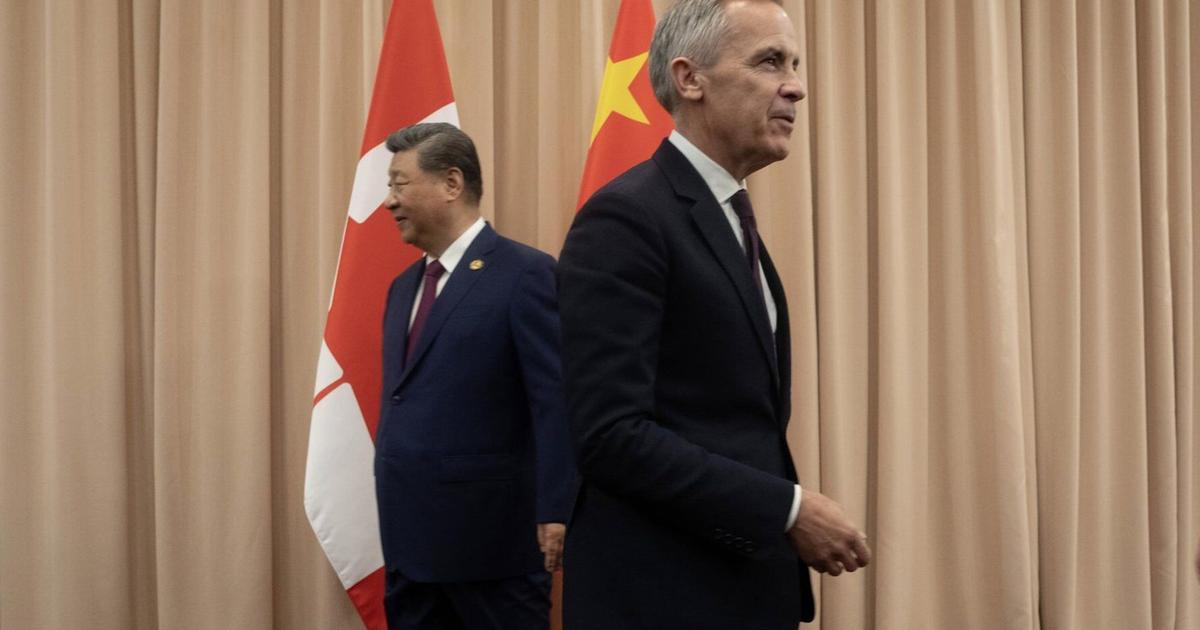
Canada and China are looking to expand trade relations, with Prime Minister Mark Carney and President Xi Jinping announcing relaxation of trade restrictions after a bilateral meeting on Tuesday.
asserted
Carney → look → Tuesday
Among the concessions was Canada’s decision to grant greater access to Chinese steel and aluminum products in the Canadian market.
asserted
decision → grant → market
In Tuesday’s meeting, China agreed to remove a 25 per cent tariff on Canadian exports of frozen pork cuts, along with frozen cold-water shrimp, Greenland halibut, some mollusks and sea cucumber.
asserted
China → agree → shrimp
Carney’s spokesperson said this represents approximately $400 million in Canadian exports annually.
asserted
this → say → exports
In exchange, Ottawa said it would expand what is called remissions coverage to 32 more steel and aluminum items from China.
asserted
what → say → China
That includes 23 steel items and nine aluminum goods for which the supply in Canada is either insufficient or unavailable.
asserted
supply → include → Canada
They agreed to open market access for Canadian fava beans, chickpeas and lentils to China, and would work toward an agreement on pet food and wild aquatic products by the end of the year.
asserted
They → agree → year
Canada has had “fairly severe restrictions on Chinese steel imports,” said McMaster University economist Colin Mang.
asserted
Mang → have → imports
These restrictions have tightened since 2024, when the Canadian Steel Producers Association and the Aluminum Association of Canada warned of “dumping” of cheap Chinese products.
asserted
Association → tighten → products
“The national government in China gives the industry cheap loans, cheap energy in order to subsidize production.
asserted
government → give → production
And that’s always been the big concern,” Mang said.
asserted
Mang → say → ?
Chinese steel products can have “artificially low” prices because of the supports provided by Beijing, said Blair Dickerson, president and CEO of the Canadian Steel Producers Association.
asserted
Dickerson → have → Association
“Canadian steel producers want to compete on a level playing field.
asserted
producers → want → field
We’ll compete with the best as long as it’s fairly priced,” she said.
asserted
she → compete → best
The current deal, however, includes a “very technical” and “niche” set of products like construction rebar wire made out of stainless steel, she said.
asserted
she → include → steel
“This is a really specific and a narrow amount of volume that we’re talking about,” Dickerson said.
asserted
Dickerson → talk → that
The biggest beneficiary could be Canada’s construction sector, Mang said, since the deal involves allowing access to Chinese goods that Canada doesn’t make itself.
uncertain
Canada → say → that
Canada stopped making long beams in the early 1990s, shortly after the (North American) free trade agreement,” he said.
asserted
he → stop → agreement
Canada’s biggest source of foreign steel by far is the United States, which accounts to 36.2 per cent of its steel imports, followed by South Korea (9.9 per cent) and China (5.9 per cent), according to the U.S International Trade Administration.
uncertain
which → account → Administration
Norwegian Cruise Line drops Halifax from select 2027 sailings, but port expects strong season
asserted
port → drop → season
Mistrial declared in trial of former Saskatoon massage therapist
- Nova Scotia hosting three virtual information sessions on AI data centres this week
-
asserted
Scotia → declare → centres
Cadet captain paralyzed from waist down after Hamilton attack
Most of Canada’s steel imports from China include long products, such as rebar and beams, followed by pipes, tubes and stainless-steel products.
asserted
Most → paralyze → pipes
While Canada is a major aluminum producer, with Quebec alone accounting for 60 per cent of North America’s supply, Canada still relies on imports for certain finished goods.
The beer industry’s supply chain and market are largely domestic — with Canadian grain being used to make beer for Canadian consumers — but it needs U.S. aluminum processing industry for packaging.
asserted
it → account → packaging
According to Beer Canada, around 80 per cent of Canada’s beer is packaged in aluminum cans, mostly made in the U.S.
“The United States and China, because there’s such large consumer markets, they have a scale advantage in manufacturing some consumer goods, like aluminum cans,” Mag said.
uncertain
Mag → accord → cans
A deepening trade relationship between Ottawa and Beijing could make Chinese-made cans more competitive against American-made ones, Mang said.
uncertain
Mang → deepen → ones
“If you’re eliminating tariffs on Chinese made aluminum products, that makes them more competitive against American aluminum products,” he said.
asserted
he → eliminate → products
This is part of Carney’s diversification strategy, Mang said, as Canada’s steel and aluminum industry still faces a 25 per cent tariff from U.S. President Donald Trump.
asserted
industry → say → Trump

 The Aporia