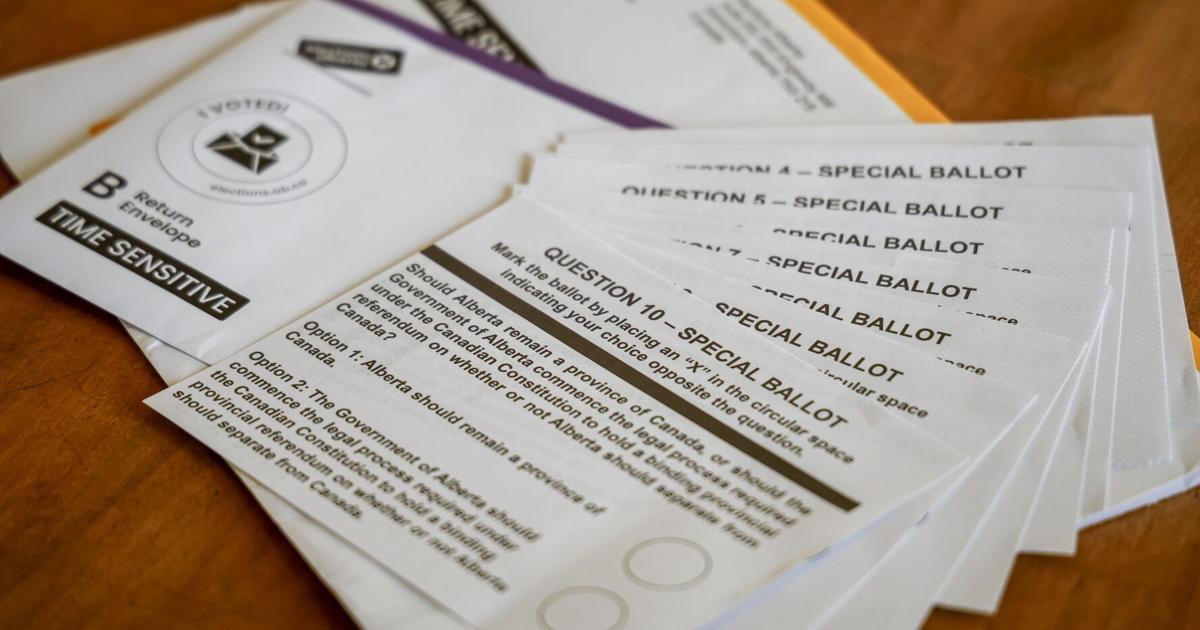
Photo via Global News

Canadians more united despite separatist sentiment in Alberta, Quebec: Ipsos

Read the original at Global News ↗
Cite

Boutilier, A. (2026, September 26). Canadians more united despite separatist sentiment in Alberta, Quebec: Ipsos. Global News. https://globalnews.ca/news/12071912/canadians-united-despite-separatist-sentiment-alberta-quebec-ipsos/

Dated when The Aporia collected the article, usually within hours of publication. Check the original for its exact date and byline.

Global News · collected 2026-09-26 · by Alex Boutilier

Quick Summary

Ipsos released data showing that 81% of Canadians outside Alberta want the province to stay part of Canada, while 69% in Quebec share this view despite their own separatist sentiments. Nationally, only 16% believe their provinces would be better off if they separated from Canada, a significant drop since 2019. The poll suggests that despite growing separatist sentiment in Alberta and Quebec, Canadians feel more united due to shared issues like the trade war with the United States and dealing with Donald Trump.
Written by AI on 2026-09-26, from this article's own text only (the story summary below draws on all the coverage).

AI analysis

Story summary

According to a new Ipsos survey exclusively for Global News, an overwhelming majority of Canadians want Alberta to remain part of Canada. Specifically, 81% of Canadians outside Alberta expressed that they wish the province stays unified with Canada, while only 9% desired its separation. In contrast, sentiments in Quebec were more divided due to local independence discussions; still, 69% of Quebeckers support Alberta remaining part of Canada. The survey indicates that despite separatist movements in both provinces, Canadians overall feel increasingly united, particularly regarding the trade war with the United States and handling issues like President Trump's policies. Gregory Jack from Ipsos Global Affairs noted this unity is stronger now than it was in 2019.

Written for “Canadian Unity Despite Separatism” on 2026-10-30, grounded in this article and the 0 other(s) covering the same event.

Story

📰 Canadian Unity Despite Separatism
Politics · 1 article(s) covering the same event.

Compared with similar articles

This article reads unscored and hedges 17% of its claims. Each row says how that neighbour differs.
CBC News
⚖️ Leans right Hedges 2 of 37 claims Outlet record 74/100
“The articles discuss different aspects of the Alberta separatist sentiment and poll results but do not describe the same specific incident or occurrence.”
CBC News
Hedges 5 of 46 claims Outlet record 74/100
“The articles discuss different aspects of public opinion regarding Alberta's potential separation from Canada and do not describe the same specific incident or occurrence.”
Global News
Hedges 0 of 6 claims Outlet record 63/100
“The articles discuss different aspects of Alberta's separatist sentiment without describing the same specific incident.”
Global News
⚖️ Leans left Hedges 2 of 23 claims Outlet record 63/100
“The articles discuss different aspects of political sentiment and polls in Canada, but do not describe the same specific incident or occurrence.”
National Post
Hedges 4 of 25 claims Outlet record 60/100
“The articles discuss different aspects of separatist sentiment in Alberta and Quebec but do not describe the same specific incident or occurrence.”
CBC News
Hedges 0 of 40 claims Outlet record 74/100
“Article A reports on a survey about Canadian sentiment towards Alberta's unity, while Article B discusses an MLA voting in favor of a binding referendum for Alberta independence.”
Global News
⚖️ Leans right Hedges 6 of 42 claims Outlet record 63/100
“The articles discuss related topics (separatist sentiment in Alberta) but describe different aspects and findings from Ipsos polls, not the same specific incident or occurrence.”
Toronto Star
⚖️ Leans left Hedges 6 of 35 claims Outlet record 64/100
“The articles discuss related topics (separatist sentiment in Alberta and a referendum vote), but they describe different aspects of the situation with distinct focuses and timeframes.”
Toronto Star
Hedges 5 of 44 claims Outlet record 64/100
“The articles discuss different aspects of Canadian unity and constitutional changes in Alberta, but do not describe the same specific incident or occurrence.”
CBC News
⚖️ Leans right Hedges 5 of 84 claims Outlet record 74/100
“Article A discusses a survey on Canadian attitudes towards separatism in Alberta and Quebec, while Article B reports on a pro-independence group's motorhome tour in northwestern Alberta to promote the upcoming referendum.”
How this article was measured signals, leaning charts, publisher record, byline, topics and claims

Signals How these are calculated →

Claims extracted
36
sentences that state something as happening or true
Uncertain
17%
6 of 36 hedged ("reportedly", "may", "according to")
Leaning
not political
takes no side on a contested political question
Publisher signals
63/100
Global News's corrections and hedging, across everything collected from it. Not a measure of accuracy.
Outlets on this story
1
Politics
Same framing elsewhere
1
articles that frame the event the way this one does
Analyzed 2026-09-26 · how these are computed

How this is being covered How these are calculated →

Article leaning vs. publisher reliability
Source leaning vs. consistency

Publisher

Global News · 2575 article(s) · 11 correction(s) detected
Running correction rate · 11 correction(s)

Who wrote this

Alex Boutilier
16 article(s) here · 1 carrying a prediction
🔮 America’s top diplomat in Ottawa appears to be conflating public diplomacy with “foreign interference” as the Republicans brace for what polls suggest could be a bruising in the U.S. midterms.
🔮 While court documents revealed that the RCMP believed Wallin had broken the law and were trying to gather proof of criminal wrongdoing, the police force announced in 2016 that Wallin would not be charged.
🔮 Researchers are McGill’s Media Ecosystem Observatory (MEO) have been keeping tabs on the online discourse around the province’s referendum which will ask, among other questions, if Albertans want a binding provincial vote on independence from Canada.
🔮 The increasing availability of sophisticated drone technology has led the Department of National Defence (DND) to move to take “critical” steps to counter “unauthorized drone activity” that could threaten Canadian military installations.
🔮 Champagne appeared non-committal when asked if Ottawa would extend the ban, which banned foreign investors from buying Canadian residential property and was first enacted in 2022.
🔮 That’s a far cry from the roughly 2,422 foreign agents Public Safety Canada has estimated are active in Canada, raising questions from opposition MPs about how effective the Liberals’ registration scheme will be.
🔮 Few are willing to be more public about it, and that’s their decision.”
🔮 “I would say that the use of counter-drone technology around critical infrastructure is becoming the norm,” Carvin said.
🔮 Anand, who formerly served as minister of national defence under former prime minister Justin Trudeau, pointed to Prime Minister Mark Carney’s decision to ramp up defence spending and the impact that money will have on northern security.
🔮 An overwhelming majority of Canadians want Alberta to remain part of a unified Canada and would vote for their own province to do the same, according to new data from Ipsos exclusively for Global News.
Also by Alex Boutilier
Nothing else under this byline is closely related to this article, so these are simply their most recent.
All 16 articles by Alex Boutilier →

Topics

Alberta Albertans Canada Canadians Ipsos

Subjects

Albertans NORP · 15× Alberta GPE · 9× Canada GPE · 7× Ipsos ORG · 6× Canadians NORP · 5× Confederation ORG · 3× Quebec GPE · 3× Global News ORG · 1× Wild Rose GPE · 1× the United States GPE · 1×

Narrative

Get breaking National news Canadians outside of Alberta were less likely than those in Alberta to feel their province was not getting its fair share from Ottawa, with just 26 per cent of respondents saying their province doesn’t get a fair shake.
framing: assertive · carried by 1 article(s) · first seen 2026-09-26
🔮 An overwhelming majority of Canadians want Alberta to remain part of a unified Canada and would vote for their own province to do the same, according to new data from Ipsos exclusively for Global News.

Claims (36 extracted, 6 hedged)

An overwhelming majority of Canadians want Alberta to remain part of a unified Canada and would vote for their own province to do the same, according to new data from Ipsos exclusively for Global News. uncertain
province → want → News
A full 81 per cent of respondents outside of Alberta said they want the Wild Rose province to remain part of Canada, with just nine per cent saying they want the province to leave. asserted
province → say → Canada
The desire for Alberta to remain in Canada was weaker in Quebec, which is having their own conversation about independence. asserted
which → remain → independence
But 69 per cent of respondents in that province still wanted Alberta to reject separation. asserted
Alberta → want → separation
Overall, Ipsos said their data suggests that Canadians are feeling more united despite separatist sentiment taking up the oxygen in Quebec and Alberta. uncertain
sentiment → say → Quebec
“The country’s more united right now, especially around the (trade) war with the United States … and dealing with Donald Trump and other issues, than they were in 2019,” said Gregory Jack, a senior vice president with Ipsos Global Affairs. asserted
Jack → ’ → Affairs
“(That’s) despite the fact that, you know, it feels like the country is really divided with a potential referendum in Quebec and a referendum here in Alberta. asserted
country → ’ → Alberta
Just 16 per cent of respondents nationally — excluding Albertans — felt that their provinces would be better off if they separated from Canada, and just 22 per cent of Albertans agreed. asserted
cent → exclude → Albertans
Both numbers are down since Ipsos asked the same question in 2019, when 33 per cent of Albertans said they’d be better off alone. asserted
they → ask → Albertans
Only 23 per cent of Canadians outside of Alberta said they felt less committed to Canada than a few years ago, with 28 per cent of Albertans saying they felt that way. asserted
they → say → Albertans
Again, the percentage of Albertans who agreed with the sentiment was down sharply since 2019. asserted
who → agree → 2019
Get breaking National news Canadians outside of Alberta were less likely than those in Alberta to feel their province was not getting its fair share from Ottawa, with just 26 per cent of respondents saying their province doesn’t get a fair shake. asserted
province → get → shake
Nearly one in two Albertans (48 per cent) told the pollster their province didn’t get a fair deal from Confederation. asserted
province → tell → Confederation
“The major outlier is the measure on whether the province gets its fair share from Confederation, where Albertans remain more likely than other Canadians to believe this is the case,” Ipsos said in its polling results. asserted
Ipsos → get → results
“The data suggest Albertans, while feeling closer to the national average on many measures, still want a discussion on benefits from Confederation, but that it doesn’t necessarily translate to desire to separate.” asserted
it → suggest → desire
Albertans will vote in a referendum next month that asks, among other questions, if they want to start the legally required process to hold a formal vote on separation. asserted
they → vote → separation
A victory for the separatists on Oct. 19 would kick off campaigning in earnest for both the separatists and those who want the province to remain within Canada. asserted
province → kick → Canada
Ipsos found that a strong majority (70 per cent) of Albertans want to remain part of Canada, while 20 per cent want to hold a referendum on separation. asserted
cent → find → separation
But Ipsos found that the separatist vote may be softer than believed. uncertain
vote → find → ?
- Lions climb standings with win over Roughriders - asserted
Lions → climb → Roughriders
RCMP remind drivers to stop for school buses after two Kelowna students are struck by a vehicle - asserted
students → remind → vehicle
Planned driving safety training campus in Beaumont gets $38.5M from province - asserted
campus → plan → province
Death of pregnant woman and her baby prompts call for Saskatchewan rural health changes asserted
Death → prompt → changes
If the province moves to holding a binding referendum on separation, the number of respondents who would vote to stay rises to 84 per cent, while just 16 per cent would vote for separation. asserted
cent → move → separation
That suggests more people want to hold a referendum than want to actually leave the country. uncertain
people → suggest → country
“Rural Albertans, older Albertans and male Albertans are more likely to say that they want to go and younger Allbertans, more urban Albertans here in Calgary or in Edmonton are more likely to see that they’re going to want to stay,” Jack said. asserted
Jack → say → Edmonton
“We should see perhaps some more movement in the next couple of weeks as the referendum gets closer, but a lot people have a position on this. asserted
people → see → this
I think that they took it earlier in the campaign and they haven’t really changed their position whether they’re on the ‘yes’ side or the ‘no’ side.” asserted
they → think → side
Both Prime Minister Mark Carney’s Liberals and Pierre Poilievre’s Conservative Party are committed to campaigning for Alberta to remain a province in Canada — although Ipsos’ had some surprising numbers about which politician might be better suited to arguing that position with Albertans. uncertain
politician → commit → Albertans
In more bad news for Poilievre, Ipsos’ findings suggest Carney is more popular than he is in Alberta — traditionally the Conservatives’ heartland, and the province Poilievre now represents in the House of Commons. asserted
Poilievre → suggest → Commons
Just over half (51 per cent) of Albertans said they had a favourable view of Carney, compared to 35 per cent who viewed the prime minister unfavourably. asserted
who → say → minister
For Poilievre, support was more divided — with 44 per cent of Albertans viewing him favourably, compared to 40 per cent unfavourably. asserted
cent → divide → cent
“That’s something we don’t often see in Alberta,” Jack noted. asserted
Jack → ’ → Alberta
“(Carney) hasn’t played a key role so far in the referendum, but obviously these numbers suggest that he could in the future.” uncertain
he → play → future
The Ipsos poll was conducted for Global News between Sept. 18 and 22, and surveyed 1,500 voting-aged Canadians — 600 in Alberta, and 900 in the rest of Canada. asserted
poll → conduct → Canada
A similar poll of 1,500 Canadians would be considered accurate within 3.1 percentage points. asserted
poll → consider → points

💬Give feedback
🕘History 🎫Support