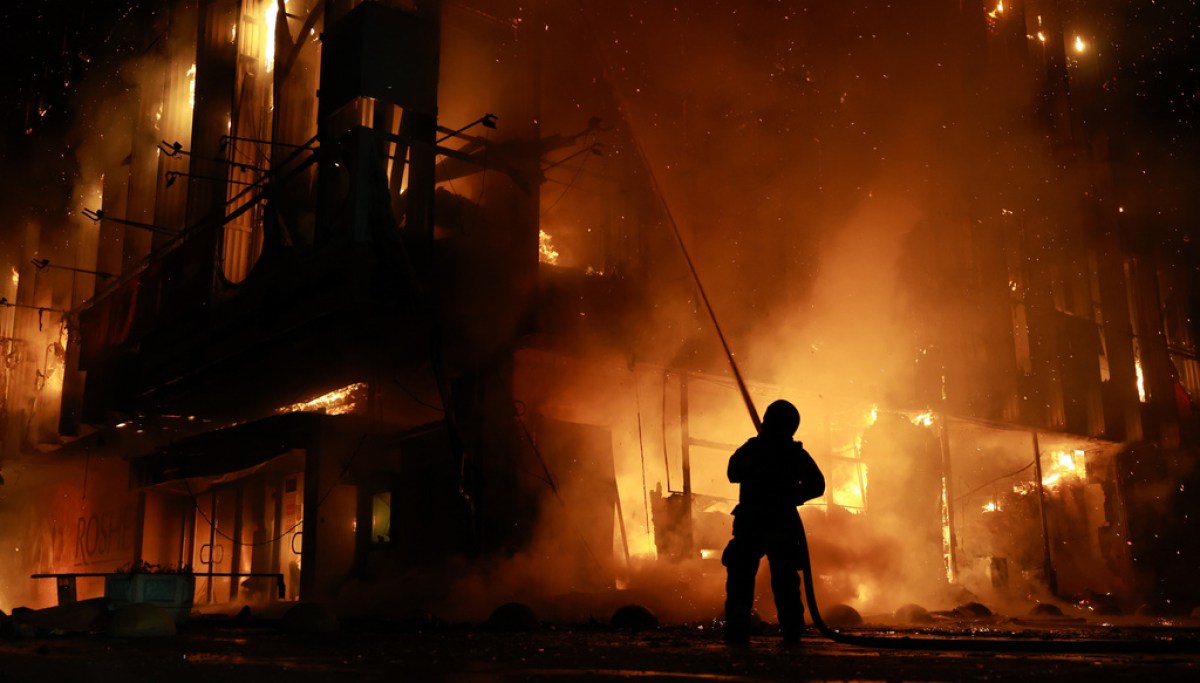
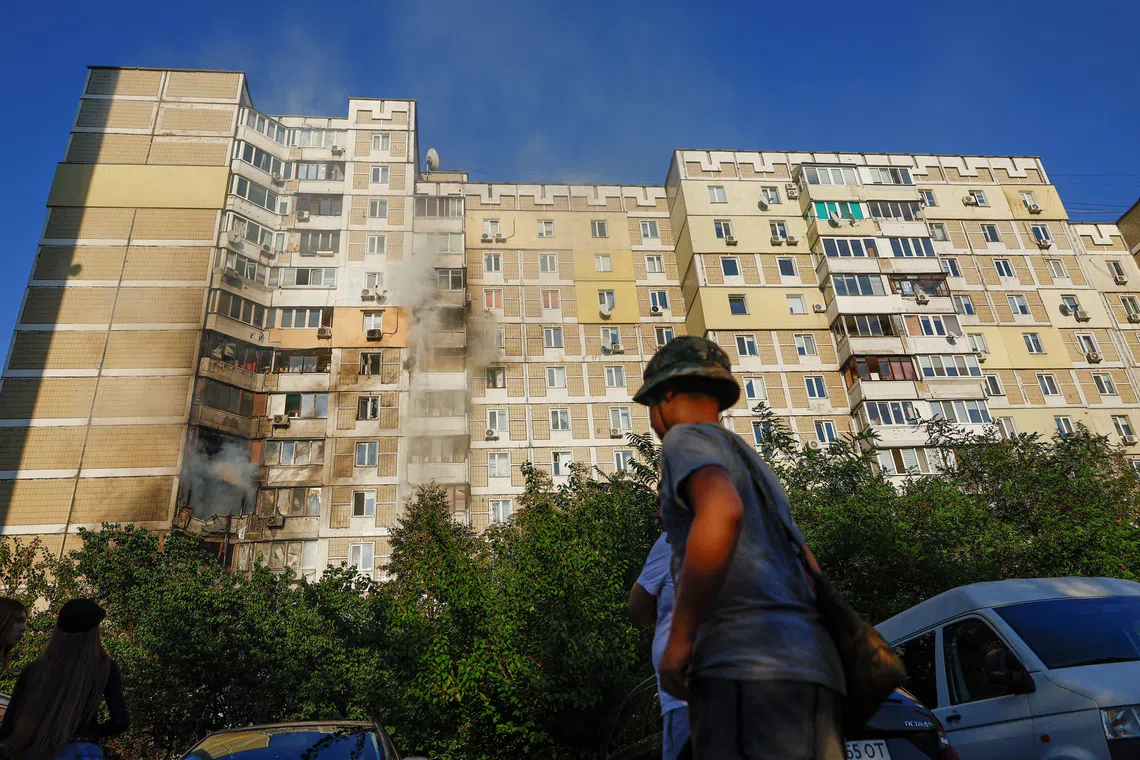
Photo via Washington Examiner

How Ukraine’s 40-day summer drone campaign to end the war with Russia backfired

Read the original at Washington Examiner ↗
Cite

Knox, B. (2026, September 26). How Ukraine’s 40-day summer drone campaign to end the war with Russia backfired. Washington Examiner. https://www.washingtonexaminer.com/news/world/4743686/ukraine-summer-drone-campaign-russia-backfired/

Dated when The Aporia collected the article, usually within hours of publication. Check the original for its exact date and byline.

Washington Examiner · collected 2026-09-26 · by Brady Knox

Quick Summary

In June, Ukrainian President Volodymyr Zelensky launched a 40-day drone campaign aimed at ending the war with Russia by targeting strategic Russian sites including Wildberries warehouses and fuel ships supplying Crimea. Initially successful, Ukrainian drones struck 35 Russian vessels from July 6 to 10, leading to immediate impacts on civilian life in Russia and supply shortages in Crimea. However, Russia quickly adapted its defenses and retaliated by intensifying attacks on Ukraine’s port city of Odesa starting July 11, targeting fuel depots, ships, and facilities with cruise missiles. This response culminated in a near-total blockade of the Greater Odesa ports by mid-August, leading to significant disruptions for international shipping.
Written by AI on 2026-09-26, from this article's own text only (the story summary below draws on all the coverage).

AI analysis

Story summary

On June 25, Ukrainian President Volodymyr Zelensky approved a 40-day plan to compel Russia to end the war through intensified strikes. Ukraine targeted two new strategic objectives: Wildberries warehouses in Russia and fuel ships supplying Crimea. Kyiv claimed these warehouses contained dual-use goods, aiming to impose costs on ordinary Russians to pressure Moscow into ending the conflict. From July 6 to 10, Ukrainian drones hit 35 Russian vessels, including 14 in one night, exploiting Russia's concentrated air defenses around military and energy sites. However, the campaign faced challenges as it progressed, with logistical and economic disruptions affecting businesses across Ukraine, according to a July 31 Facebook post by National Bank of Ukraine Governor Andriy Pyshny.

Written for “Ukraine Drone Campaign Backfire” on 2026-11-02, grounded in this article and the 0 other(s) covering the same event.

Story

📰 Ukraine Drone Campaign Backfire
World · 1 article(s) covering the same event.

Compared with similar articles

This article reads unscored and hedges 3% of its claims. Each row says how that neighbour differs.
The Independent
Hedges 2 of 35 claims Outlet record 59/100
“Article A discusses Zelensky's speech at the United Nations General Assembly, while Article B covers a previously announced military campaign strategy by Ukraine.”
CBC News
⚖️ Leans left Hedges 2 of 46 claims Outlet record 74/100
“Article A describes a specific drone attack in Kyiv that killed a teenager and injured others, while Article B discusses Ukraine's broader 40-day drone campaign strategy and its strategic targets.”
ABC News (AU)
⚖️ Leans strongly right Hedges 2 of 36 claims Outlet record 68/100
“The articles describe different incidents occurring in different locations and involving distinct events.”
South China Morning Post
Hedges 0 of 3 claims Outlet record 63/100
“Article A discusses Ukraine's strategic drone campaign against Russian targets, while Article B reports on Russian drones attacking a market outside Kyiv and other regions, killing several people.”
The Independent
⚖️ Leans right Hedges 3 of 35 claims Outlet record 59/100
“Article A discusses Ukraine's strategic drone campaign targeting Russian warehouses and fuel ships, while Article B covers local residents' fear of missile or drone attacks in a Polish border village receiving emergency alerts. These describe different specific events.”
Al Jazeera
⚖️ Leans right Hedges 0 of 2 claims Outlet record 60/100
“Article A discusses Lavrov's statement about Russia's ongoing war in Ukraine, while Article B talks about a 40-day drone campaign by Ukraine to end the war, which are different specific events.”
South China Morning Post
Hedges 0 of 8 claims Outlet record 63/100
“The articles describe different aspects of the conflict, one focusing on Ukraine's strategic drone campaign from June to August, and the other detailing Russia's jet drones breaching Kyiv's defenses in October.”
The Guardian
Hedges 9 of 65 claims Outlet record 66/100
“Article A describes a single drone attack mission during the night, while Article B discusses a broader 40-day campaign announced by Ukrainian President Zelensky that includes multiple strategic targets over an extended period.”
Washington Examiner
⚖️ Leans strongly right Hedges 9 of 68 claims Outlet record 70/100
“The articles describe different aspects of the Russia-Ukraine conflict over a period of time rather than a single incident.”
The Straits Times
Hedges 1 of 7 claims Outlet record 66/100
“Article A describes Ukraine's announcement of a 40-day drone campaign against Russia, while Article B reports on Russia's response with its own strikes in Ukraine.”
How this article was measured signals, leaning charts, publisher record, byline, topics and claims

Signals How these are calculated →

Claims extracted
60
sentences that state something as happening or true
Uncertain
3%
2 of 60 hedged ("reportedly", "may", "according to")
Leaning
withheld
no quote in the article backed the model's score
Publisher signals
70/100
Washington Examiner's corrections and hedging, across everything collected from it. Not a measure of accuracy.
Outlets on this story
1
World
Same framing elsewhere
1
articles that frame the event the way this one does
Analyzed 2026-09-26 · how these are computed

How this is being covered How these are calculated →

Article leaning vs. publisher reliability
Source leaning vs. consistency

Publisher

Washington Examiner · 3900 article(s) · 7 correction(s) detected
Running correction rate · 7 correction(s)

Who wrote this

Brady Knox
83 article(s) here · 1 carrying a prediction
🔮 On Friday, Editor-in-Chief Sergei Sokolov announced that the newspaper would be shutting down for good due to pressure from authorities, dramatically beginning his statement with, “We were killed.”
2026-10-30 · assertive framing · Russia shuts down last independent newspaper
🔮 Pope Leo XIV may become the first-ever pope to vote in a secular election, let alone a U.S. one, as he ordered a mail-in ballot for the 2026 midterm elections.
🔮 Israel’s 2026 parliamentary elections are set to amount to political deadlock, with neither Prime Minister Benjamin Netanyahu nor Gadi Eisenkot getting enough votes to form a government.
🔮 A judge ruled in favor of his deportation, but said he couldn’t be deported to Mali over fears of persecution.
🔮 President Donald Trump said that work on the East Potomac Golf Links course in Washington, D.C., would begin “immediately,” despite a legal challenge.
🔮 The graph showed the climb in price over time, with annotations showing major events in Iran and Ukraine that could have had an effect.
🔮 Zelensky then said Ukraine would no longer obey Trump’s ceasefire in an interview with the Financial Times, in which the Ukrainian president also spoke openly about his anger over the United States allegedly throttling Ukraine’s access to Starlink and intelligence.
🔮 Secretary of War Pete Hegseth claimed the Department of War would field “hundreds of thousands” of one-way attack systems in 2026, and that the second Trump administration inherited no such programs from the Biden administration.
🔮 That threat moves again because they will.
🔮 He raised his candidacy for the award by claiming he had “saved more lives than anyone in history” since he prevented Iran from obtaining a nuclear weapon, which the country would use to blow up “the entire Middle East, and ultimately far beyond the Middle East.”
Also by Brady Knox
Russia shuts down last independent newspaper
2026-10-30 · Washington Examiner
Nothing else under this byline is closely related to this article, so these are simply their most recent.
All 83 articles by Brady Knox →

Topics

Crimea Moscow Russia Russian Ukraine

Subjects

Russia GPE · 7× Ukraine GPE · 7× Crimea GPE · 5× Moscow GPE · 4× Russian NORP · 4× Ukrainian NORP · 4× Kremlin ORG · 2× Kyiv GPE · 2× Russians NORP · 2× Turkish PERSON · 2×

Narrative

” “Cash flows are deteriorating, finished goods are accumulating, prices and demand are changing, and production and logistics chains are being disrupted,” National Bank of Ukraine Governor Andriy Pyshny wrote in a July 31 Facebook post discussing the strikes, warning that businesses’ ability to service loans was eroding.
framing: assertive · carried by 1 article(s) · first seen 2026-09-26
🔮 Kyiv argued the warehouses held dual-use goods, and that hitting them would impose an immediate cost on ordinary Russians, who would pressure the Kremlin to end the war.
2026-09-26 · Washington Examiner
How Ukraine’s 40-day summer drone campaign to end the war with Russia backfired · assertive framing

Claims (60 extracted, 2 hedged)

On June 25, at the height of Ukraine’s long-range drone success, Ukrainian President Volodymyr Zelensky announced that he had approved a 40-day plan to compel Moscow to end the war through an intensified strike campaign. asserted
he → announce → campaign
As part of the surge, Ukraine chose two new strategic targets to ramp up pressure on the Russian populace: Wildberries warehouses, Russia’s equivalent to Amazon, and fuel ships supplying Crimea. asserted
Ukraine → choose → Crimea
Kyiv argued the warehouses held dual-use goods, and that hitting them would impose an immediate cost on ordinary Russians, who would pressure the Kremlin to end the war. asserted
who → argue → war
The shipping strikes aimed to strangle Crimea into an energy and supply crisis. asserted
strikes → aim → crisis
Each campaign started strong. asserted
campaign → start → ?
With air defenses concentrated around energy and military sites, civilian warehouses and shipping were largely exposed. asserted
warehouses → concentrate → sites
From July 6 to 10, Ukrainian drones struck 35 Russian vessels, including 14 in a single night. asserted
drones → strike → night
The world became awash with images of burning warehouses blackening out the sky, and fuel shortages in Crimea became more acute. asserted
shortages → become → Crimea
Russian air defenses soon adapted. asserted
defenses → adapt → ?
Of far greater consequence, however, was Moscow’s decision to overhaul its own strike doctrine in response. asserted
decision → overhaul → response
Strangling Odesa The Greater Odesa ports, Ukraine’s only access to the Black Sea and an economic lifeline, were blockaded early in the war, but reopened under a Turkish-negotiated deal. asserted
ports → strangle → deal
After it collapsed in 2023, Russia opted against another blockade, likely out of fear of retaliation against its own shadow fleet or attacks against shipping to Crimea. asserted
Russia → collapse → Crimea
Russia first began stepping up attacks on Odesa in December, but these remained only disruptive, rather than crippling, with Moscow’s mind on the escalation ladder. asserted
these → begin → ladder
After Ukraine’s drone blitz in the Black and Azov seas, the gloves came off. asserted
gloves → come → seas
, Moscow launched a sustained drone and missile campaign against the port city, hitting fuel depots, ships, and port facilities at an intensity not seen since the war’s beginning. asserted
Moscow → launch → beginning
The inflection point came on July 19, when Russia targeted and sank the Turkish-owned MV Golden Leo as it left the nearby port of Chornomorsk with three cruise missiles, killing 10 crewmen. “Since then every vessel entering or leaving Odessa has been targeted,” the Economist reported. asserted
Economist → come → Odessa
Russia’s S8000 Banderol, a cheap jet-powered cruise missile, proved ideal for hunting cargo ships while evading the port’s depleted air defenses. asserted
Banderol → power → defenses
By July 30, the port was under a “de facto blockade,” RBC Ukraine reported, with Maersk and CMA CGM canceling all port calls to Greater Odesa and diverting them to Constanta, Romania. asserted
Maersk → report → Constanta
Ukraine offered a mutual Black Sea truce by mid-August, which Russia ignored. asserted
Russia → offer → which
On Sept. 21, Ukrainian Ports Association president Dmytro Barinov revealed that over 300 vessels had been damaged or destroyed since the missile and drone campaign began. asserted
campaign → reveal → Sept.
The Ukrainian Agribusiness Club told grain traders to expect Odesa to remain closed through the winter. asserted
Odesa → tell → winter
“This is an unprecedented situation, when civilian vessels are not simply struck but methodically finished off and destroyed, to deny us the ability to conduct trade,” Ukrainian Major Gen. Vadim Skibitsky, deputy head of Ukraine’s military intelligence, told RBC-Ukraine on Aug. 10. asserted
Skibitsky → strike → Aug.
The damage is difficult to overstate. asserted
damage → overstate → ?
“One ship of 100,000 tons is equivalent to 5,000 trucks, 5,000 drivers, and 5,000 border procedures,” Barinov explained to the Economist, adding that the current situation is the worst of the entire war, as Danube routes that offset losses in 2022 suffer from low water and Russian attacks. asserted
that → explain → water
The exports can’t all be diverted overland either, especially as Russia’s sustained attacks on Ukraine’s locomotive fleet are degrading the most efficient overland route. asserted
attacks → divert → route
Ukrainian Agriculture Minister Taras Vysotsky estimated that Ukraine has over 60 million tons of agricultural products awaiting export, requiring about 5 million tons of monthly capacity. asserted
Ukraine → estimate → capacity
Assuming the complete closure of Greater Odessa ports, alternative routes can only reach half of this total, according to Ag Bull, and that estimate assumes full railroad capacity and use of Danube routes. uncertain
estimate → assume → routes
The World Bank put Ukraine’s GDP in 2024 at $190.74 billion, and its exports at $41.6 billion. asserted
Bank → put → billion
Ukraine’s Economy Ministry says more than 60% of merchandise exports, and 89% of agricultural exports, pass through its seaports. asserted
% → say → seaports
That leaves roughly $25 billion in annual exports, about 13% of GDP, at the mercy of ports that are now commercially dead. asserted
that → leave → ports
Vysotsky told Reuters in early August that the agricultural sector alone could lose as much as $3 billion this year. uncertain
sector → tell → billion
Ferrexpo halted mining and suspended two major steel plants on Aug. 5. asserted
Ferrexpo → halt → Aug.
Mining and metallurgy made up 15.2% of Ukraine’s export revenue in 2025. asserted
Mining → make → 2025
Russia’s warehouse retaliation came even faster. asserted
retaliation → come → ?
On July 18, the day of Ukraine’s first Wildberries strikes, Moscow launched one of the war’s largest missile barrages on Kyiv. asserted
Moscow → launch → Kyiv
Warehouses quickly became a top target, and later concentrated assaults were framed as explicit retaliation, including an Aug. 5 strike hitting Rozetka, Epicentr, Novus, and Silpo warehouses in Kyiv. asserted
assaults → become → Kyiv
Some analysts dispute any link, noting Russia struck warehouses earlier in the war. asserted
Russia → dispute → war
But most agree that July brought a sudden shift toward systematically targeting them, coinciding with Ukraine’s Wildberries campaign. asserted
July → agree → campaign
…and 20 more, not listed.

💬Give feedback
🕘History 🎫Support