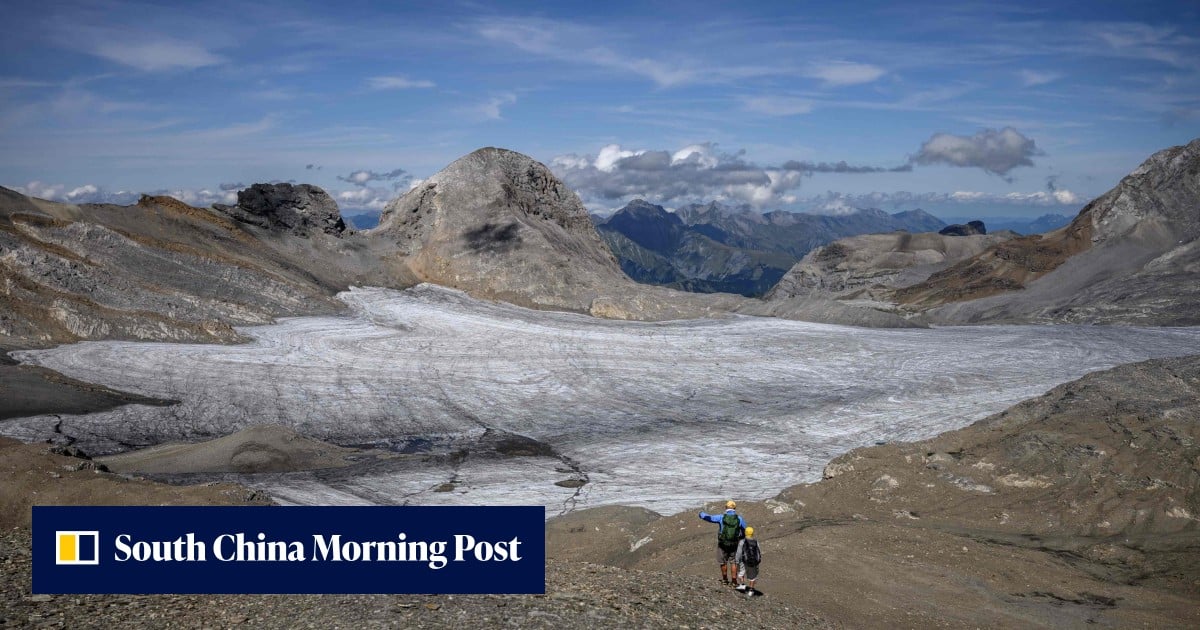
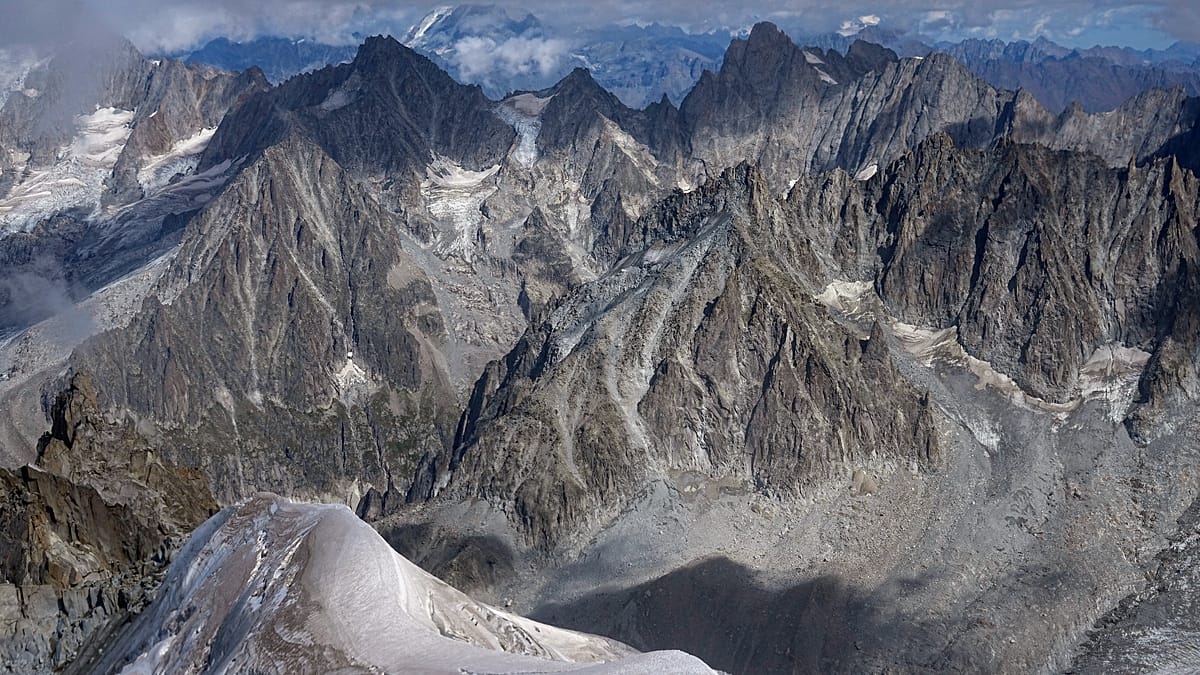
Photo via Al Jazeera

How Switzerland lost 20 percent of its ice in five years

Read the original at Al Jazeera ↗
Cite

Shankar, P. (2026, October 2). How Switzerland lost 20 percent of its ice in five years. Al Jazeera. https://www.aljazeera.com/news/2026/10/2/how-switzerland-lost-20-percent-of-its-ice-in-five-years?traffic_source=rss

Dated when The Aporia collected the article, usually within hours of publication. Check the original for its exact date and byline.

Al Jazeera · collected 2026-10-02 · by Priyanka Shankar

Quick Summary

Switzerland’s glaciers have experienced a significant loss, shrinking by nearly 20% since 2021 due to warmer winters with less snow and record-high temperatures during the summer of 2026. Scientists from the Swiss Glacier Monitoring Network reported that in just one hydrological year ending September 30, 2026, glaciers lost 5.5% of their ice volume. GLAMOS chief Matthias Huss noted that under current conditions, small Alpine glaciers are unlikely to survive, highlighting the impact of anthropogenic climate change on these natural formations.
Written by AI on 2026-10-02, from this article's own text only (the story summary below draws on all the coverage).

AI analysis

Story summary

In 2026, Swiss glaciers experienced significant ice loss, with more than 5% of the remaining glacier volume disappearing over the year. This near-record melt is attributed to intense summer heatwaves following a winter with little snowfall, accelerating long-term climate-driven glacial retreat. Since 2021, Switzerland has lost nearly 20% of its glaciers, making it one of the most dramatic losses observed globally. Scientists from organizations like GLAMOS warn that such rapid melting could threaten water supplies for farming, hydropower, and transport in coming decades, destabilizing mountain slopes and increasing landslide risks. Researchers stress that without human-induced climate change and fossil fuel emissions, this warming would not be occurring, underscoring the urgent need to address global warming.

Written for “Swiss Glaciers Melting” on 2026-10-31, grounded in this article and the 7 other(s) covering the same event.

Story

📰 Swiss Glaciers Melting
Environment · 8 article(s) covering the same event. Compare every outlet's account →

Compared with similar articles

This article reads unscored and hedges 10% of its claims. Each row says how that neighbour differs.
The Guardian
Hedges 1 of 20 claims Outlet record 66/100
South China Morning Post
Hedges 1 of 5 claims Outlet record 64/100
ABC News (AU)
Hedges 4 of 29 claims Outlet record 68/100
Euronews
Hedges 0 of 5 claims Outlet record 60/100
“While both articles discuss significant glacier melt in Switzerland during 2026, Article A focuses on a single year's data, while Article B covers a five-year period and provides more context about cumulative ice loss.”
BBC News
⚖️ Leans left Hedges 4 of 35 claims Outlet record 68/100
“While both articles discuss significant glacial ice loss in Switzerland due to climate change, they describe different periods of time (one focuses on a single year's near-record losses, the other covers five years of cumulative loss).”
CBC News
Hedges 0 of 25 claims Outlet record 60/100
“While both articles discuss the melting of Swiss glaciers due to climate change over a similar timeframe, they appear to be reporting on slightly different aspects of this ongoing issue rather than the exact same specific event or report.”
How this article was measured signals, leaning charts, publisher record, byline, topics and claims

Signals How these are calculated →

Claims extracted
41
sentences that state something as happening or true
Uncertain
10%
4 of 41 hedged ("reportedly", "may", "according to")
Leaning
not political
takes no side on a contested political question
Publisher signals
60/100
Al Jazeera's corrections and hedging, across everything collected from it. Not a measure of accuracy.
Outlets on this story
8
Environment
Same framing elsewhere
1
articles that frame the event the way this one does
Analyzed 2026-10-02 · how these are computed

How this is being covered How these are calculated →

Article leaning vs. publisher reliability
Source leaning vs. consistency

Publisher

Al Jazeera · 4530 article(s) · 2 correction(s) detected
Running correction rate · 2 correction(s)

Who wrote this

Priyanka Shankar
11 article(s) here · 1 carrying a prediction
🔮 “First, Russia could have deliberately shared information with Iran,” he said.
🔮 No clear winner has emerged from Israel’s election, raising speculation over which party could form the next government.
2026-10-30 · assertive framing · How can Israel break its election deadlock?
🔮 The estimate, disclosed last week, comes just days before the November 3 midterm elections, which will determine if US President Donald Trump’s Republican Party will maintain control of Congress for the next two years.
🔮 The government is also expected to announce changes to Parcoursup, France’s national online university admissions platform, according to French media reports.
🔮 Israeli settler attacks during this year’s olive harvest season have already surpassed 2025 totals, with critics pointing out that mere condemnations by the EU and member states without holding Israel to account will not deter settler pogroms, which are granted impunity by the Israeli authorities.
🔮 - list 3 of 3G7 nations to release oil and diesel stocks, will it bring down the prices?
🔮 In a statement on Thursday, G7, which includes the US, UK, Canada, Japan, Germany, Italy and France, with the EU also represented, said there will also be a “substantial diesel release within the first 20 days” and discussions over “additional diesel releases as necessary” will be held in the coming days.
🔮 Thousands more troops are also on their way to the region, just a month before November US midterm elections, which could see US President Donald Trump’s Republican Party hit hard by his handling of the war, which is deeply unpopular in the US.
🔮 “This is more than four times the annual drinking water consumption of all Swiss households,” the report’s researchers said and warned this could impact the country’s future water supply.
🔮 Pike would have been the first woman in more than 200 years to be put to death in Tennessee and was the only woman on the state’s death row.
Also by Priyanka Shankar
Nothing else under this byline is closely related to this article, so these are simply their most recent.
All 11 articles by Priyanka Shankar →

Topics

GLAMOS Nepal Switzerland the Swiss Commission for Cryosphere Observation the Swiss Glacier Monitoring Network

Subjects

Switzerland GPE · 9× GLAMOS ORG · 4× Al Jazeera ORG · 2× Nepal GPE · 2× Swiss NORP · 2× 3India GPE · 1× SCNAT ORG · 1× the Swiss Academy of Sciences ORG · 1× the Swiss Commission for Cryosphere Observation ORG · 1× the Swiss Glacier Monitoring Network ORG · 1×

Narrative

In a report (PDF) published by the Swiss Glacier Monitoring Network (GLAMOS) and the Swiss Commission for Cryosphere Observation of the Swiss Academy of Sciences (SCNAT) on Thursday, researchers said Swiss glaciers lost 5.5 percent of their ice volume over the hydrologic year ending September 30, 2026, and nearly 20 percent since 2021.
framing: assertive · carried by 1 article(s) · first seen 2026-10-02
🔮 “This is more than four times the annual drinking water consumption of all Swiss households,” the report’s researchers said and warned this could impact the country’s future water supply.
2026-10-02 · Al Jazeera
How Switzerland lost 20 percent of its ice in five years · assertive framing

Claims (41 extracted, 4 hedged)

Switzerland’s glaciers are rapidly receding due to a combination of winters with too little snow and record-high temperatures across Europe this summer, scientists say. asserted
scientists → recede → Europe
In all, one of the world’s top ski destinations has lost nearly one-fifth of its glacial ice in just five years. asserted
one → lose → years
In a report (PDF) published by the Swiss Glacier Monitoring Network (GLAMOS) and the Swiss Commission for Cryosphere Observation of the Swiss Academy of Sciences (SCNAT) on Thursday, researchers said Swiss glaciers lost 5.5 percent of their ice volume over the hydrologic year ending September 30, 2026, and nearly 20 percent since 2021. asserted
glaciers → publish → 2021
What the science says - list 2 of 3Why Nepal is demanding climate justice and compensation after deadly floods - list 3 of 3India to supply Nepal electricity after floods wrecked hydropower projects Why is Switzerland, famed for its Alpine terrain and winter sports, losing its glaciers and what does this mean for the country? asserted
this → say → country
Here’s what we know. What have scientists discovered? asserted
scientists → ’ → What
In September, a GLAMOS team visited 23 glaciers in Switzerland to record end-of-summer measurements of ice melt and snow accumulation. asserted
team → visit → melt
Visiting one glacier named Scex Rouge in the Western Swiss Alps in early September, GLAMOS chief Matthias Huss, one of the report’s researchers, told the Reuters news agency that a measuring pole, about four metres (13 feet) high, was drilled into the ice in July to provide the team with a point of reference. asserted
pole → visit → reference
“Now when we have come back here, we saw the pole was out by three metres [10ft]. asserted
pole → come → metres
So just in August and September of this year, even excluding the heatwaves of June and July, we have lost three metres of ice at an elevation of almost 3,000 metres [9,843ft],” he explained. asserted
he → exclude → metres
“This clearly indicates these conditions that we had this summer, they are just inconsistent with the survival of these small glaciers in the Alps,” he added. asserted
he → indicate → Alps
Why are glaciers in Switzerland losing ice? asserted
glaciers → lose → ice
According to the report, the total mean thickness of individual glaciers in Switzerland has fallen by between 2.5 and four metres in 2026. uncertain
thickness → accord → 2026
At glacier tongues – narrow glacial extensions of a glacier which project from land into a body of water – it had decreased by as much as 10 metres in some places over the summer. asserted
it → project → summer
“We can clearly attribute the massive ice loss to the warming, and thus anthropogenic [caused by humans] climate change. asserted
We → attribute → humans
In addition, there was little snow in winter, and therefore the glaciers were poorly protected when the heat started,” GLAMOS chief Huss told Al Jazeera. asserted
Huss → be → Jazeera
He noted that while their measurements have indicated that the melting has affected all glaciers in Switzerland equally, the effects were most visible on smaller glaciers. asserted
effects → note → glaciers
“Those shrink very quickly and sometimes even completely disappeared. asserted
Those → shrink → ?
Also, large glaciers lost an enormous quantity of ice, but they remain impressive,” he added. asserted
he → lose → ice
The report’s scientists warned that the glaciers also lost a total of about 2.2 trillion litres of water (581 billion gallons) between July and September alone. asserted
glaciers → warn → July
“This is more than four times the annual drinking water consumption of all Swiss households,” the report’s researchers said and warned this could impact the country’s future water supply. uncertain
this → say → supply
What does this mean for Switzerland? asserted
this → mean → Switzerland
Switzerland is a country known for winter sports and Alpine tourism, which depends on the glaciers. asserted
which → know → glaciers
About 4 percent of the country’s entire workforce is employed in the tourism sector. asserted
percent → employ → sector
“This affects tourism and also how we perceive the mountains – they are no longer white but increasingly grey and black,” he told Al Jazeera. asserted
he → affect → Jazeera
He added that the water provided by glaciers is also important for the economy. asserted
water → add → economy
“It is used to fill up hydropower lakes that produce clean energy, and supplies the biggest streams of Europe,” he said. asserted
he → use → Europe
“We’re not yet seeing the full consequences as glaciers are still around and they contribute water when we need it. asserted
we → see → it
But this potential is soon being lost,” he added. asserted
he → lose → ?
Harry Zekollari, a glaciologist and associate research professor at the Department of Water and Climate at the Vrije Universiteit Brussel, shared a similar view. asserted
Zekollari → share → view
He stressed that glaciers are important natural water suppliers, as they provide water when people need it most – in summer, when it is hot and dry. asserted
it → stress → summer
“With climate change, glaciers initially provide more water during summer as they rapidly melt. asserted
they → provide → summer
However, as glaciers become smaller, there is less ice to be melted, and as such the water supply in summer decreases. asserted
supply → become → summer
This peak in water supply has now been passed for glaciers in the European Alps, meaning that we expect glaciers to provide less and less water in the coming years,” he told Al Jazeera. asserted
he → pass → Jazeera
“Glacier changes can also cause natural hazards, and since most of the ice lost turns into water that reaches the oceans, the consequences of glacier loss [in Switzerland and elsewhere] will be felt for coastlines all around the globe,” he added. asserted
he → cause → globe
According to Zekollari, in order to save as much glacier ice as possible in Switzerland, the world needs to stabilise rising temperatures as soon as possible. uncertain
world → accord → temperatures
“Projections for the European Alps and Swiss glaciers show that if we are able to rapidly stop emissions, we may still be able to save about one-third of their ice mass. uncertain
we → show → mass
However, in a case with strong warming, these glaciers are projected to lose more than 90 percent of their volume by 2100,” he said. asserted
he → project → 2100
He noted that the situation is less grim globally as some glaciers in other regions are more persistent. asserted
glaciers → note → regions
“However, even globally, future emissions play a big role and will decide whether we lose about 25 percent of glacier mass by 2100 – that’s the good case, with limited warming – or rather 50 percent – the bad case, with more warming,” he said. asserted
he → play → warming
“The losses in the longer term – past 2100 – are even larger due to the long response of glaciers, but also here it is the future warming that decides how much remains. asserted
much → decide → glaciers
…and 1 more, not listed.

💬Give feedback
🕘History 🎫Support