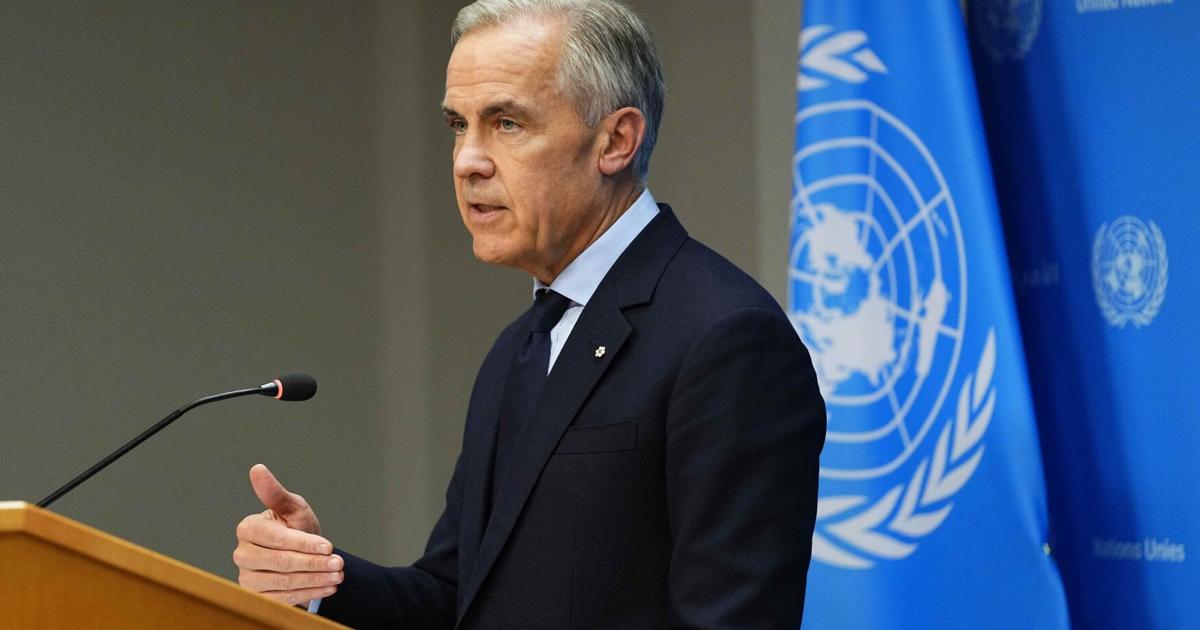
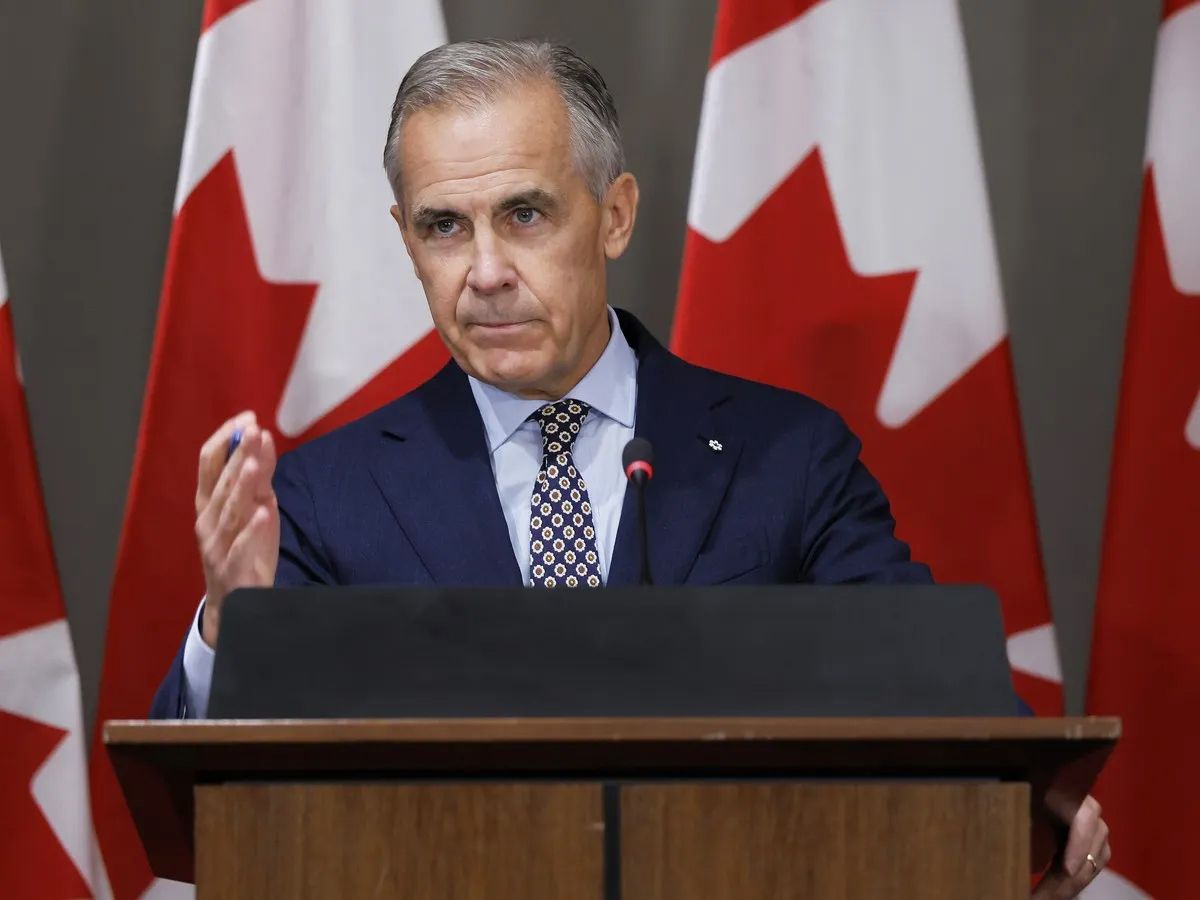
Photo via Toronto Star

Canada is open for business, but it's not for sale. Here's what Carney's investment pitch glosses over

Read the original at Toronto Star ↗
Cite

Contributor, G. I. (2026, October 3). Canada is open for business, but it's not for sale. Here's what Carney's investment pitch glosses over. Toronto Star. https://www.thestar.com/business/opinion/canada-is-open-for-business-but-it-s-not-for-sale-here-s-what-carney-s-investment-pitch-glosses-over/article_8c38a484-16bd-4a97-8ab5-83124a84628f.html

Dated when The Aporia collected the article, usually within hours of publication. Check the original for its exact date and byline.

Toronto Star · collected 2026-10-03 · by Gustavo Indart Contributor

Quick Summary

Prime Minister Mark Carney addressed an international investment summit in Toronto to emphasize that Canada welcomes business investments but underscores that such openness does not mean all sectors or types of foreign investment are beneficial for the country. The article highlights concerns about past private sector involvement, citing examples like the 407 Highway and the Walkerton tragedy. It argues against the conventional economic view that foreign capital is necessary to fill a savings gap, pointing out instead that Canada's issue lies in insufficiently profitable domestic investment opportunities rather than low savings rates. Furthermore, it discusses how increased foreign investments can lead to an appreciation of the Canadian dollar, potentially harming export and import-competing industries.
Written by AI on 2026-10-03, from this article's own text only (the story summary below draws on all the coverage).

AI analysis

Story summary

Prime Minister Mark Carney highlighted Canada's openness to business during a recent summit in Toronto, emphasizing opportunities despite trade uncertainties under US President Donald Trump. However, critics like Gustavo Indart caution against hasty acceptance of foreign investments due to past controversies such as the Hwy 407 toll road and the Walkerton water crisis, which highlight potential downsides. Indart argues that sectors like healthcare should remain off-limits to private investment, advocating for careful regulation rather than an indiscriminate embrace of capital inflows aimed at boosting economic growth. The concern is rooted in ensuring that Canada’s economy benefits from foreign investments without compromising national interests or public welfare.

Written for “Canada Investment Climate” on 2026-11-04, grounded in this article and the 0 other(s) covering the same event.

Story

📰 Canada Investment Climate
Economy/Business · 1 article(s) covering the same event.

Compared with similar articles

This article reads leans left and hedges 3% of its claims. Each row says how that neighbour differs.
Toronto Star
⚖️ Leans strongly left further left than this Hedges 0 of 40 claims Outlet record 64/100
“The articles discuss different aspects of Mark Carney's stance on business and foreign investment, with Article A focusing on his rebuke towards Stelco for layoffs and potential legal action, while Article B discusses a broader message at an investment summit regarding Canada's openness to business.”
National Post
⚖️ Leans right further right than this Hedges 0 of 5 claims Outlet record 60/100
“Article A describes Prime Minister Carney's announcement regarding a West Coast pipeline in Fort McMurray, while Article B discusses his message at an international investment summit in Toronto.”
Al Jazeera
⚖️ Leans left Hedges 3 of 56 claims Outlet record 60/100
“The articles discuss different aspects of Prime Minister Carney's economic policies and initiatives without clearly referring to the same specific incident or time.”
Toronto Star
⚖️ Leans strongly left further left than this Hedges 1 of 55 claims Outlet record 64/100
“The articles discuss different aspects of Prime Minister Mark Carney's policies and public messaging; one focuses on his shift towards economic interests while the other critiques his investment pitch at a summit.”
Who owns Canada's economy? Different event
CBC News
⚖️ Leans left Hedges 1 of 7 claims Outlet record 74/100
“The articles discuss similar themes but do not describe the same specific incident or occurrence.”
National Post
⚖️ Leans right further right than this Hedges 3 of 29 claims Outlet record 60/100
“The articles discuss different aspects of Prime Minister Carney's recent statements or actions regarding international relations, but they do not describe the exact same incident occurring at the same time and place.”
BBC News
⚖️ Leans right further right than this Hedges 4 of 46 claims Outlet record 68/100
“The articles discuss different aspects of Prime Minister Carney's responses to potential risks under the Trump presidency, but they do not describe the same specific incident or occurrence.”
How this article was measured signals, leaning charts, publisher record, byline, topics and claims

Signals How these are calculated →

Claims extracted
32
sentences that state something as happening or true
Uncertain
3%
1 of 32 hedged ("reportedly", "may", "according to")
Leaning
Leans left
of the writing, not the subject · beta estimate
Publisher signals
64/100
Toronto Star's corrections and hedging, across everything collected from it. Not a measure of accuracy.
Outlets on this story
1
Economy/Business
Same framing elsewhere
1
articles that frame the event the way this one does
Analyzed 2026-10-03 · how these are computed

How this is being covered How these are calculated →

Article leaning vs. publisher reliability
Source leaning vs. consistency

Publisher

Toronto Star · 11337 article(s) · 28 correction(s) detected
Running correction rate · 28 correction(s)
2026-10-26
Correction
2026-10-24
Correction
2026-10-07
Correction
2026-09-24
Correction

Who wrote this

Gustavo Indart Contributor
2 article(s) here · 1 carrying a prediction
🔮 Would that improve performance?
🔮 Given the Donald Trump trade mayhem, it is a welcome message — with this proviso: we must be careful about how we proceed and remind Carney that while Canada is open for business, it is not for sale.
Also by Gustavo Indart Contributor
Nothing else under this byline is closely related to this article, so these are simply their most recent.

Topics

Canada Canadian Ontarians Statistics Canada Toronto

Subjects

Canada GPE · 13× Canadian NORP · 7× Carney PERSON · 2× Armine Yalnizyan PERSON · 1× Donald Trump PERSON · 1× Mark Carney PERSON · 1× Ontarians NORP · 1× Statistics Canada ORG · 1× Toronto GPE · 1×

Narrative

Conventional economic theory nevertheless argues that capital will flow to countries where savings are scarce, facilitating a more efficient global allocation of financial resources. But things are more complicated.
framing: assertive · carried by 1 article(s) · first seen 2026-10-03
🔮 Given the Donald Trump trade mayhem, it is a welcome message — with this proviso: we must be careful about how we proceed and remind Carney that while Canada is open for business, it is not for sale.

Claims (32 extracted, 1 hedged)

Given the Donald Trump trade mayhem, it is a welcome message — with this proviso: we must be careful about how we proceed and remind Carney that while Canada is open for business, it is not for sale. asserted
it → give → sale
The debacle of Hwy. 407 and the tragedy of Walkerton, to mention just two examples, remain fresh in the memories of many Ontarians. asserted
mention → mention → Ontarians
As economist Armine Yalnizyan recently reminded us, the care sector should not be up for grabs. asserted
sector → remind → grabs
Why Canada’s savings problem isn’t what it seems The underlying assumption behind Carney’s pitch to attract international investment is that capital inflows will foster greater growth in the Canadian economy. asserted
inflows → seem → economy
Implicit in this argument is the conventional view that investment is determined by an economy’s capacity to save. asserted
investment → determine → capacity
If domestic savings are insufficient, the argument goes, foreign savings — in the form of capital inflows — can fill the gap and increase investment. asserted
savings → go → investment
It is true, from an accounting perspective, that investment equals the sum of domestic and foreign savings. asserted
investment → equal → savings
But this is an accounting identity; it does not imply causality. asserted
it → imply → causality
Conventional economic theory nevertheless argues that capital will flow to countries where savings are scarce, facilitating a more efficient global allocation of financial resources. But things are more complicated. asserted
things → argue → resources
Canadian foreign direct investment abroad is significantly greater than foreign direct investment in Canada — about $2.4 trillion compared with $1.6 trillion in 2025, according to Statistics Canada. uncertain
investment → compare → Canada
Second, international capital inflows have consequences that domestic capital movements do not. asserted
movements → have → consequences
Foreign investment in Canada requires the conversion of foreign currency into Canadian dollars, increasing demand for the loonie and putting upward pressure on its value. asserted
investment → require → value
An appreciating Canadian dollar, in turn, reduces the competitiveness of Canada’s tradable sector. asserted
dollar → appreciate → sector
As a result, capital inflows can contribute to a contraction of export industries and industries that compete with imports. asserted
that → contribute → imports
In other words, international capital inflows can create both winners and losers within the Canadian economy. asserted
inflows → create → economy
The question, then, is not whether Canada should welcome investment. asserted
Canada → welcome → investment
The real question is what kind of investment Canada should welcome, where it should be directed, and under what conditions. asserted
it → welcome → conditions
Foreign portfolio investment — the purchase of Canadian stocks and bonds — can contribute to currency appreciation without significantly increasing Canada’s GDP. asserted
investment → contribute → GDP
Beyond commissions earned by domestic financial intermediaries, these capital inflows do little to expand the Canadian economy. asserted
inflows → earn → economy
This type of investment, therefore, should not be actively encouraged. asserted
type → encourage → investment
Not all foreign investment helps Canada equally asserted
investment → help → Canada
With foreign direct investment (FDI), we should distinguish between the so called brownfield and greenfield investments. asserted
we → distinguish → investments
Brownfield FDI involves acquiring existing businesses or production facilities. asserted
FDI → involve → businesses
Essentially, it transfers ownership from domestic to foreign agents, with little or no immediate impact on GDP. asserted
it → transfer → GDP
Such investments should not be encouraged unless they are accompanied by meaningful economic benefits, such as increased production, technological improvements, productivity gains, or employment. asserted
they → encourage → production
Greenfield FDI, by contrast, involves establishing a new operation from the ground up. asserted
FDI → involve → ground
Because it creates new productive capacity, it contributes directly to the expansion of GDP. asserted
it → create → GDP
This is the kind of foreign investment Carney should seek to attract to Canada. asserted
Carney → seek → Canada
Its contribution to production, employment, technology, and productivity can outweigh the negative effects associated with currency appreciation. asserted
contribution → outweigh → appreciation
Opening Canada to international capital without considering these differences risks confusing an increase in financial flows with an increase in productive capacity. asserted
Opening → open → capacity
What matters is not simply how much foreign capital enters Canada, but what that capital does once it gets here. asserted
it → matter → what
But being open for business does not mean being open to every investment on any terms. asserted
being → mean → terms

💬Give feedback
🕘History 🎫Support