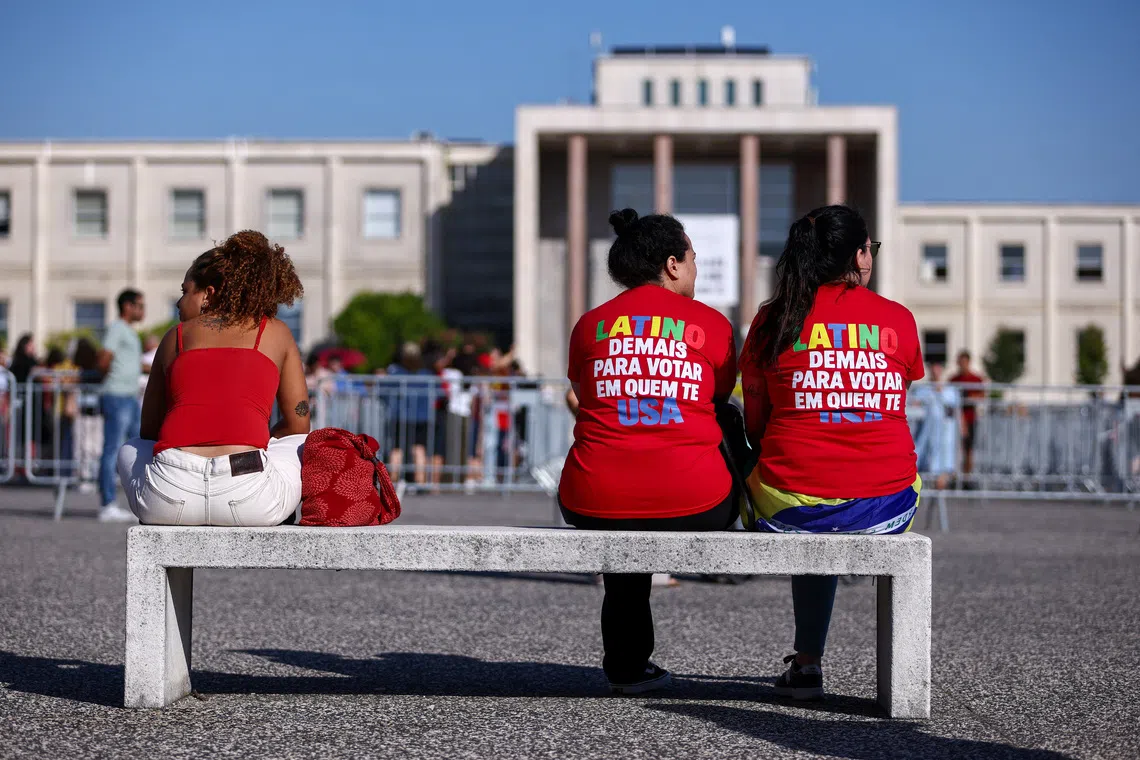
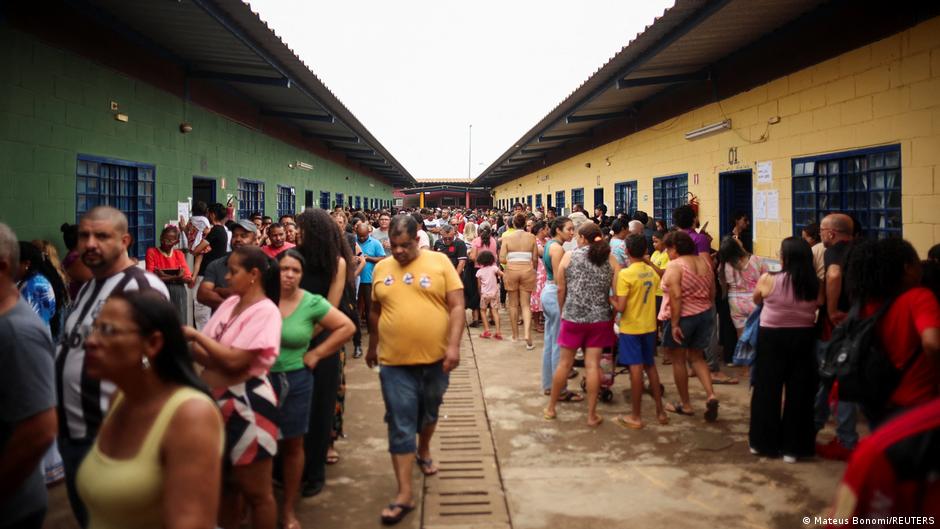
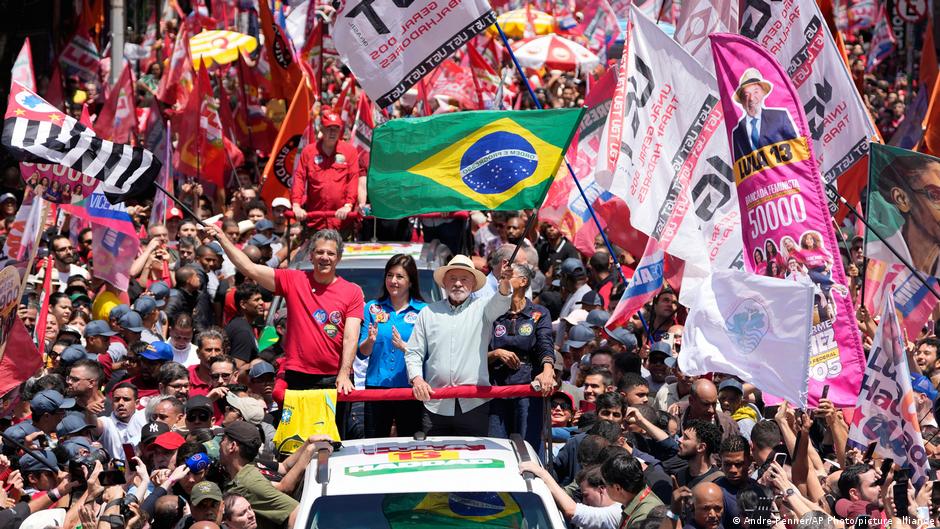
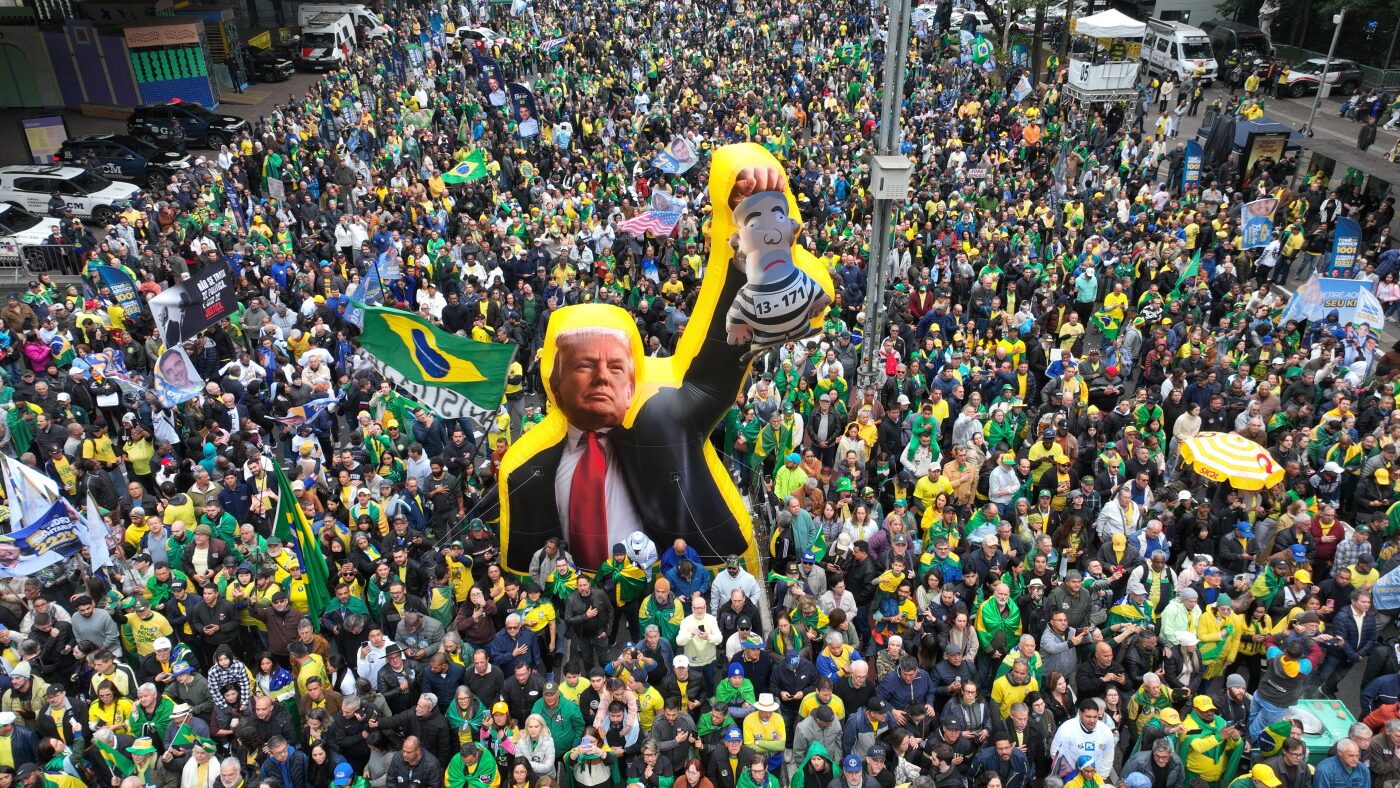
Photo via The Guardian

Brazil goes to polls in decisive election for future of Latin America

Read the original at The Guardian ↗
Cite

Janeiro, T. R. i. R. d. (2026, October 4). Brazil goes to polls in decisive election for future of Latin America. The Guardian. https://www.theguardian.com/world/2026/oct/04/brazil-presidential-election-lula-flavio-bolsonaro

Dated when The Aporia collected the article, usually within hours of publication. Check the original for its exact date and byline.

The Guardian · collected 2026-10-04 · by Tiago Rogero in Rio de Janeiro

Quick Summary

Brazilians are voting in the first round of a presidential election that could significantly influence Latin America's political landscape. The main contenders are incumbent President Luiz Inácio Lula da Silva, running for a fourth non-consecutive term, and Senator Flávio Bolsonaro, son of former president Jair Bolsonaro who is serving time for attempting a coup. Polls indicate the race is tight, with both candidates trying to secure over 50% support to avoid a runoff on October 25. The election has drawn international attention due to allegations of US interference and concerns about democratic stability in Brazil.
Written by AI on 2026-10-04, from this article's own text only (the story summary below draws on all the coverage).

AI analysis

Story summary

On October 4, 2026, Brazilian voters went to polls in a highly polarized presidential race between incumbent President Luiz Inácio Lula da Silva and senator Flávio Bolsonaro, son of former president Jair Bolsonaro. Polls showed Lula leading with 47.8% of the vote, compared to Flávio Bolsonaro's 42.1%, indicating a likely second-round runoff on October 25 if no candidate reaches an outright majority. The election follows four years of political turmoil and environmental challenges in Brazil, raising concerns about climate policy under potential new leadership.

Written for “Brazil Election Flávio Bolsonaro Leads Runoff Race” on 2026-10-31, grounded in this article and the 58 other(s) covering the same event.

Story

📰 Brazil Election Flávio Bolsonaro Leads Runoff Race
Politics · 59 article(s) covering the same event. See how they differ ↓

Compared with similar articles

This article reads leans left and hedges 20% of its claims. Each row says how that neighbour differs.
The Straits Times
Hedges 5 of 34 claims Outlet record 66/100
South China Morning Post
⚖️ Leans left Hedges 1 of 5 claims Outlet record 64/100
Toronto Star
⚖️ Leans left Hedges 4 of 24 claims Outlet record 64/100
BBC News
Hedges 0 of 5 claims Outlet record 69/100
Deutsche Welle
Hedges 1 of 30 claims Outlet record 95/100
BBC News
Hedges 6 of 54 claims Outlet record 69/100
Deutsche Welle
Hedges 1 of 24 claims Outlet record 95/100
Al Jazeera
Hedges 0 of 3 claims Outlet record 60/100
NPR
⚖️ Leans left Hedges 10 of 60 claims Outlet record 60/100
Toronto Star
Hedges 2 of 38 claims Outlet record 64/100
How this article was measured signals, leaning charts, publisher record, byline, topics and claims

Signals How these are calculated →

Claims extracted
15
sentences that state something as happening or true
Uncertain
20%
3 of 15 hedged ("reportedly", "may", "according to")
Leaning
Leans left
of the writing, not the subject · beta estimate
Publisher signals
66/100
The Guardian's corrections and hedging, across everything collected from it. Not a measure of accuracy.
Outlets on this story
59
Politics
Same framing elsewhere
1
articles that frame the event the way this one does
Analyzed 2026-10-04 · how these are computed

How this is being covered How these are calculated →

Article leaning vs. publisher reliability
Source leaning vs. consistency

Publisher

The Guardian · 2734 article(s) · 6 correction(s) detected
Running correction rate · 6 correction(s)

Who wrote this

Tiago Rogero in Rio de Janeiro
8 article(s) here · 1 carrying a prediction
🔮 Brazil’s congress has approved a constitutional amendment to shorten the working week to a maximum of 40 hours, a move that could affect 30 million workers and that will hand a political victory to the leftist president Luiz Inácio Lula da Silva ahead of the presidential runoff in under two weeks.
🔮 He went from fewer than 10,000 votes in a mayoral race two years ago to 380,000 votes for congress.
🔮 Brazil’s presidential race will go to a second round after the far-right candidate, Flávio Bolsonaro, beat the incumbent leftwing president, Luiz Inácio Lula da Silva, but failed to secure the outright majority he needed to avoid a runoff.
🔮 Brazilians go to the polls on Sunday in the first round of a highly polarised and high-stakes presidential election that could change not only the direction of Latin America’s largest country but that of the entire region.
🔮 On Sunday, Brazilians go to the polls in a presidential election that many believe will determine more than Latin America’s largest country’s fate for the next four years.
🔮 The accusation came in a televised campaign advert that was broadcast on Thursday by Lula’s team amid growing fears over the impact alleged US interference could have on the vote.
🔮 On 4 October, the leftwing incumbent will face the far-right senator Flávio Bolsonaro, son of the former president Jair Bolsonaro, who has been gaining ground in recent weeks.
🔮 After learning that the document would prevent Lula from taking office, Baptista Júnior told the defence minister he refused even to receive it: “The air force will not take part in this.”
Also by Tiago Rogero in Rio de Janeiro
Nothing else under this byline is closely related to this article, so these are simply their most recent.
All 8 articles by Tiago Rogero in Rio de Janeiro →

Topics

Brazil Brazilians Latin American Pinhais Venezuela

Subjects

Lula PERSON · 6× Bolsonaro PERSON · 4× Jair Bolsonaro PERSON · 4× Brazil GPE · 3× Brazilians NORP · 2× Flávio Bolsonaro PERSON · 2× Trump PERSON · 2× Donald Trump PERSON · 1× Latin American NORP · 1× Luiz Inácio Lula da Silva PERSON · 1×

Narrative

Like his father, who was Brazil’s president during Trump’s first term, Flávio Bolsonaro, 45, frequently praises the US president and has pledged to join the US-led anti-drug cartel coalition that has killed dozens in airstrikes and carried out military operations across the region. Lula and Bolsonaro have alternated as frontrunners in the final stretch, making the outcome unpredictable.
framing: assertive · carried by 1 article(s) · first seen 2026-10-04
🔮 Brazilians go to the polls on Sunday in the first round of a highly polarised and high-stakes presidential election that could change not only the direction of Latin America’s largest country but that of the entire region.
2026-10-04 · The Guardian
Brazil goes to polls in decisive election for future of Latin America · assertive framing

Claims (15 extracted, 3 hedged)

Brazilians go to the polls on Sunday in the first round of a highly polarised and high-stakes presidential election that could change not only the direction of Latin America’s largest country but that of the entire region. uncertain
that → go → region
The election pits the leftwing president, Luiz Inácio Lula da Silva, who is seeking a fourth non-consecutive term, against the far-right senator Flávio Bolsonaro, an ally of Donald Trump and the son of the former president Jair Bolsonaro, who is serving a 27-year sentence for attempting a coup after his failed 2022 re-election attempt. asserted
who → pit → attempt
Brazil is one of the few Latin American countries that still has a leftwing government after a wave of rightwing and far-right electoral victories across the region and the US takeover of Venezuela following the capture of Nicolás Maduro. asserted
that → have → Maduro
The 80-year-old Lula has positioned himself as one of the last regional leaders still willing to say no to Trump, and has recently accused the US president of trying to interfere in Brazil’s election in Bolsonaro’s favour. asserted
Lula → position → favour
Like his father, who was Brazil’s president during Trump’s first term, Flávio Bolsonaro, 45, frequently praises the US president and has pledged to join the US-led anti-drug cartel coalition that has killed dozens in airstrikes and carried out military operations across the region. Lula and Bolsonaro have alternated as frontrunners in the final stretch, making the outcome unpredictable. asserted
outcome → pledge → stretch
In recent days, both have focused on persuading undecided voters in hopes of reaching 50% plus one vote; if neither does, there will be a runoff on 25 October. asserted
neither → focus → October
“My first choice would be Jair Bolsonaro but, since he is under house arrest and there is no other rightwing candidate strong enough to take on the current president, I’m going with Flávio,” said Claudinei Ferreira Viana, 45, a workshop manager in Pinhais, in Paraná state. asserted
Viana → be → state
At the beginning of the year, polls suggested Bolsonaro voters would have preferred a ticket led by the São Paulo governor, Tarcísio de Freitas, or the former first lady Michelle Bolsonaro. uncertain
voters → suggest → governor
But the former president chose his eldest son. asserted
president → choose → son
The campaign was also marked by a scandal in which the senator was caught on tape asking a banker accused of corruption for $26.8m (£20m) to fund a film about his father, as well as speculation that Bolsonaro might strip the country’s widely cherished patron saint of her status, but he has nevertheless remained highly competitive. uncertain
he → mark → status
For many analysts, that reflects a combination of a straightforward transfer of his father’s voter base – Jair Bolsonaro lost to Lula by less than two percentage points in 2022 – and an anti-Lula vote, with the president still facing high rejection rates despite strong social and economic indicators. asserted
president → reflect → indicators
The incumbent’s campaign has also been hit by corruption allegations – still under investigation – involving his son and a former aide, as well as a scandal involving supreme court justices which, despite having no connection to Lula, is seen as fuelling an “anti-system” vote and, by extension, an anti-incumbent one. asserted
which → hit → extension
Brazilians will also elect 27 state governors, members of state legislatures, all 513 federal congress members and 54 of the country’s 81 senators in Sunday’s vote. asserted
Brazilians → elect → vote
AMC, 40, who asked to be identified only by her initials because she fears reprisals from the local conservative government where she works in the interior of Amazonas state, will vote for Lula on Sunday “because of the many programmes he created to support the most vulnerable groups”. asserted
he → ask → groups
“Jair Bolsonaro weakened protections for Indigenous peoples, and everything Lula has done over the past four years to strengthen those protections and protect the Amazon would be seriously threatened if his son came to power,” she said. asserted
she → weaken → power

💬Give feedback
🕘History 🎫Support