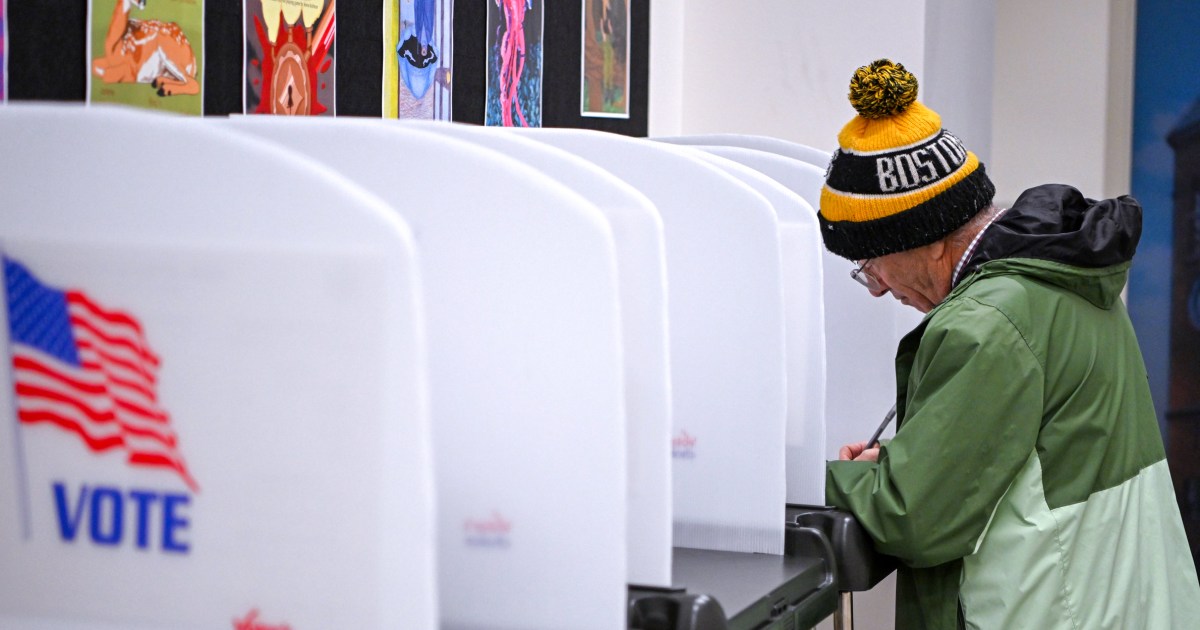
Nearly half of voters say they view the midterm election as an opportunity for a major rebuke of President Donald Trump’s performance, according to early results from the NBC News Exit Poll.
uncertain
they → say → Poll
Forty-three percent said one reason for their votes was to express opposition to Trump — far higher than the share who said the same in the 2018 midterm election during his first term.
asserted
who → say → term
The early results show that Trump’s midterm campaign blitz in support of Republican candidates in recent weeks has done little to lift his job approval rating.
asserted
blitz → show → rating
A key frustration voters cited?
asserted
voters → cite → frustration
Most voters said inflation is causing hardship for their families, with the affordability of gas, food and utilities being a significant concern.
asserted
affordability → say → gas
Voters blamed Trump for high prices and said his policies are making the economy worse.
asserted
economy → blame → prices
The poll was conducted as voters left polling locations across the U.S. on Election Day.
asserted
voters → conduct → Day
Results also include extensive interviews by phone and mail and online with people who voted early or by mail.
asserted
who → include → mail
Thirty-eight percent of voters said they approve of Trump’s performance, according to the poll.
uncertain
they → say → poll
That’s substantially lower than in his first midterm election in 2018 (when 45% of voters approved of his performance).
asserted
% → ’ → performance
Trump’s dismal approval ratings have dropped in Senate battleground states, as well.
asserted
ratings → drop → states
Majorities of Senate voters in Georgia, Ohio, Michigan and Texas all said they disapprove of Trump’s handling of his job — also up compared with 2018.
asserted
they → say → 2018
Voters have negative opinions of both parties
Voters expressed more unfavorable than favorable views of the Republican and Democratic parties, the poll showed.
asserted
poll → have → parties
And almost 1 in 5 voters said they don’t have favorable opinions of either party — at least 5 percentage points more than the share who said so during the past two midterm elections.
asserted
who → say → elections
Fifty-four percent of voters Tuesday said they have unfavorable views of the Democratic Party, while 46% have favorable views.
asserted
% → say → views
For the Republican Party, 59% of voters today said they have unfavorable views, and 41% said they have favorable views.
asserted
they → say → views
Voters expressed more unfavorable views toward both parties than they did in the last two midterms.
asserted
they → express → midterms
Voters were likelier to say the Democratic Party could better handle several big issues than the Republican Party, including the economy, foreign policy, healthcare, government corruption and policies about transgender people.
uncertain
Party → say → people
The GOP held an advantage on immigration.
asserted
GOP → hold → immigration
On policies related to AI and taxes, voters were split.
asserted
voters → relate → AI
Economic pessimism
The economy — once Trump’s strongest issue — is no longer viewed positively by voters, the poll showed.
asserted
poll → view → voters
An overwhelming majority said the nation’s economy is in rough shape (75%) — and 65% said Trump’s policies have worsened economic conditions in the U.S.
asserted
policies → say → U.S.
About half of voters casting ballots said the cost of living was crucial to their votes.
asserted
cost → cast → votes
That is the opposite of how voters viewed the economy in 2018 — a wave election for Democrats during Trump’s first term.
asserted
voters → view → term
That year, 68% of voters said the economy was in good shape.
asserted
economy → say → shape
Voters are driven by the economy
Voters rated the economy as the most important issue facing the country today (39%), followed by the state of democracy (32%), according to the poll.
uncertain
Voters → drive → poll
They voiced significant concerns about the prices of gas, groceries and utilities, blaming Trump for affordability problems.
asserted
They → voice → problems
Forty-four percent of voters said their finances are worse today than they were two years ago when Trump returned to office.
asserted
Trump → say → office
Just 18% say they’re better off.
asserted
they → say → ?
These numbers are in line with the way voters characterized their finances during the 2022 midterms but much worse than in Trump’s first midterm election in 2018.
asserted
voters → characterize → 2018
Driving voters’ financial concerns: the cost of living.
asserted
concerns → drive → living
Top issues include the cost of gas and diesel fuel (87% said they were “very” or “somewhat” concerned), food and groceries (88% concerned), utilities (86%) and healthcare (85%).
asserted
they → include → gas
All told, just under 8 in 10 voters said inflation is causing hardship for their families.
asserted
inflation → tell → families
More than half (65%) say Trump’s policies have made the economy worse; 62% said he’s responsible for high prices.
asserted
he → say → prices
Groups we’re watching closely as the night unfolds
We’ll closely watch several groups that helped propel Trump to victory in 2024 — but with particular interest in Latino voters and voters under 30.
asserted
that → watch → 30
After having fallen in every national election since 2018, the share of Latino voters who identify as Democrats ticked up this year to 43% from 39% in 2024, the poll showed.
asserted
poll → fall → 2024
The share of Latino voters calling themselves independents dropped slightly, to 30% from 32%.
asserted
share → call → %
The share identifying as Republicans also dropped slightly, to 27% from 29% in 2024.
asserted
share → identify → 2024
The results halted a steady erosion of the Democrats’ advantage among Latino voters in party identification, which narrowed from 33 points in 2018 to 10 points in 2024.
asserted
which → halt → 2024
This year, Democrats hold a 16-point edge.
asserted
Democrats → hold → edge
…and 1 more, not listed.
 The Aporia