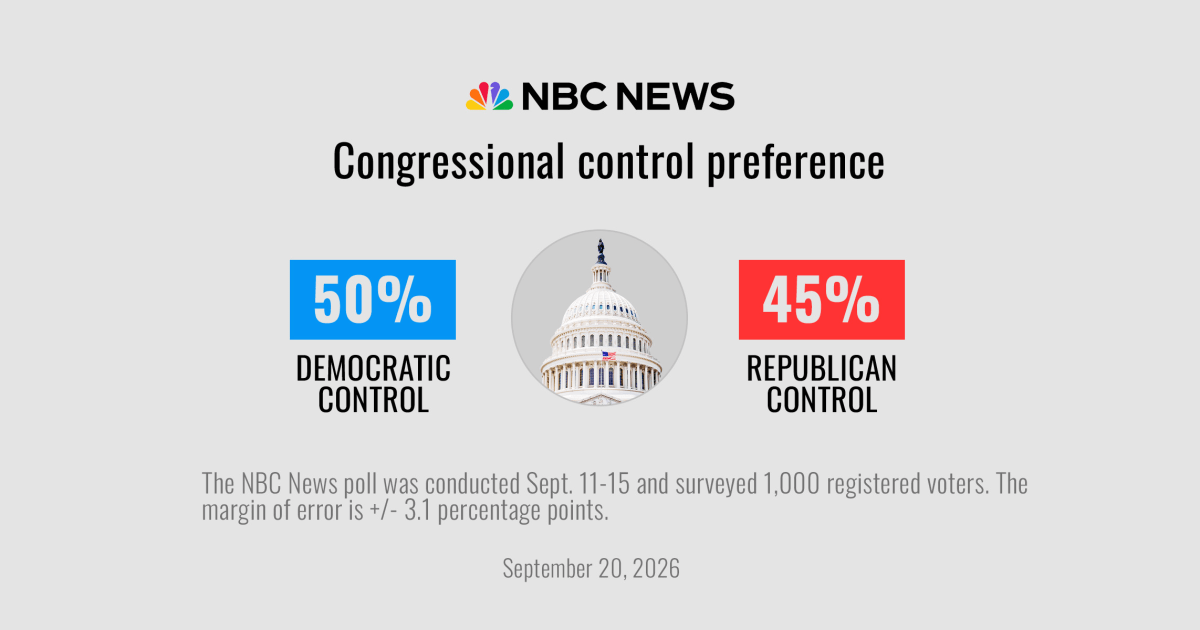
Democrats are heading into the final stretch of the 2026 midterms with their largest lead yet in the race for Congress and President Donald Trump’s approval rating at a significant low, according to NBC News’ newly released polling averages.
uncertain
Democrats → head → averages
A 9-percentage-point advantage for Democrats when it comes to control of Congress is part of a steady deterioration of the political environment for Republicans.
asserted
it → come → Republicans
The parties started the road to this November effectively tied in the weeks after President Donald Trump returned to office last year, but independents have gradually begun to prefer a Democratic-controlled Congress.
asserted
independents → start → Congress
And those voters have soured on Trump and his economic policies in particular.
asserted
voters → sour → Trump
The congressional average, which stands at 52% to 43% after adjusting to a likely voter scale, measures whether Americans prefer a Congress controlled by Democrats or Republicans before things like individual races and candidates come into play.
asserted
things → stand → play
Individual polls can bounce around, but an average gives a broad sense of where surveys are trending, and it controls for outliers, which is one reason NBC News released our averages now.
asserted
News → bounce → averages
At a time when a flurry of polling is released, such as in the homestretch of an election cycle, averages can be valuable tools for tracking what’s happening in the election and diving deeper into how Republicans, Democrats and independents view Trump and the battle for Congress.
asserted
Republicans → release → Congress
The NBC News averages are weighted calculations of all publicly available polls that meet certain standards for methodology and transparency tracking back to the beginning of the second Trump administration.
asserted
that → weight → administration
How NBC News' poll averages work
Our polling averages are designed to measure changes in public opinion over time, rather than reflecting the result of any single survey.
asserted
averages → work → survey
They combine national polls using a statistical weighting method that gives greater influence to the polls that are most informative while reducing the effect of random variation from individual surveys.
asserted
that → combine → surveys
Every polling average makes methodological choices about which polls to include and how much influence each should have.
asserted
each → make → influence
This methodology is used for both the NBC News presidential approval average and the generic congressional ballot average.
asserted
methodology → use → average
While the underlying calculations differ slightly to reflect the characteristics of each type of polling, the overall approach is the same.
asserted
approach → underlie → polling
Our approach emphasizes five principles:
- Recency: Newer polls matter more than older polls.
- Precision: Polls with a lower margin of error are weighted higher.
asserted
Polls → emphasize → error
The margin of error can be influenced by the number of people in the poll and the amount of weighting needed to make the poll representative.
asserted
poll → influence → weighting
- Stability: Individual outliers and day-to-day fluctuations have limited influence until they are supported by additional evidence.
asserted
they → support → evidence
- Variety: Frequent pollsters have their older polls downweighted more sharply so that no one firm can dominate the average.
asserted
firm → downweighte → average
- Consistency: Polls measuring different populations are placed on the same registered voter scale before being combined.
asserted
Polls → measure → scale
Instead, they aim to provide the clearest possible aggregate measure of the current available polling.
asserted
they → aim → polling
Polls of all adults, registered voters and likely voters are all eligible for inclusion, as are polls with a partisan affiliation provided those surveys meet certain methodological transparency requirements.
asserted
surveys → register → requirements
Polls with partisan affiliations are noted as such whenever possible.
asserted
Polls → note → affiliations
NBC News collected all the surveys included in the average.
asserted
News → collect → average
To be eligible for inclusion in the average, a polling organization must, at minimum, meet methodological transparency standards by reporting details on when a poll was conducted and how many respondents were interviewed.
asserted
respondents → meet → details
If a poll does not publicly release information on field dates, sample size and/or margin of error, it is not included.
asserted
it → release → error
Not every poll contributes equally to the average.
asserted
poll → contribute → average
Older polls gradually receive less weight as new surveys are released.
asserted
surveys → receive → weight
Likewise, polls with smaller sample sizes or larger margins of error contribute less than more precise surveys.
asserted
polls → contribute → surveys
With a month to go before the midterm elections, Trump’s approval rating has slid to 39% in the NBC News polling average, with 59% disapproving of his job performance so far.
asserted
% → go → performance
He began his term at 50% approval, according to the average.
uncertain
He → begin → average
Independents drive the shift toward Democrats
There has been little change over time among partisans in the race for Congress, with the vast majorities of Republicans and Democrats standing with their parties consistently.
asserted
majorities → drive → parties
As a result, much of the shift toward a preference for a Democratic-controlled Congress can be explained by the changing preferences of political independents.
asserted
much → control → independents
Independents preferred Democrats by about 6 points at the beginning of Trump’s second term, and they slowly moved toward Democrats toward the first half of last year.
asserted
they → prefer → year
But things began to shift more rapidly during fall 2025 and early 2026, moving to a lead of about 20 points for Democrats in the spring — as public frustration with Trump’s handling of the economy, the war in Iran and the killings of two Americans by federal immigration officers began to boil over.
asserted
frustration → begin → officers
The Republican Party hasn’t fully recovered with independents since, and Democrats now hold a 16-point lead among those voters in the race for Congress, according to the average.
uncertain
Democrats → recover → average
While survey responses don’t automatically translate into election results, such a strong showing among political independents is one of the many encouraging signs for Democrats heading into the election.
asserted
showing → translate → election
Even so, it’s no guarantee of electoral success for Democrats as Republicans seek to find a way to energize the coalition that sent Trump to the White House just two years ago and narrow the gap before Election Day, more than a month away.
asserted
that → ’ → Day
Republicans also hope they can defy the political headwinds because so many of the key battleground House and Senate races are being fought in districts and states Trump won in 2024, some by double-digit margins.
asserted
Trump → hope → margins
What’s behind Trump’s low approval rating
For Trump, movement among independents — and Republicans, to a lesser extent — explains his low marks from voters.
asserted
movement → ’ → voters
His approval rating among Republicans fluctuated in the mid-to-high 80s for the first six months of his second term, but now, his GOP approval rating is at 79% in a slight but noticeable decline, according to the average.
uncertain
rating → fluctuate → average
Independents’ approval of Trump has dropped further, to 26% in the NBC News average.
asserted
approval → drop → average
…and 13 more, not listed.
 The Aporia