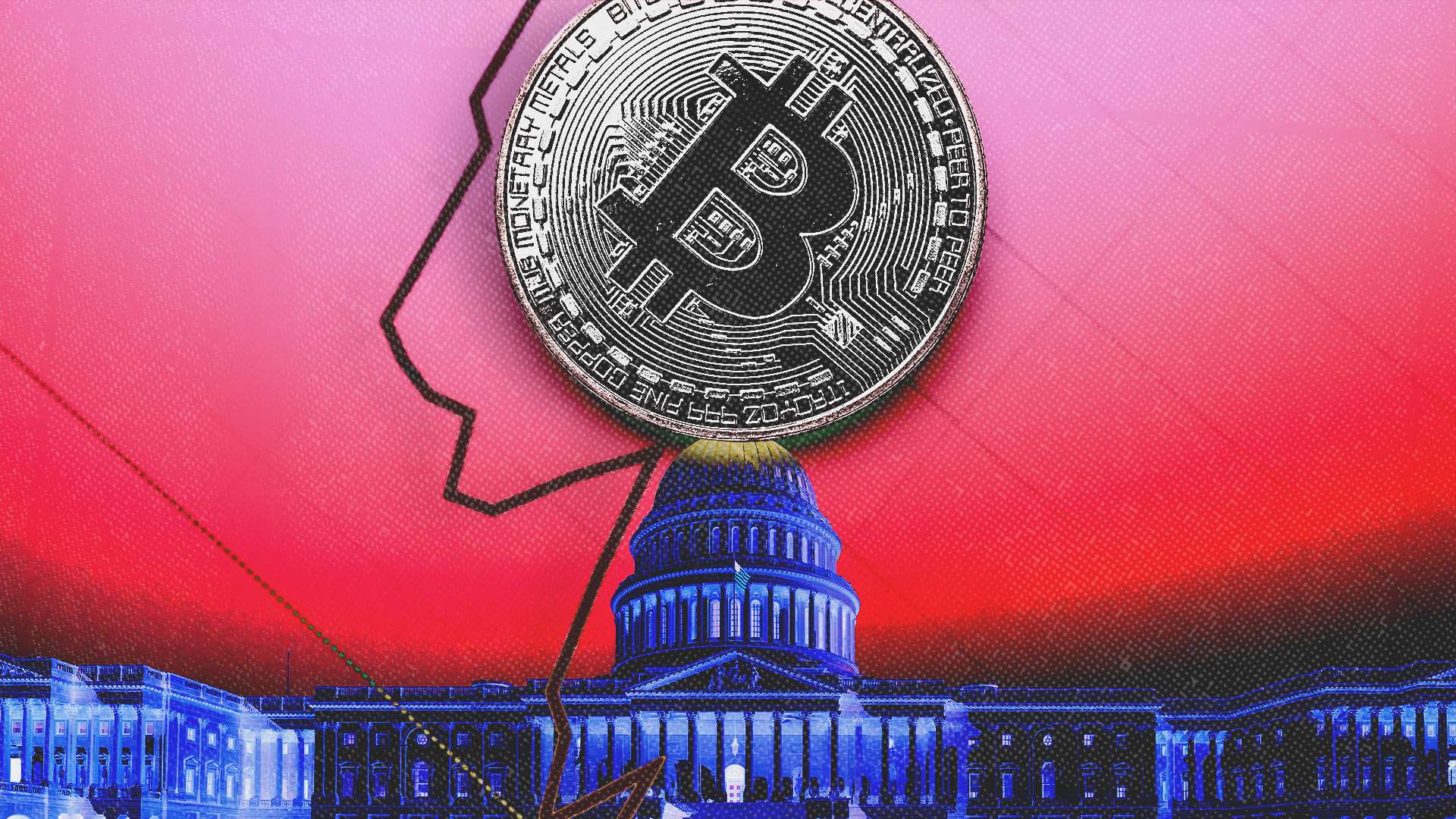
Photo via Reason

Trump's $1.4 Billion Crypto Haul Sinks the Senate's Crypto Bill

Read the original at Reason ↗
Cite

Akintola, T. (2026, September 17). Trump's $1.4 Billion Crypto Haul Sinks the Senate's Crypto Bill. Reason. https://reason.com/2026/09/17/trumps-1-4-billion-crypto-haul-sinks-the-senates-crypto-bill/

Dated when The Aporia collected the article, usually within hours of publication. Check the original for its exact date and byline.

Reason · collected 2026-09-17 · by Tosin Akintola

Quick Summary

The Senate failed a procedural vote on the Digital Asset Market Clarity Act, which aimed to provide regulatory clarity for the crypto industry but faced opposition due to concerns over potential conflicts of interest involving former President Donald Trump's significant cryptocurrency earnings, totaling $1.4 billion according to recent financial disclosures. Democrats were particularly concerned that the bill’s ethics provisions did not adequately prevent Trump and other politicians from profiting from digital assets, given Trump's substantial holdings in companies like World Liberty Financial and his meme coin business CIC Digital. The proposed legislation would have set disclosure requirements and anti-fraud protections but also granted federal agencies broad regulatory powers, raising concerns about bureaucratic overreach.
Written by AI on 2026-09-18, from this article's own text only (the story summary below draws on all the coverage).
See how they differ ↓

AI analysis

Story summary

On September 15, the U.S. Senate was set to vote on advancing the Clarity Act, a bill that aims to establish federal regulations for digital assets like cryptocurrency. The House had already passed the legislation, but disagreements persisted over ethics and regulatory concerns. Key opponents included Senator Mike Rounds (R-SD) and Senator Thom Tillis (R-NC), who warned it was unlikely to pass due to unresolved issues regarding President Donald Trump's conflicts of interest in crypto investments. Despite support from industry groups that spent $451 million on lobbying, significant hurdles remained, with some Democrats demanding stronger ethics provisions to prevent financial conflicts for the president and his family. The vote was seen as a critical test for both the cryptocurrency market and political forces ahead of the November midterm elections.

Written for “Crypto Regulation Debate” on 2026-11-21, grounded in this article and the 13 other(s) covering the same event.

How they differ

9 outlets covered “Crypto Regulation Debate”.

What each outlet says

One AI summary per outlet of its latest article on this story, written from that article alone and checked against it. Open the article for the outlet's own words.

ReasonThis outlet17 Sep

The Senate failed a procedural vote on the Digital Asset Market Clarity Act, which aimed to provide regulatory clarity for the crypto industry but faced opposition due to concerns over potential conflicts of interest involving former President Donald Trump's significant cryptocurrency earnings, totaling $1.4 billion according to recent financial disclosures. Democrats were particularly concerned that the bill’s…

Trump's $1.4 Billion Crypto Haul Sinks the Senate's Crypto Bill (this article)
Semafor15 Sep

Senators failed to advance the cryptocurrency industry's top legislative priority, dealing a significant blow to efforts aimed at regulating digital assets. Despite heavy lobbying from the industry and fears among traditional banks about increased competition, three Republican senators joined all Democrats in rejecting the bill. The failure underscores the difficulty of achieving bipartisan support on crypto…

Crypto industry’s top legislative priority implodes →4 articles from Semafor on this story
Washington Examiner20 Sep

The Senate's failure to advance the CLARITY Act highlights ongoing regulatory uncertainty in the U.S. for digital assets, despite their rapid development and adoption. AXG, a company focused on regulation-first stablecoin issuance, reported significant growth with $1.04 billion in trading volume and $848.8 million in assets under administration recently, showcasing the scale of activity in this space. The article…

Washington stalled. Crypto didn’t →3 articles from Washington Examiner on this story
Zeteo15 Sep

Senators are preparing to consider a bill that would provide favorable regulatory treatment for the cryptocurrency industry, which has spent over $450 million on political campaigns in the 2024 election cycle. Critics argue this regulation will instead "supercharge" former President Trump's cryptocurrency schemes, including his family’s memecoin and crypto exchange funded by foreign interests. The bill needs seven…

Will Dems Help ‘Supercharge’ Trump’s Crypto Corruption? →
NPR15 Sep

The Senate is set to vote on the Digital Asset Market Clarity Act, a 600-page bill that aims to establish the first regulatory framework for cryptocurrencies in U.S. history. Proponents like Ryan VanGrack of Coinbase argue it clarifies oversight needed for tens of millions of Americans investing in crypto products without clear rules. Opponents view the act as too lenient on the industry, particularly because it…

This bill could reshape crypto in America -- and it's sparking a major battle →
The Straits Times15 Sep

On September 15, the U.S. Senate plans to vote on advancing the Clarity Act, a bill aimed at creating regulatory clarity for digital assets. Crypto companies have spent hundreds of millions campaigning for it, but analysts doubt it will secure the necessary 60 votes. The revised bill includes provisions addressing conflicts of interest for public officeholders and concerns from the banking sector, though these…

US Senate to vote on advancing landmark crypto bill →
Show 3 more outlets
Toronto Star15 Sep

The Senate is scheduled to vote on Tuesday regarding a new regulatory framework for cryptocurrency, an issue worth $2.3 trillion. Democrats are pushing back on the bill, arguing that it does not sufficiently address conflicts of interest related to former President Donald Trump's investments in cryptocurrencies during his presidency. The article highlights the tension between creating industry-friendly regulations…

Senate is to vote on cryptocurrency regulation as Democrats push back on Trump investments →
CBS News15 Sep

The Senate failed to advance the Clarity Act, a cryptocurrency regulation bill, on Tuesday with a vote of 49 to 50, falling short of the required 60 votes. Republicans, including Majority Leader John Thune, pushed for the bill's passage, arguing it would establish clear regulatory guidelines and ensure cooperation between financial regulators. However, Democrats such as Senator Elizabeth Warren opposed the bill…

Senate fails to advance Clarity Act amid Democratic concerns about crypto bill →
The Intercept15 Sep

Senator Kirsten Gillibrand initially lobbied fellow Democrats to support a crypto bill before voting against it at the last minute, joining progressives in blocking its advancement due to concerns over President Trump's significant cryptocurrency profits. The vote on October 13th fell short of the required 60 votes with a tally of 49–50, highlighting the political challenges for moderate Democrats who previously…

Crypto Darling Gillibrand’s 11th-Hour Flip-Flop Helps Block Trump Crypto Bill →

Where they agree and split

Agreed

AI · cited, from two or more outlets

  • The CLARITY Act would establish a clearer federal framework for digital asset markets by defining regulatory responsibilities and creating more predictable rules for market participants.12

Disputed

Picked by our model, which is sometimes wrong

  • While some outlets argue that the bill's failure is a significant setback for the crypto industry, others suggest it may not be the end of America’s digital asset experiment and could force more practical questions about financial system regulation.45

Framing

How the first headlines put it

  • The Washington Examiner frames the issue as a concern over Trump's conflicts of interest, while NPR presents it as a major battle with significant implications for crypto regulation in America.12
  • The Toronto Star highlights the vote on cryptocurrency regulation and Democratic pushback against Trump investments, whereas CBS News focuses solely on the failure of the Clarity Act amid concerns about ethics provisions.36
The full story: what happened, how it changed, and all 14 articles →

Compared with similar articles

This article reads leans left and hedges 15% of its claims. Each row says how that neighbour differs.
CBS News
Hedges 2 of 24 claims Outlet record 66/100
Washington Examiner
Leans left Hedges 3 of 34 claims Outlet record 67/100
“Article A discusses a procedural cloture vote scheduled for Sept. 15, while Article B reports on an actual failed procedural vote that occurred on the same day as the scheduled vote mentioned in Article A, indicating different phases or outcomes of related but separate events.”
The Hindu
Leans left Hedges 10 of 39 claims Outlet record 60/100
“The articles describe different stages or outcomes related to the cryptocurrency bill, but do not refer to the exact same moment in time.”
Semafor
Leans strongly left further left than this Hedges 1 of 6 claims Outlet record 64/100
Washington Examiner
Leans left Hedges 7 of 51 claims Outlet record 67/100
Washington Examiner
Leans left Hedges 1 of 35 claims Outlet record 67/100
Semafor
Hedges 2 of 30 claims Outlet record 64/100
“Article A discusses efforts to advance cryptocurrency legislation, while Article B reports on a failed procedural vote related to the same legislation but describes different actions and outcomes.”
The Straits Times
Hedges 4 of 14 claims Outlet record 64/100
“The articles describe different points in time regarding the same legislation: Article A mentions the Senate is set to vote, while Article B reports on a failed procedural vote that occurred later.”
Semafor
Hedges 8 of 114 claims Outlet record 64/100
“Article A discusses a warning about an upcoming procedural vote on a cryptocurrency bill, while Article B reports on the actual outcome of that vote.”
Toronto Star
Leans left Hedges 0 of 3 claims Outlet record 64/100
“The articles describe different stages or outcomes of Senate voting on cryptocurrency regulation, not the exact same occurrence.”

Story

Crypto Regulation Debate
Politics · 14 article(s) covering the same event. Compare every outlet's account →
How this article was measured signals, leaning charts, publisher record, byline, topics and claims

Signals How these are calculated →

Claims extracted
26
sentences that state something as happening or true
Uncertain
15%
4 of 26 hedged ("reportedly", "may", "according to")
Leaning
Leans left
of the writing, not the subject · beta estimate
Publisher signals
67/100
Reason's corrections and hedging, across everything collected from it. Not a measure of accuracy.
Outlets on this story
14
Politics
Same framing elsewhere
1
articles that frame the event the way this one does
Analyzed 2026-09-18 · how these are computed

How this is being covered How these are calculated →

Article leaning vs. publisher reliability
Source leaning vs. consistency

Publisher

Reason · 1464 article(s) · 4 correction(s) detected
Running correction rate · 4 correction(s)

Who wrote this

Tosin Akintola
28 article(s) here · 1 carrying a prediction
Six USDA employees and the National Federation of Federal Employees, a labor union representing 19,000 USDA workers, filed the lawsuit in May.
On Wednesday, Rep. Robert Garcia (D–Calif.), who will become chairman of the House Committee on Oversight and Government Reform in January, sent document preservation letters to President Donald Trump's family, Vice President J.D. Vance, White House Chief of Staff Stephen Miller, and others, as an escalation of "existing investigations" into allegations of corruption in the Trump administration.
In Caracas, Hegseth said that would include joint training, partnerships, intelligence sharing, and the provision of "defense equipment and capabilities."
2026-11-19 · mixed framing · U.S. and Venezuela Enter Military Deal
Despite some contrary reports, Commerce Secretary Howard Lutnick still appears to be in President Donald Trump's good graces, and Semafor reported that the Commerce boss would be part of Trump's China contingent, traveling with the president to Beijing on Wednesday.
The all-inclusive figure might play well to the president's supporters, but it obscures the atmosphere of fear and illiberalism powering the Trump administration's deportation numbers.
Sponsored by Sen. Shelley Moore Capito (R–W.Va.), chairwoman of the Senate Environment and Public Works Committee, the 494-page bill would modify the federal permitting process by limiting the scope of environmental reviews and expediting the timeline for project approval.
When Democrat Gina Hinojosa is sworn in as Texas governor in January, one of her first acts, "within an hour of taking the oath of office," she recently told The Texas Tribune, will be to "declare a high-cost emergency in the state of Texas and issue an emergency executive order to: one, suspend the gas and diesel tax; and two, freeze electricity rates."
Yet messaging from ranking Democrats makes it clear their inquiries won't be limited to government actions; they will also extend to the actions of private companies and industries they perceive as allies of the president.
Even when they weren't on the ballot, they may have been a factor in the elections: NBC's exit polls report that artificial intelligence and data centers were a "crucial or a major factor" for 56 percent of voters.
2026-11-04 · assertive framing · Ohio Leads a Wave of Local Data Center Bans
In August, U.S. District Court Judge Robert J. Shelby found that federal law did not preempt Utah from enforcing its anti-gambling laws against Kalshi, meaning the platform could not legally operate in the Beehive State.
2026-10-29 · assertive framing · Utah Files Criminal Charges Against Kalshi Co-Founders
Also by Tosin Akintola
Nothing else under this byline is closely related to this article, so these are simply their most recent.
All 28 articles by Tosin Akintola →

Topics

Americans SEC Senate WLF the Digital Asset Market Clarity Act

Subjects

WLF ORG · 5× Senate ORG · 4× Trump PERSON · 3× Americans NORP · 2× SEC ORG · 2× CFTC ORG · 1× Democrats NORP · 1× The Wall Street Journal ORG · 1× the Commodity Futures Trading Commission ORG · 1× the Securities and Exchange Commission ORG · 1×

Narrative

Instead of the SEC regulating crypto through individual enforcement—which it currently does—the bill would give Americans holding digital assets a pathway to legal certainty by establishing disclosure requirements, preserving both agencies' anti-fraud authorities and creating risk-management, cybersecurity, and compliance standards for decentralized finance. Still, the bill also gives federal agencies far too much discretion, authorizing them to set new regulations and exemptions and coordinate with international regulators if it is "in the public interest or for the protection of investors," an invitation for career bureaucrats to decide what's best for Americans.
framing: assertive · carried by 1 article(s) · first seen 2026-09-18
A failed Senate procedural vote on the Digital Asset Market Clarity Act on Tuesday may have saved crypto consumers from a questionable regulatory bill backed by industry insiders.
2026-09-18 · Reason
Trump's $1.4 Billion Crypto Haul Sinks the Senate's Crypto Bill · assertive framing

Claims (26 extracted, 4 hedged)

A failed Senate procedural vote on the Digital Asset Market Clarity Act on Tuesday may have saved crypto consumers from a questionable regulatory bill backed by industry insiders. uncertain
vote → fail → insiders
The bill—a first-of-its-kind regulatory framework for the crypto industry—would have drawn clear jurisdictional lines between the Securities and Exchange Commission (SEC) and the Commodity Futures Trading Commission (CFTC) on regulating the offer and sale of digital commodities. asserted
bill → draw → commodities
Instead of the SEC regulating crypto through individual enforcement—which it currently does—the bill would give Americans holding digital assets a pathway to legal certainty by establishing disclosure requirements, preserving both agencies' anti-fraud authorities and creating risk-management, cybersecurity, and compliance standards for decentralized finance. Still, the bill also gives federal agencies far too much discretion, authorizing them to set new regulations and exemptions and coordinate with international regulators if it is "in the public interest or for the protection of investors," an invitation for career bureaucrats to decide what's best for Americans. asserted
what → regulate → Americans
After a year of bipartisan negotiations, The Wall Street Journal reports the bill failed to pass a procedural vote—which would have allowed it to be fully voted on by the Senate—because Democrats weren't sold on the bill's ethics provisions as strong enough to prevent President Donald Trump "from continuing to profit off digital assets." asserted
Democrats → report → assets
It's a statement that seems to ring true, considering an ABC News report that Trump's June financial disclosure reports showed crypto earnings of more than $1.4 billion. asserted
reports → seem → billion
This includes more than $591 million from World Liberty Financial (WLF), $636 million from his meme coin business CIC Digital, and more than $196 million from the equity sale of a holding company linked to WLF. asserted
This → include → WLF
Last year, the president announced that he would hold an "intimate private dinner" for the top 220 holders of his $TRUMP meme coin. asserted
he → announce → coin
In the days after the announcement, the coin's value surged by 50 percent. asserted
value → surge → percent
The bill would bar the president, vice president, members of Congress, senior federal officials, and their spouses from profiting from crypto tokens, promoting tokens, or owning a meaningful stake ($15,000 or more) in a crypto venture such as WLF. asserted
bill → bar → WLF
Anyone who currently owns a stake would have to sell it or place it in a blind trust—or face fines of at least $500,000 and the potential loss of any profits. asserted
who → own → profits
These provisions are a step in the right direction, but they're largely milquetoast and do little to address the air of corruption surrounding the president's crypto dealings. asserted
they → do → dealings
With a blind trust, the president could still profit from WLF, and any new tokens the company launches would be grandfathered in under the bill. uncertain
company → profit → bill
The ethics provisions also fail to account for children and other relatives. asserted
provisions → fail → children
That would seemingly insulate WLF, which was launched by Trump's sons and the sons of U.S. peace envoy Steve Witkoff. asserted
which → insulate → Witkoff
The bill tasks the Department of Justice (DOJ) with enforcing penalties against violators. asserted
bill → task → violators
Given what we've seen from the department under Trump, it's fair to wonder whether the attorney general would remain impartial. asserted
general → give → Trump
The bill's enforcement mechanism gives state attorneys general the power to sue the Justice Department for any harm to a state or its residents. asserted
mechanism → give → state
However, it does not allow them to sue federal officials. asserted
them → allow → officials
State AGs are also empowered to hold trading platforms that run afoul of state laws accountable. asserted
that → empower → laws
Despite the disagreements, the bill is still on the Senate calendar and could resurface. uncertain
bill → resurface → calendar
On Tuesday, Sen. Thom Tillis (R–N.C.) said this is "not the end" for the bill. asserted
this → say → bill
It might be wishful thinking from Tillis; Forbes reports that it's "unlikely Senate Majority Leader John Thune will allocate calendar time without certainty that they have enough Republican and Democratic commitments. uncertain
they → report → commitments
Lawmakers' back-and-forth hasn't stopped the push to regulate the crypto industry. asserted
back → stop → industry
On Thursday, in the absence of congressional leadership, the SEC issued an order—part of the agency's Project Crypto initiative to make America the center of the crypto industry—allowing certain trading platforms to issue digital tokens that represent publicly traded U.S. stocks. asserted
that → issue → stocks
The order grants a five-year Innovation Exemption to platforms that facilitate tokenized stock trading and further integrates digital assets with traditional markets like Nasdaq and the New York Stock Exchange. asserted
that → grant → Nasdaq
In a statement on X, CFTC Chairman Mike Selig called the failed vote on the bill "unfortunate," adding that the CFTC is "locked in and ready to ship its rules for the new frontier of finance." asserted
CFTC → call → finance
Give feedback · no sign-in needed

No sign-in needed for now. Your note is sent without a name, so it cannot be answered.

History Support